SBA Loans vs Traditional Bank Loans
SBA Loans vs Traditional Bank Loans
SBA loans carry government-backed guarantees and set maximum interest rates, making them affordable but slower to process. Conventional bank loans, by contrast, offer the lowest rates and fastest approvals for businesses with strong cash flow and good credit. Business owners denied by a conventional lender often turn to SBA financing as the next viable path, and understanding SBA 7a vs conventional business loan structures helps clarify why. VIP Business Credit's Capital-Ready Scan clarifies which option fits a business's credit profile, aiding entrepreneurs in the complex decision of sba vs bank loans.
Key Takeaways on SBA vs Bank Loans and Government Backed Loans
- Government backed loans feature federal guarantees and fixed maximum interest rates, making them affordable for qualifying entrepreneurs.
- Conventional bank loans typically require stronger credit profiles and offer lower rates for well-qualified borrowers only.
- SBA loans provide longer repayment terms that reduce monthly payments despite higher upfront fees than traditional financing loans.
- VIP Business Credit connects entrepreneurs to over 1,000 national and local lenders offering both government backed loans and traditional financing options.
Why Compare SBA vs Bank Loans and Traditional Financing?
Two financing paths lead to very different outcomes for a growing business. Comparing sba vs bank loans side by side reveals which one fits a company's cash position, timeline, and risk tolerance. Skipping this comparison risks locking a business into higher costs or a rejection that could have been avoided with a better-matched lender.
Conventional bank loans usually come with the lowest interest rates and strongest terms available in the market. That’s why banks are typically the first stop for business owners seeking capital. Strong revenue, solid credit history, and time in business make approval more likely through this route.
What happens if a bank says no to traditional financing?
A denial from a conventional lender doesn’t close the door on financing. Government backed loans through the SBA program often become the next-best option when a bank loan isn’t available. These loans carry guarantees that make lenders more willing to work with businesses that don’t fit a bank's strict criteria.
Which option should a business owner start with in the SBA vs bank loans decision?
Most owners should explore traditional financing first, since it generally offers better pricing. If that path stalls, an SBA-backed loan becomes the logical next step rather than a last resort.
Relying on a single bank limits options considerably. VIP Business Credit connects clients to more than 1,000 national and local lenders, giving businesses far more paths than one institution alone could offer. This broader access matters most when traditional financing through a single bank doesn’t pan out. Throughout Northern Virginia and the Greater Washington, DC region, VIP Business Credit also helps entrepreneurs build credit under the company’s own EIN, keeping personal Social Security numbers out of the equation entirely. For businesses looking to fund specific needs, VIP Business Credit also offers guidance on construction loans and inventory funding, enhancing flexibility in financial strategies.

What Exactly Is An SBA Loan in Government Backed Loans and Traditional Financing Context?
A U.S. Small Business Administration loan carries a federal guarantee from an independent government agency, not a promise of direct funding. That guarantee reduces risk for the lender, which is why government backed loans often open doors that stay closed with traditional financing. Business owners weighing an SBA-backed option against a standard bank product need to understand this structure before comparing rates or terms.
Does the SBA lend money directly to businesses?
No. The agency backs a portion of the loan, but approved lending partners — banks, credit unions, and specialized lenders — originate and fund every dollar. Business owners apply through one of these partners, not through the SBA itself. This distinction matters because approval speed, documentation requirements, and communication all depend on the individual lender's process, not a federal office.
How does this differ from conventional bank loans in traditional financing?
A conventional loan carries no government guarantee at all. The bank absorbs the full risk, which typically means stricter qualification standards but a faster path to a decision.
Comparing sba vs bank loans side by side helps owners see where flexibility comes from and where speed wins out. VIP Business Credit connects clients to a network exceeding 1,000 lending options, spanning traditional banks, alternative finance providers, and specialized programs — giving owners a realistic view of which path fits their business today.

How Do Traditional Bank Loans Work in the Context of Traditional Financing?
Traditional bank loans extend credit based on a business's financial history, collateral, and repayment capacity, with banks and credit unions favoring applicants who already have a proven operating record. Newer businesses often hit a wall here. Without years of revenue and tax returns to show, many startups get declined for a conventional term loan and have to look at alternative online lending instead.
This pattern shapes how traditional financing actually gets distributed across the small business landscape. Established companies with steady cash flow, strong credit, and collateral to pledge sit at the front of the line. Businesses still building that track record often need a different path, which is exactly where broader lender networks matter.
What makes bank loans different from other funding options in SBA vs bank loans?
Bank loans typically carry stricter qualification standards than alternative or specialized lending programs. Approval hinges on documented history, not projected growth, which puts newer ventures at a disadvantage regardless of how promising the business model looks.
Where does VIP Business Credit fit into this picture of traditional financing?
VIP Business Credit connects clients to more than 1,000 lending options, spanning traditional banks, alternative finance providers, and specialized programs. Rather than pointing every client toward a single bank, VIP Business Credit's advisors match the business to a lender type suited to its stage and risk profile. That range matters when comparing sba vs bank loans. A bank decline doesn’t have to end the search for capital.
Operating from Sterling, Virginia, VIP Business Credit serves clients digitally while working with lenders across the country. Location no longer limits access to the right funding source. A business in any state can tap the same lender network and advisory support to explore options such as construction loans or inventory funding.
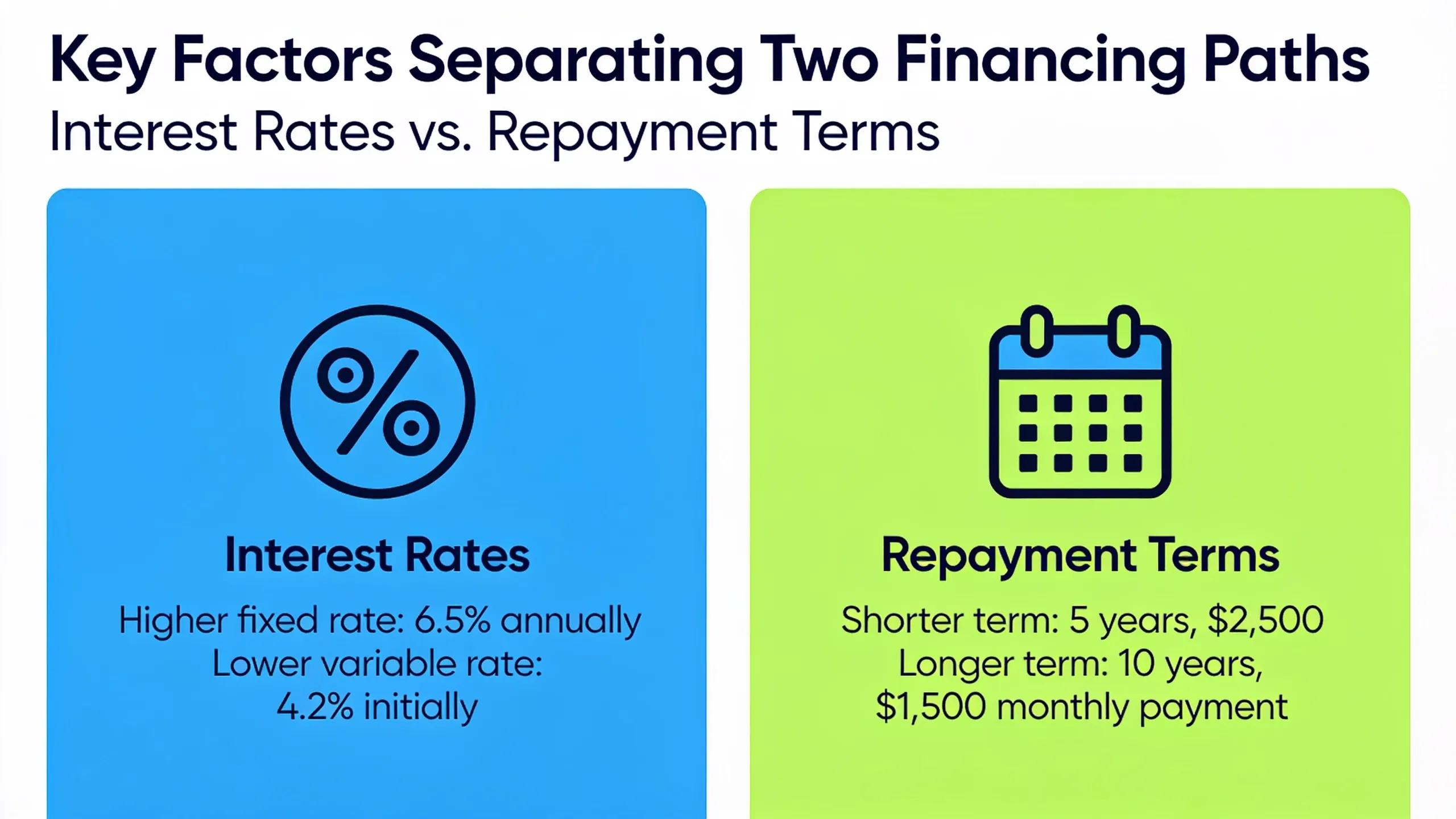
What Are The Key Differences In Rates And Terms of SBA vs Bank Loans?
Interest rates and repayment terms separate these two financing paths more than any other factor. Bank loans reward businesses with strong financials. Government backed loans trade a higher price tag for breathing room on monthly payments.
Well-qualified borrowers get the best deal from conventional banks. Strong revenue, solid credit, and years in business unlock the lowest rates on the market. Businesses without that track record often find the door closed, even when the underlying operation is healthy.
SBA vs bank loans comes down to a trade-off between cost and cash flow. SBA-backed products typically carry higher fees than a conventional bank loan. That added cost gets offset by longer repayment terms, which stretch payments out and lower the monthly obligation. A business paying less each month keeps more working capital available for payroll, inventory, or unexpected expenses.
Which Option Costs Less Over Time in SBA vs Bank Loans?
Cost depends on the full picture, not just the sticker rate. A bank loan's lower rate can save money overall for a business that qualifies. But a business that can’t secure that rate elsewhere often finds the SBA route more affordable in practice. The extended term keeps monthly cash flow manageable.
VIP Business Credit's Capital-Ready Scan gives owners a clear view of where their business stands with lenders before they submit an application. The scan flags credit gaps and lays out a roadmap toward the right funding path, removing much of the guesswork from comparing traditional financing against SBA-backed options.
Which Qualification Requirements Should You Expect in SBA vs Bank Loans and Government Backed Loans?
Qualification standards separate sba vs bank loans more than almost any other factor, and understanding small business loan qualifications for each path helps owners plan ahead. Government-backed programs tend to accept applicants that a conventional bank would turn away. Neither path moves quickly or skips paperwork. Approval for either option still demands preparation, and business owners who understand the gap can plan their timeline and documentation accordingly.
Government-backed loans exist precisely to widen the door for businesses that don’t fit a bank’s narrow risk profile. A conventional lender often wants years of strong revenue, high credit scores, and substantial collateral before saying yes. Programs backed by a federal guarantee shift some of that risk away from the lender, which explains why approval odds improve even though the application itself stays demanding.
Does an SBA Loan Guarantee Faster Approval in Traditional Financing?
No. Easier qualification does not translate to quick funding. Both SBA-backed and conventional applications involve extensive documentation, credit review, and underwriting steps that can stretch the timeline to weeks or months.
What Can Business Owners Do to Strengthen Their Qualification Odds for SBA vs Bank Loans?
Building credit under the company's own EIN, rather than relying on the owner's Social Security number, gives lenders a cleaner picture of business performance separate from personal history. This separation strengthens how a business appears to underwriters regardless of which loan type it pursues.
Because the qualification maze differs by lender and program, local Business Credit Advisors walk clients through each requirement individually, offering concierge-level guidance rather than a one-size-fits-all checklist. That personalized review often reveals which traditional financing options are realistic today and which need groundwork first.
How Fast Can You Get Funded from SBA vs Bank Loans and Government Backed Loans?

Timelines depend heavily on which path a business takes. Traditional financing through a bank or the sba vs bank loans decision generally means a wait of weeks to months before funds actually land in an account. That delay comes from underwriting, paperwork, and approval layers built into government backed loans and conventional lending alike. Businesses facing payroll gaps or urgent equipment needs can’t always afford that runway.
Speed starts earlier than the application, though. Before a business even approaches a lender, knowing where it stands matters. VIP Business Credit's Capital-Ready Scan matches a business to pre-qualified funding options in just 2 to 5 minutes, with zero impact on personal credit. That kind of instant visibility helps owners decide, before submitting anything, which products fit their timeline and which don’t.
Why does lender access affect funding speed in SBA vs bank loans?
More lender options mean more paths to a fast yes. VIP Business Credit's network of over 1,000 national and local lenders gives owners room to shop for speed, not just rate. A business turned down by one lender for timing reasons may still qualify quickly through another in that same network.
Is a slower SBA loan ever the better choice for traditional financing?
Sometimes patience pays off. If a business can absorb a longer approval window, the government-backed structure often brings lower rates and steadier terms than a rushed alternative. The tradeoff is straightforward:
- Speed-focused financing: faster decisions, often higher cost
- SBA-backed financing: longer timeline, often lower long-term cost
Matching timeline to real business needs, rather than defaulting to whichever option closes fastest, protects both cash flow and credit standing.
Which Option Fits Your Business Stage in SBA vs Bank Loans or Government Backed Loans?

Business stage determines which financing route makes sense, not personal preference. A company with strong revenue and clean credit but a recent bank denial sits in a different position than a startup with no track record yet. Matching the funding type to that stage prevents wasted applications and protects credit inquiries that count.
Strong cash flow and solid credit history usually point toward traditional bank financing first. Banks reward proven performance with competitive terms. But strong financials alone don’t guarantee approval. A business that meets those two benchmarks yet still gets turned down by a conventional lender has a clear next move: pursue a government backed loan through the SBA. This path exists precisely for qualified borrowers who fall outside conventional underwriting boxes despite healthy numbers.
Is an SBA loan better for a new business than a bank loan in traditional financing?
Newer businesses often lack the multi-year revenue history banks require, making approval difficult through traditional financing alone. Government-backed programs frequently accept thinner track records because the government guarantee reduces lender risk. Established firms, by contrast, typically have more room to negotiate bank terms directly.
How does VIP Business Credit match financing to my stage in SBA vs bank loans?
VIP Business Credit builds each financing strategy around a business’s particular stage, sector, and risk profile, rather than offering one product for every client. This approach serves two distinct groups:
- Newer ventures seeking their first approvals and establishing a credit foundation
- Established firms looking to scale operations, consolidate existing costs, or expand using better-priced capital
Comparing sba vs bank loans isn’t about picking a winner. It’s about identifying which lender’s criteria match the business’s current stage, then applying with a strategy built for approval rather than guesswork.
How Can You Prepare To Qualify for SBA vs Bank Loans and Government Backed Loans?

Preparation starts with knowing exactly how a lender will see the business, not guessing at it. Underwriters weigh specific eligibility gaps long before an application reaches a decision-maker, and closing those gaps ahead of time changes the outcome. Business owners weighing sba vs bank loans gain the most ground by treating qualification as a process, not a single event.
VIP Business Credit's tools are built around this reality. They reveal how underwriters actually view a business, flag eligibility gaps early, and surface funding products matched to the company's profile. Monitoring account data from the bureaus lenders rely on rounds out the picture, so nothing surprising shows up mid-application.
What do lenders look for before approving a loan in traditional financing?
Lenders check for consistency first. Business identity details — legal name, address, industry codes — need to match across every registration and filing. Trade credit reporting history matters too, since it shows lenders a track record of on-time payment behavior.
Strengthening these credibility signals is foundational work. It applies equally to owners pursuing government backed loans through SBA programs and those pursuing traditional financing through a conventional bank. Neither path forgives inconsistent business records.
How does coaching factor into approval odds for SBA vs bank loans?
Coaching closes the knowledge gap that trips up many first-time applicants. VIP Business Credit provides education that helps owners understand underwriting criteria before they ever submit paperwork. That guidance extends to maintaining healthy credit usage over time, not just at the moment of application.
Owners preparing to qualify should focus on a few concrete steps:
- Confirm business identity details match across all registrations and filings
- Build a trade credit reporting history with consistent, on-time payments
- Understand the underwriting criteria specific to the loan type being pursued
- Monitor bureau data regularly instead of waiting for a lender to flag problems
Pricing transparency matters at this stage as well. VIP Business Credit operates with no-surprise pricing and functions as a long-term partner, guiding preparation well before — and long after — a loan closes.
FAQ
Which loan type should a business owner start with in SBA vs bank loans?
Conventional bank loans generally offer better pricing, so most owners explore that path first. If it stalls, an SBA-backed loan becomes the logical next step rather than a last resort.
Does the SBA lend money directly to businesses?
No. The SBA provides a federal guarantee that reduces risk for lenders rather than funding loans directly itself.
How can VIP Business Credit help find the right loan option in traditional financing?
VIP Business Credit's Capital-Ready Scan clarifies which financing option fits a business's credit profile. Its network connects entrepreneurs to over 1,000 national and local lenders offering both SBA and conventional loans.
Conclusion
In closing, the choice between SBA loans and traditional bank loans hinges on your business stage, timeline, and financial profile. Both pathways offer distinct advantages—SBA programs provide flexibility and lower down payments for qualifying ventures. Traditional bank loans reward established credit and faster funding. The key is understanding how lenders evaluate your business and positioning your company accordingly. By building a strong EIN-based credit profile and identifying which loan structure aligns with your growth goals, you gain clarity in a complex funding landscape and unlock the capital your business needs to thrive.
About The Author
Lee Johnson is the Founder of VIP Business Credit, a seasoned Real Estate Investor, Business Growth Strategist, and Master Certified Professional Coach. Bringing over 25 years of experience in business finance and credit strategy, Lee specializes in guiding entrepreneurs to build fundable, lender-ready business credit profiles tied to an EIN rather than personal SSNs, separating business and personal liabilities.
Contact VIP Business Credit
- 📞 Phone: (571) 248-3863
- ✉️ Email: [email protected]
- 📅 Consultation: Schedule A Business Financial Health Strategy Call
- 🌐 Website: https://vipbizfunds.com
- 🎯 FREE Business Success Scan: FREE Business Success Scan
- 📍 Service Area: Serving Sterling, VA and surrounding areas


