Equipment Financing vs. Business Line of Credit
Equipment Financing vs. Business Line of Credit
Equipment financing secures capital for specific assets, using the equipment as collateral. A business line of credit provides flexible, revolving funds for any acquisition. VIP Business Credit helps clients choose the right structure, protecting personal assets while accessing 1,000+ lending options for machinery, technology, or fleet vehicles.
Key Takeaways
- Equipment financing secures capital for specific assets using the equipment as collateral, while a business line of credit offers flexible revolving funds for any acquisition.
- Equipment financing converts a major capital outlay into predictable monthly expenses, preserving working capital instead of draining cash for a single purchase.
- Lenders evaluate business credit profile, identity consistency, and thorough documentation to determine access to commercial equipment loans and equipment credit lines.
- An equipment credit line provides a predetermined facility drawn upon as needed, similar to a traditional line of credit, enhancing financial flexibility.
What will you accomplish with this guide?
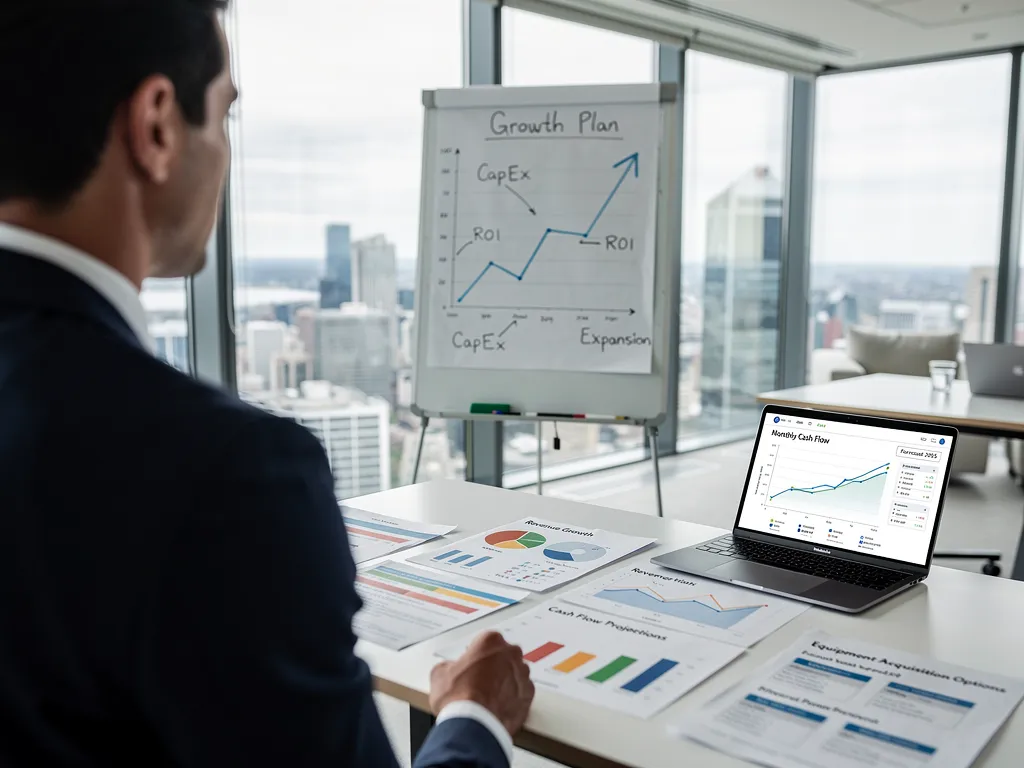
Business owners and financial managers gain a clear, actionable path to acquiring essential assets without exhausting cash reserves. This guide equips readers to evaluate equipment financing options, understand commercial equipment loans, and apply equipment credit lines effectively for sustainable growth. Without a structured approach, companies risk tying up working capital in depreciating assets, leaving no buffer for payroll, inventory, or unexpected opportunities.
What types of assets qualify for equipment financing?
Organizations use equipment financing to purchase nearly anything the business needs, aside from real estate. Qualifying assets include company vehicles, technology systems, production machinery, and office furniture. This wide eligibility makes the financing tool relevant across manufacturing, logistics, healthcare, and professional services.
How does equipment financing protect a company's financial position?
Rather than using large amounts of cash for a single purchase, businesses preserve working capital and align payments with the assets' useful life. This strategy converts a major capital expense into manageable monthly payments. VIP Business Credit assists entrepreneurs in building EIN-based business credit, protecting personal assets while accessing the funds needed to accelerate growth. The company connects clients to a broad network of national and local lenders, ensuring that growing firms find terms tailored to their industry and equipment type, and for further insights into structuring these transactions, refer to the guidance on equipment financing for small business growth.
What steps should a business take before applying?
- Audit current equipment needs and projected useful life. Identify assets needing replacement within 12 months and new acquisitions that would enhance capacity.
- Separate business credit from personal credit. Establish or strengthen the company's EIN-based credit profile to enable lenders to evaluate the business independently.
- Gather financial documentation. Prepare balance sheets, cash flow statements, and equipment quotes to demonstrate readiness to underwriters.
- Compare financing structures. Evaluate loans, leases, and revolving credit lines to ensure payment schedules align with the asset's revenue contribution.

What prerequisites do you need before applying?
Lenders evaluate specific business readiness indicators before approving equipment financing. A company's credit profile, identity consistency, and comprehensive documentation determine access to commercial equipment loans and equipment credit lines. Missing prerequisites can delay funding or cause outright denial.
VIP Business Credit's proprietary tools reveal how underwriters assess a business. Their pre-qualification workflow identifies which programs a business qualifies for immediately and which require additional preparation. This insight prevents wasted applications and protects the owner's personal credit from unnecessary inquiries.
What documentation do lenders typically require?
Lenders request three main document categories: financial statements demonstrating revenue stability and debt service ability; business tax returns verifying income over multiple years; and equipment quotes or purchase agreements specifying the financed assets and their valuation. Incomplete documentation stalls underwriting and lengthens approval timelines.
How does business credit readiness affect approval?
Credibility signals shape lender risk assessments. VIP Business Credit helps clients enhance foundational factors like consistent business identity data and trade credit reporting. When these signals align across bureaus, lenders see the business as lower risk. An equipment credit line, similar to a traditional line of credit, offers a predetermined facility drawn upon as needed, according to Wingspire Equipment Finance. Strong credit readiness unlocks higher limits and improved terms, and a structured approach to loan pre-qualification clarifies eligibility prior to any hard credit pull. Business owners who verify prerequisites first obtain equipment capital faster and with fewer barriers.
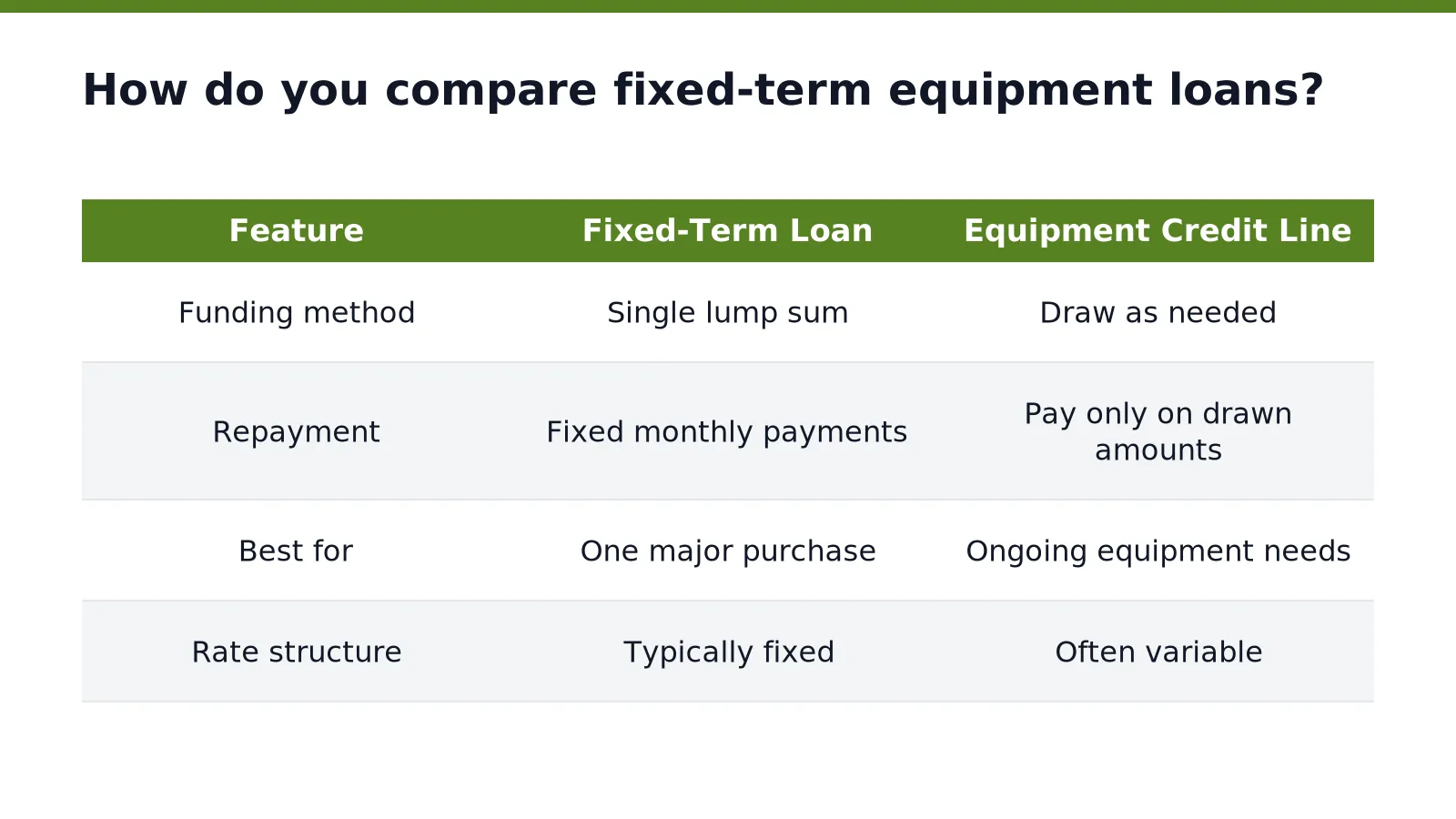
How do you compare fixed-term equipment loans?
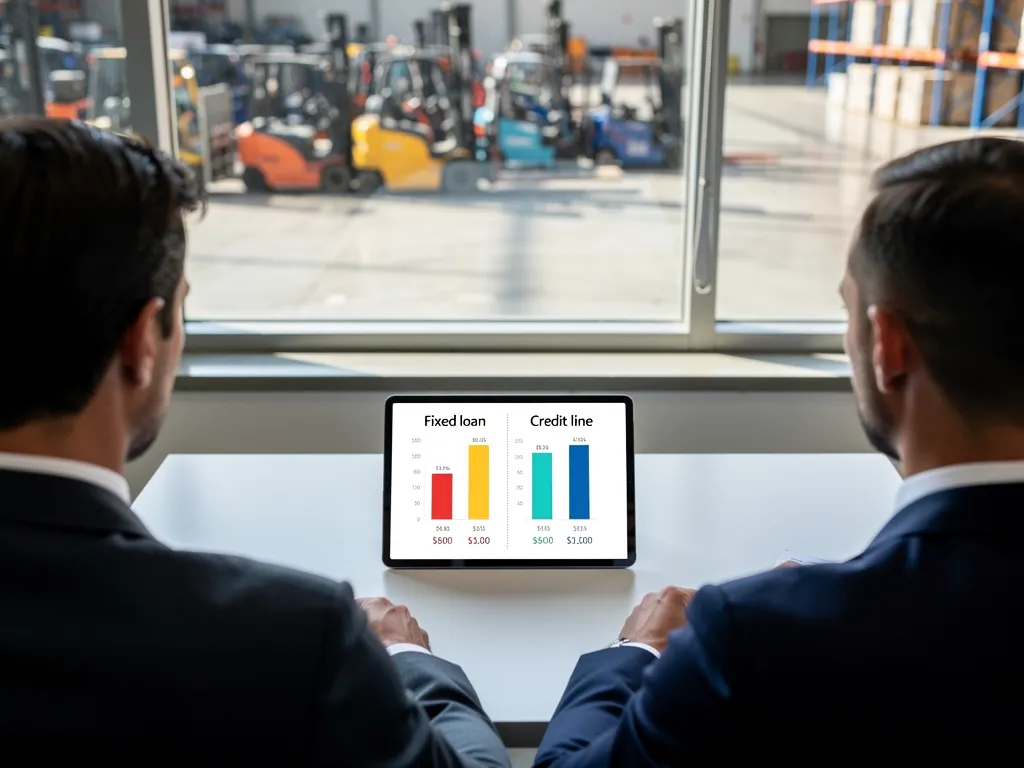
Comparing fixed-term equipment financing options involves evaluating loan structure, repayment terms, and total cost relative to business needs. A standard loan remains the most common method for purchasing new or used equipment. The process requires lender engagement, providing equipment details, and submitting an application for a lump-sum amount repaid over a defined period.
Commercial equipment loans are straightforward: the business borrows a set amount to purchase equipment outright, repaying principal plus interest in fixed monthly installments. Ownership transfers immediately, enabling depreciation deductions. This suits businesses planning to retain equipment beyond the loan term.
What factors determine the true cost of a fixed-term loan?
The total borrowing cost depends on three key elements: the interest rate (fixed or variable) determining monthly payments, the loan term length influencing cumulative interest, and any down payment affecting initial cash outlay and monthly obligations. Lenders also factor in the equipment's useful life when setting terms: as Mark Bearden, senior vice president at First American Equipment Finance, notes, businesses often need several years to realize full equipment returns, so matching loan duration with this timeline prevents cash flow strain.
How do fixed-term loans compare to equipment credit lines?
Equipment credit lines provide revolving access to funds rather than a one-time lump sum, letting a business draw capital repeatedly as new equipment needs arise instead of reapplying for each purchase. A fixed-term loan secures a single purchase at fixed costs with a predictable payoff date, while a credit line offers flexibility for multiple acquisitions over time, replenishing as the balance is repaid. The right choice often comes down to how often the business expects to buy equipment and how far in advance those purchases can be planned.
VIP Business Credit assists owners in understanding underwriting criteria through its business credit-building program. They provide both business loans and lines of credit, aligning financing types to acquisition strategies. Equipment financing includes loans and leases for nearly any business need except real estate. The choice depends on purchase frequency, cash flow, and long-term equipment plans.
How do you evaluate revolving equipment credit lines?
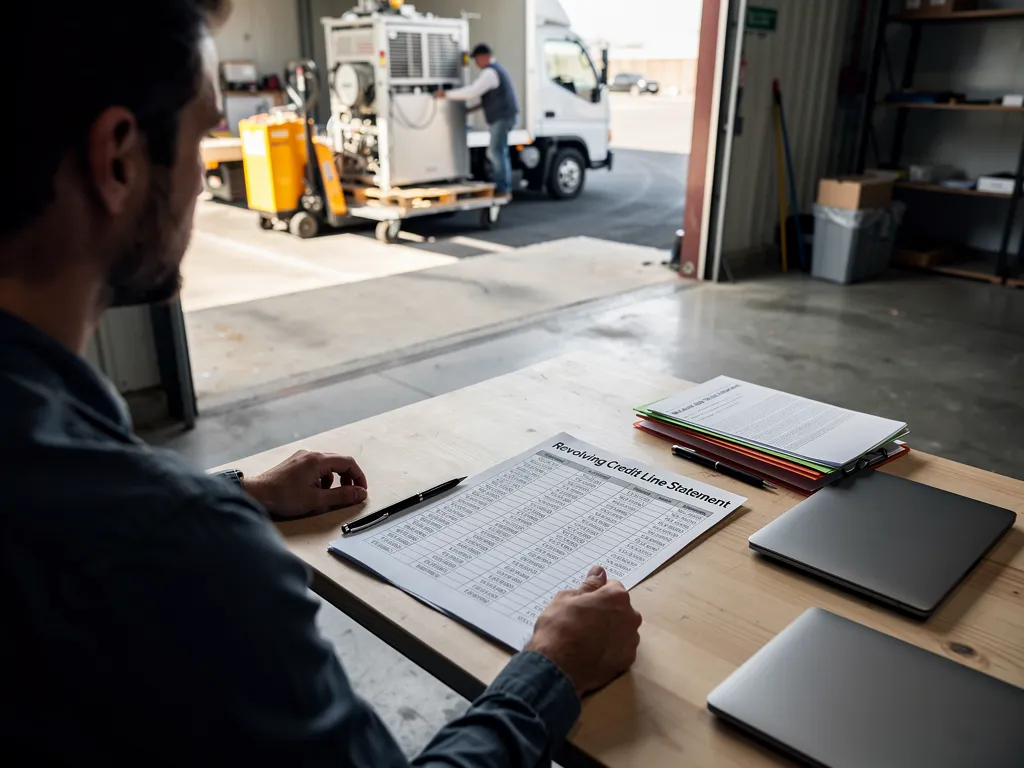
Evaluating revolving equipment credit lines starts by matching credit limits with the equipment purchase cycle. These facilities streamline capital access for equipment acquisitions, so continuous buying avoids repeated loan applications. This protects working capital and expedites procurement.
Prerequisites are essential: confirm the business has an EIN-based credit profile, collect recent financial statements, and document intended equipment categories. VIP Business Credit guides clients to access high-limit business loans and revolving credit lines, segregating personal and business liability via EIN-linked credit.
Next, follow these steps:
- Map the draw schedule. Outline planned equipment purchases and their timing.
- Compare limits and replenishment terms. A revolving line replenishes as payments are made, restoring capital for future purchases.
- Check repayment flexibility. An equipment line provides funds as needed up to a limit, minimizing cash flow disruption.
- Review collateral and covenant terms. Assess which assets secure the line and lender reporting requirements.
- Model the cost of capital. Contrast total interest and fees with cash that might otherwise be tied up.
How does replenishment change the math?
Replenishment is what distinguishes a line of credit from a lump-sum loan. As borrowers repay what they've drawn, their available balance restores, allowing successive equipment upgrades using the same facility without a new application each time. Businesses purchasing in cycles, such as rotating fleet vehicles or periodically upgrading technology, benefit far more from this structure than those making a single, one-time acquisition, since each repayment effectively rebuilds their purchasing power for the next round of equipment.
When should a business choose a line over a term loan?
A line suits recurring or unpredictable purchases, where the timing and total equipment spend are hard to pin down in advance, whereas a term loan fits a single, well-defined acquisition with a known price and a clear payoff timeline. Businesses that would rather not pledge specific equipment as collateral, or that need funding flexibility across several asset types at once, can explore unsecured line structures before committing to either path.
What common mistakes should you avoid?

Business owners often rush into equipment financing without understanding lender requirements, risking delays, higher interest, or denial. Avoiding these pitfalls protects cash flow and borrowing capacity.
Why do businesses overlook the collateral advantage in equipment credit lines?
Many applicants don't realize the equipment itself secures the financing. Under an equipment credit line, purchased machinery or vehicles typically serve as collateral, which leads to more favorable terms per Wingspire Equipment Finance. Treating equipment financing as unsecured debt misses out on the lower rates and higher approval limits that collateral enables, and it can push a business toward costlier capital than the asset actually warrants, since lenders price risk differently once they know a tangible, resalable asset backs the loan.
What happens when companies skip the pre-approval step?
Waiting until deadlines to seek funding creates pressure that rarely leads to the best terms. After securing an equipment credit line, subsequent acquisitions require no lengthy loan process, as PNC notes, which is precisely the advantage a business forfeits by skipping pre-approval. Delaying this step restricts quick action on time-sensitive deals or sudden equipment shortages, often forcing rushed decisions, a weaker negotiating position, and less favorable terms than a business would secure with financing already lined up.
How does choosing a transactional lender undermine long-term growth?
Using brokers who vanish post-closing leaves owners unsupported when the next equipment need arises, forcing them to restart the search for financing from scratch each time. VIP Business Credit offers transparent pricing and serves as a long-term partner, not a transactional broker, and its local Business Credit Advisors guide clients step-by-step, helping them avoid funding roadblocks before they surface. Prioritizing speed over relationship quality sacrifices this ongoing guidance, trading a one-time close for ongoing support that would otherwise turn borrowing into a strategic advantage.
Commercial equipment loans require careful preparation. Avoiding collateral evaluation, delaying pre-approval, and accepting transactional relationships each incur costs. A deliberate approach keeps capital accessible and terms competitive.
FAQ
What types of assets qualify for equipment financing?
Organizations use equipment financing for company vehicles, technology systems, production machinery, and office furniture, excluding real estate.
What steps should a business take before applying for equipment financing?
Businesses audit equipment needs, separate business credit from personal credit, gather financial documentation, and compare financing structures such as loans, leases, and revolving credit lines.
Is equipment financing or a business line of credit better for one-time purchases?
A fixed-term equipment loan generally suits a single, defined purchase since it locks in predictable payments tied to that asset. A business line of credit is better reserved for recurring or unpredictable equipment needs, where the ability to draw funds repeatedly matters more than a fixed repayment schedule.
Does an equipment credit line require collateral?
Yes. Under most equipment credit lines, the purchased machinery or vehicles serve as collateral, which typically results in more favorable rates and higher approval limits than unsecured financing.
How long does it take to get approved for equipment financing?
Approval timelines depend on documentation readiness. Businesses that prepare financial statements, tax returns, and equipment quotes in advance, and that verify their EIN-based credit profile beforehand, generally move through underwriting faster than those who apply without this preparation.
Conclusion
Choosing between equipment financing and a business line of credit depends on purchase frequency and cash flow patterns. A fixed-term loan locks in one acquisition at known costs, while a revolving line supports ongoing equipment needs with replenishable capital. Matching financing to buying cycles protects working capital and maintains favorable terms.
Businesses that prepare their documentation and credit profile before approaching a lender tend to secure better terms and move through underwriting with fewer delays. Whether the right fit is a single equipment loan or an ongoing credit line, working with an experienced partner helps align the financing structure with the business's growth plans rather than its immediate cash pressure.
About the Author
Lee Johnson is a Master Certified Professional Coach with extensive experience in business growth strategies and financial solutions. Lee specializes in empowering entrepreneurs and financial managers to make informed decisions about equipment financing and business credit, enabling sustainable development and operational success.
Contact & Strategy Links
Serving Sterling, VA and the surrounding Greater Washington D.C. region.


