Best Net 30 Vendors for Building Business Credit
Best Net 30 Vendors for Building Business Credit
Three net 30 vendors stand out for building an EIN-based business credit profile. Crown Office Supplies and Uline report payment history to credit bureaus consistently. Amazon's Pay by Invoice option provides flexible purchasing authority. VIP Business Credit recommends these accounts because consistent on-time payments strengthen a business's lender-ready credit foundation across 1,000+ lending options.
Key Takeaways
- Crown Office Supplies and Uline are known for reporting payment history to business credit bureaus.
- Amazon's Pay by Invoice option offers flexible purchasing authority for business credit building.
- Consistent on-time payments strengthen a business's lender-ready credit foundation.
- Net 30 vendors that report payment history to credit bureaus create a documented record of reliability.
What Is a Net 30 Account?
A net 30 account is a 30-day trade credit arrangement for business purchases. Vendors extend these payment terms so companies acquire needed supplies immediately and settle the invoice within 30 days.
Nav explains that net 30 accounts let businesses purchase items and pay for them later. The structure is straightforward. A vendor ships goods or provides services, sends an invoice, and the buyer has 30 calendar days to remit full payment. No interest accrues during that window. Unlike revolving credit lines carrying variable balances, net 30 terms apply to a single invoice. Each transaction stands alone.
How Do Net 30 Accounts Work Step by Step?
The process follows a predictable sequence from application to final payment:
- Apply for a vendor account. The business submits basic company information; many net 30 vendors approve new businesses without a personal credit check.
- Place an order on terms. The business selects products and elects net 30 payment at checkout rather than paying upfront.
- Receive goods with an invoice. The vendor ships the order and includes an invoice showing the amount due and the payment deadline, typically 30 days out.
- Pay the invoice within 30 days. The business remits full payment before the due date to keep the account current and avoid late fees.
Why Do Net 30 Accounts Matter for Business Credit?
Not all invoices strengthen a credit profile. Office Garner notes that when net 30 activity is reported to business credit bureaus, it can help build a business credit file. The key distinction sits in reporting. Vendors that share payment history with Dun & Bradstreet, Experian, or Equifax transform routine supply purchases into vendor credit lines that establish a track record. Strategic Net 30 Accounts confirms that accounts reporting payment history to business credit bureaus help establish business credit history when paid on time.
Entrepreneurs seeking to build business credit should prioritize vendors that report. Paying on time generates positive data points. Late payments do the opposite. The substrate of every credit decision is payment consistency. Choosing the right vendors turns operational spending into a credit-building engine through a structured approach to net 30 vendor accounts. That is why identifying the best net 30 vendors building business credit is crucial for success in establishing a solid reputation.
Why Do Net 30 Vendors Matter for Credit?
Net 30 vendors extend 30-day payment terms on purchases, letting a business buy now and pay later. Opening accounts with vendors that offer easy approval helps new businesses establish credit history, including a business credit score from credit reporting agencies.
Without reported trade lines, a business stays invisible to lenders. That invisibility costs owners access to better financing terms later. Flexible payment terms from net 30 vendors do more than ease cash flow. They play a key role in building business credit, making future financing easier to secure.
How Do Net 30 Accounts Build a Credit File?
The process works through three sequential steps:
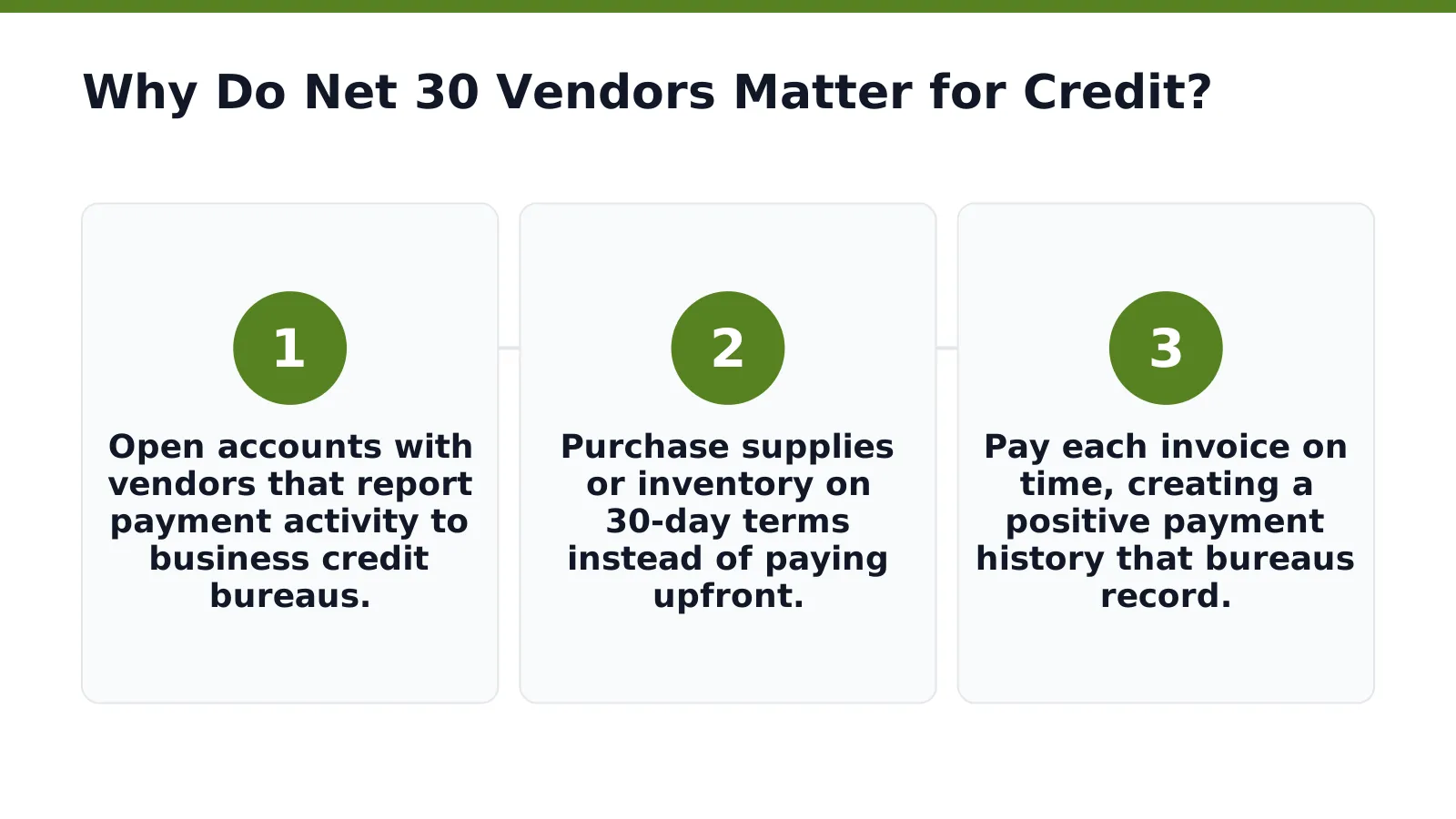
- Open accounts with vendors that report payment activity to business credit bureaus.
- Purchase supplies or inventory on 30-day terms instead of paying upfront.
- Pay each invoice on time, creating a positive payment history that bureaus record.
Each on-time payment adds a data point to the business credit file. Over time, those data points build a score that lenders review. Establishing tier 1 vendor credit accounts early on is pivotal to creating a robust credit profile. These accounts form the backbone of the business's creditworthiness.
Why Does EIN-Based Credit Matter More Than Personal Credit?
Vendor credit lines tied to a company's EIN separate business liability from the owner's SSN. VIP Business Credit guides clients toward high-limit business loans and revolving credit lines built on EIN-based credit. This structure protects personal assets while the business establishes its own borrowing profile.
Entrepreneurs across Northern Virginia and the Greater Washington, DC region use this approach to access funding and grow faster. The company's core focus remains guiding clients to separate personal and business liability through EIN-based credit.

What Should You Look for in a Vendor?
Selecting the right net 30 vendors requires evaluating three specific criteria. Approval ease, credit bureau reporting, and the vendor's value as a future credit reference determine whether an account builds a business credit profile or simply delays a payment. Missing any one of these factors leaves a business owner with extended terms and no credit-building progress.
Which Vendors Offer the Easiest Approval?
Many vendors do not require a business credit history. They ask only for basic business information during the application process. This low barrier makes them ideal starting points for new businesses. A list of the best net 30 accounts focuses on vendors with easy approval for business accounts with credit terms, according to a guide on strategic net 30 accounts.
Why Does Credit Bureau Reporting Matter?
Not all net 30 vendors report to business credit bureaus. Choosing the right vendors means the difference between strengthening a credit profile or just extending payment terms, as noted by Wise's list of net 30 companies. The vendors that do report payment history to credit bureaus create a documented record of reliability. That record becomes a tangible asset for future financing opportunities.
How Do Vendors Help Beyond the First Account?
The best vendor credit lines serve a dual purpose. They report payment history to credit bureaus and may also serve as a credit reference for customer credit applications to new vendors. A business that pays on time builds a reference that unlocks larger lines later. This compounding effect accelerates the effort to establish Paydex score business credit and across multiple reporting agencies.
Step 1: Set Up Your Business Foundation
A strong business credit profile starts with a properly structured legal entity. VIP Business Credit helps entrepreneurs build EIN-based business credit, protecting personal assets while accessing funding. Without this foundation, owners risk personal liability for every business debt.
The company operates from Sterling, Virginia, serving clients across Northern Virginia and the Greater Washington, DC region. Its office sits at 21000 Southbank St Ste 106-380, Sterling VA 20165. Local presence matters when lenders evaluate business legitimacy.
What does a lender-ready foundation include?
A lender-ready foundation requires three core elements. First, a registered business entity separates the company from its owner. Second, an Employer Identification Number (EIN) replaces the owner's Social Security Number on credit applications. Third, consistent business identity data across all registrations and applications signals stability to underwriters.
VIP Business Credit positions itself as a long-term partner rather than a transactional broker. The firm emphasizes transparent, no-surprise pricing throughout the setup process. Clients receive guidance on each foundational step before any funding application begins.
Why does EIN-based credit matter for new businesses?
EIN-based credit keeps business debts off the owner's personal credit report. This separation protects personal assets when the business faces financial strain. Owners who skip this step expose homes, savings, and personal credit scores to business risk.
The complete credit building checklist covers registration, EIN acquisition, and bureau enrollment in sequence. Following each step in order prevents gaps that delay lender approvals later. VIP Business Credit's advisory team reviews every foundation element before connecting clients to funding options.
Step 2: Choose Your First Net 30 Vendors
Selecting the right net 30 vendors determines how quickly a new business builds a credible credit file. The best starting accounts approve new entities without a tough credit check and report payment history to major business credit bureaus. Without these two features, a net 30 account merely delays a bill without strengthening the company's borrowing profile.
Which net 30 vendors offer the easiest approval for new businesses?
For new businesses trying to establish business credit, finding vendors that extend accounts without a tough credit check is one of the most important early steps, according to Office Garner's guide to net 30 vendors. These vendor credit lines let a company buy now and pay later, typically within 30 days. The arrangement proves its value immediately by easing cash flow pressure while simultaneously feeding positive data into the business credit reporting system.
A curated list of top-picked net 30 vendor accounts, identified by Tipalti's Strategic Net 30 Accounts guide, includes the following options:
- Crown Office Supplies (and Shirtsy)
- Uline
- Quill
- Amazon (Pay by Invoice)
- Newegg Business
- Walmart (Community Card)
- Grainger
- Summa Office Supplies
- Creative Analytics
Each vendor on this list extends trade credit with 30-day payment terms. The key differentiator is whether the vendor reports to bureaus like Dun & Bradstreet, Experian Business, or Equifax Business. A business owner should verify reporting practices before applying. Opening two or three of these accounts creates multiple tradelines, which accelerates the process to build business credit with a Paydex score and other bureau ratings.
How many net 30 accounts should a business open first?
Starting with three to four accounts provides enough reporting activity to generate a score within 60 to 90 days. Spreading purchases across different vendor categories, such as office supplies, shipping materials, and technology, demonstrates diversified credit usage. Timely payment on every invoice remains the non-negotiable factor. A single late payment on a new file causes disproportionate damage because the credit history lacks positive data to offset the negative mark.
Step 3: Make Small Purchases and Pay on Time
Building a business credit file requires active, reported trade lines. Small purchases paid on time create the payment history that credit bureaus record. Without this activity, a business remains invisible to lenders regardless of its revenue or time in operation.
The mechanics are straightforward. Net 30 vendors extend vendor credit lines that give a business 30 days to pay after invoicing. When the business makes a purchase and settles the invoice before the due date, that positive payment behavior becomes a data point. Nav confirms that accounts reporting payment history to business credit bureaus help establish business credit history when reported and paid on time. The key word is "reported." Not every vendor shares data with bureaus, so selecting reporting vendors matters from the start.
How much should a business spend on net 30 accounts?
The amount matters less than the consistency. A small order of office supplies paid early carries the same reporting weight as a larger order paid on the due date. Office Garner notes that when net 30 activity is reported to business credit bureaus, it helps build a business credit file. The bureau sees a pattern of on-time payments, not the dollar figure. Start small. A single monthly purchase from one or two vendors establishes the initial tradeline. Over time, adding more accounts and varying purchase types strengthens the file.
What happens if a payment is late on a net 30 account?
Late payments damage a credit profile before it gains momentum. A single 30-day delinquency on a reported account signals risk to future lenders. The company's advisory team helps clients strengthen foundational credibility signals, including trade credit reporting habits, so that lenders and vendors view the business as lower risk. Setting calendar reminders or automating payments prevents missed deadlines. The goal is a flawless payment record across every reporting account.
Business owners who combine net 30 vendor activity with business credit card usage create multiple reporting streams. Each on-time payment adds another positive entry. Over six to twelve months, this disciplined approach produces a credit file that opens doors to larger vendor credit lines and unsecured financing. The process rewards patience. Every invoice paid on time is a brick in a foundation that separates business liability from personal assets.
Step 4: Monitor Your Business Credit Reports
Monitoring business credit reports catches errors early. Unverified discrepancies in a credit file extend the time required to secure vendor terms and loan approvals. Small business owners lose weeks of opportunity when inaccurate trade lines or missing payment histories go unchallenged. Most business credit bureaus do not proactively alert companies to negative changes. The responsibility to audit these reports sits squarely with the entrepreneur.
How Can a Business Check Reports from Multiple Credit Bureaus?
A reliable monitoring routine requires access to data from several bureaus at once. Through Nav Prime, business owners check and monitor their credit across multiple business credit bureaus in a single dashboard. This consolidated view eliminates the friction of logging into separate platforms. Catching a reporting gap at one bureau before it spreads to others protects the company's broader credit profile.
What Does a Capital-Ready Assessment Reveal About Credit Gaps?
A deeper audit examines the specific factors that lenders and net 30 vendors evaluate. This targeted approach converts monitoring from a passive check into an active step to build business credit through strategic vendor accounts.
The cycle is straightforward. Owners establish vendor credit lines with net 30 accounts that report payment activity. They then monitor business credit reports monthly to verify those accounts appear correctly. Discrepancies get flagged and disputed through the bureau's formal process. VIP Business Credit's network spans many lenders, providing a broad safety net when disputes require alternative financing sources during the correction window.
This disciplined review cadence transforms vendor credit lines into durable credit assets. Each on-time payment and accurate trade line strengthens the file that future capital decisions rest upon.
What Mistakes Should You Avoid?
Avoiding common missteps with net 30 vendors protects a business from wasted effort and stalled credit growth. The most damaging error is selecting vendors that never report payment history to business credit bureaus. A business owner pays invoices on time but sees no credit file improvement. The activity simply extends payment terms without building a credit profile.
Why Does Vendor Selection Matter for Credit Building?
Selecting the wrong vendors means the difference between strengthening a credit profile or just extending payment terms, as noted by Wise. A business must verify reporting practices before opening any account. Without bureau reporting, on-time payments remain invisible to future lenders.
How Can a Business Avoid Stalled Credit Progress?
A second mistake involves treating vendor accounts as isolated transactions. Business owners often open accounts without a coordinated strategy. VIP Business Credit designs its approach for both newer ventures seeking initial approvals and established firms looking to scale or consolidate costs. The company's local Business Credit Advisors deliver personalized, concierge-level guidance. This support helps owners select reporting vendors and sequence applications correctly.
A third error is neglecting foundational business identity data. Inconsistent addresses, phone numbers, or legal names across applications trigger lender skepticism. Credibility signals must remain uniform everywhere. Owners who skip this step face repeated denials despite strong revenue. The path forward requires methodical preparation, not scattered applications. Each vendor relationship either builds momentum or consumes time with no return.
FAQ
Which net 30 vendors report payment history to business credit bureaus?
Crown Office Supplies and Uline report payment history to business credit bureaus consistently.
How does a net 30 account work step by step?
Apply for a vendor account, place an order on terms, receive goods with an invoice, and pay the invoice within 30 days.
Why do net 30 accounts matter for business credit?
When net 30 activity is reported to business credit bureaus, it helps build a business credit file.
Conclusion
The path forward is clear: select vendors that report to business credit bureaus, pay every invoice on time, and monitor your credit reports monthly to catch discrepancies early. Each consistent payment builds a stronger file that separates business liability from personal assets. Start with one or two reporting accounts, verify their activity appears correctly, and expand from there. This disciplined approach transforms vendor terms into durable credit assets that future lenders will recognize.
About The Author
Lee Johnson, MBA, Master Certified Professional CoachLee Johnson is a seasoned Real Estate Investor, Business Growth Strategist, and Master Certified Professional Coach with over 25 years of industry experience and more than 500 coaching hours completed. Holding a Bachelor of Science from Fairleigh Dickinson University and an MBA from the University of Phoenix, Lee has built and managed a personal real estate portfolio surpassing 1,700 units valued at over $254 million across various U.S. markets. He is dedicated to helping entrepreneurs, founders, and small business owners achieve true financial freedom through disciplined business credit building, corporate fundability, and tailored lending solutions.
Contact VIP Business Credit
- 📞 Phone: (571) 248-3863
- ✉️ Email: [email protected]
- 📅 Consultation: Schedule A Business Financial Health Strategy Call
- 🌐 Website: vipbizfunds.com
- 🎯 FREE Business Success Scan: FREE Business Success Scan
Service Area Business serving Sterling, VA and surrounding areas.


