Working Capital Line of Credit Essentials
Working Capital Line of Credit Essentials
Working capital solutions bridge timing gaps between outgoing expenses and incoming revenue, keeping daily operations funded without disrupting growth plans. VIP Business Credit connects owners to 1,000+ lenders while separating personal and business credit through EIN-based profiles. A business credit evaluation assesses key financial factors, delivering a roadmap that strengthens cash positions and protects personal assets.
Key Takeaways
Working capital measures current assets minus current liabilities at a single point in time.
Cash flow tracks money moving in and out over a period, revealing timing gaps.
A working capital line of credit provides revolving access to bridge short-term cash flow gaps.
Tightening inventory management and managing payables strategically strengthen working capital without adding debt.
What is working capital and why does it matter?
Working capital measures the difference between a company's current assets and current liabilities. This metric reveals whether a business can cover its short-term obligations with the resources it already holds. Together, cash flow and working capital provide an excellent snapshot of a company's health, its current needs, growth potential, and sustainability.
Without adequate business working capital, daily operations grind to a halt. A cash flow shortage occurs when more money flows out of a business than into it. Payroll, supplier invoices, and rent become immediate risks. The stakes are severe. According to Business Insider, 82% of businesses fail due to cash flow problems. That statistic transforms working capital from an accounting concept into a survival imperative.
How does working capital differ from cash flow?
Working capital is a balance-sheet snapshot. Cash flow tracks money moving in and out over time. A business can show positive working capital yet still face a cash crunch if receivables lag behind payables. Both metrics must be monitored together for a complete financial picture.
What happens when working capital runs too low?
Operations seize up. Vendors demand cash on delivery. Growth opportunities slip away because the business lacks the liquidity to act. A working capital line of credit or cash flow financing provides a buffer against these disruptions. The right funding structure keeps the business solvent while receivables clear, protecting both payroll and supplier relationships.

How do working capital and cash flow differ?
Working capital measures a company's short-term financial health at a single point in time. Cash flow tracks the actual movement of money into and out of the business over a period. These two measures answer different questions, and a company can look healthy on one while struggling on the other.
Business working capital comes from a simple calculation: current assets minus current liabilities. Current assets include cash, receivables, and inventory. Current liabilities include payables and short-term debt. The result shows what remains available to fund day-to-day operations.
Cash flow works differently. It records money as it actually arrives and departs, which reveals whether the business generates enough incoming cash to cover its obligations. A company can hold strong working capital on paper and still face a cash shortage when customers pay slowly.
Why do some business owners treat working capital and cash flow as the same thing?
Working capital and cash flow seem to measure similar things, so some entrepreneurs mistakenly assume the two are interchangeable. That assumption creates blind spots. A business owner who watches only the working capital figure may miss a timing gap that leaves the company short on cash when payroll comes due.
Which measure matters more for short-term decisions?
Both measures matter, and each answers a different question. Working capital shows the cushion available for near-term obligations. Cash flow shows whether money is actually moving in the right direction. Lenders and advisors typically review both together before recommending a working capital line of credit or other cash flow financing option.

What are the best working capital solutions for cash flow gaps?
A working capital line of credit delivers revolving access to funds that bridge short-term cash flow gaps. Without this flexible buffer, businesses lose the ability to cover payroll, inventory, or unexpected expenses during lean cycles. The right solution depends on the specific timing and nature of the shortfall.
Cash flow financing takes several forms. Invoice factoring accelerates accounts receivable by converting unpaid invoices into immediate cash. Short-term loans provide a lump sum for defined needs, and SBA loan alternatives offer another path for businesses that don't fit traditional bank criteria. Each option carries distinct trade-offs in cost, speed, and qualification requirements.
How does a working capital line of credit differ from a term loan?
A line of credit provides revolving access. A business draws funds, repays them, and draws again. A term loan delivers a one-time lump sum with fixed repayment. The line of credit suits ongoing fluctuations, while the term loan fits a single, known expense. Operational adjustments strengthen business working capital without adding debt: tightening inventory management frees cash trapped in excess stock, and managing payables with intention preserves liquidity by timing outgoing payments strategically. These internal moves reduce reliance on external financing.
What internal changes improve working capital before seeking financing?
Rightsizing cash reserves stabilizes operations against predictable dips. Tools that speed up money movement shorten the gap between billing and available funds. These steps lower the amount a business must borrow and improve the terms lenders offer.
VIP Business Credit connects business owners to over 1,000 national and local lenders. The company's advisory team evaluates cash flow patterns and matches each business to the most appropriate structure. This guidance helps owners avoid costly mismatches between their needs and the financing product they select.
How do you choose the right working capital solution?
Choosing the right working capital solution starts with matching the financing structure to the business's cash conversion cycle. A working capital line of credit suits recurring gaps between paying suppliers and collecting receivables. Term loans fit one-time purchases. The wrong structure creates a mismatch that drains cash even when revenue grows.
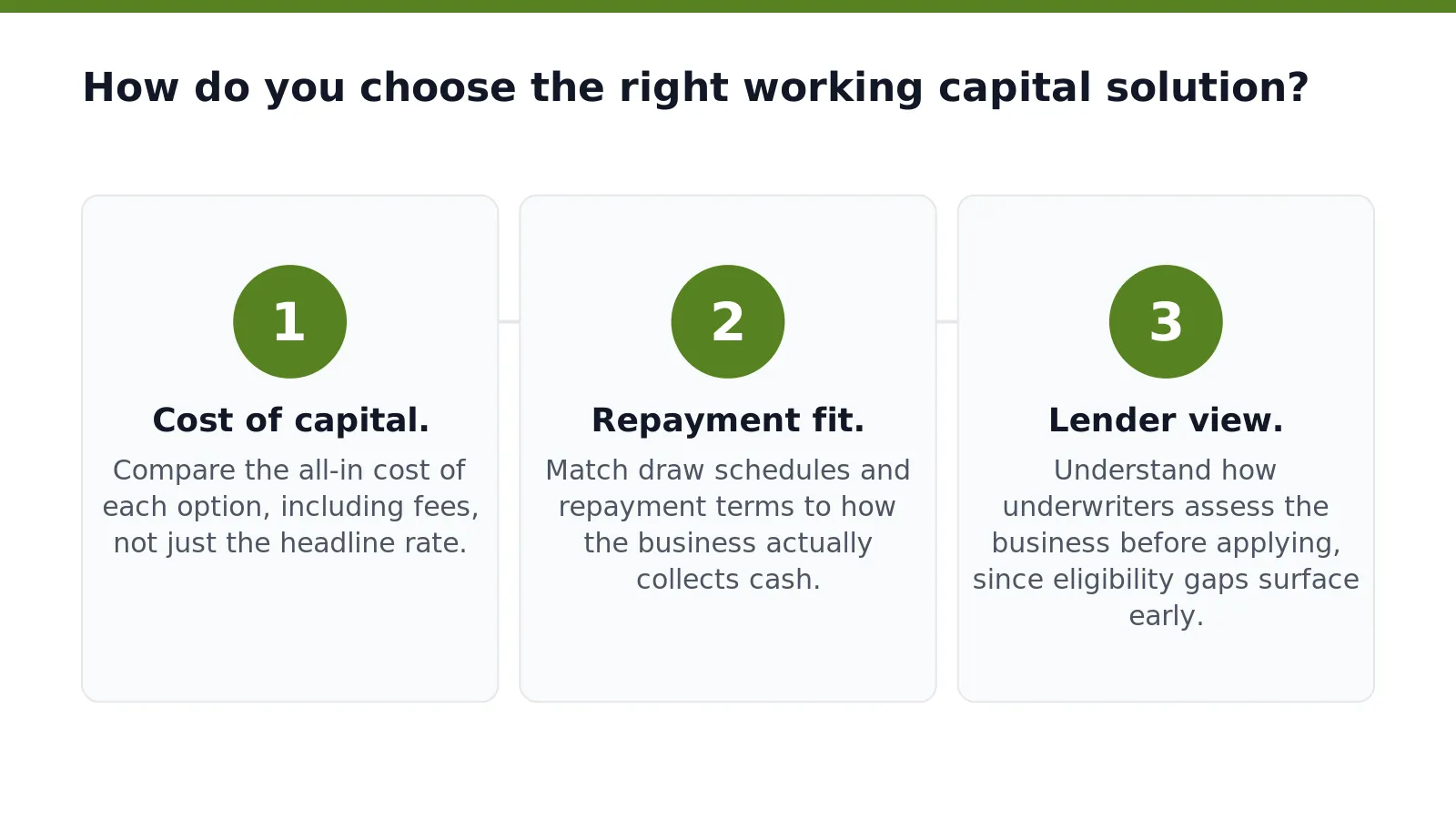
Three criteria separate a sound decision from an expensive one.
Cost of capital. Compare the all-in cost of each option, including fees, not just the headline rate. Debt management counseling can help clarify these tradeoffs before signing.
Repayment fit. Match draw schedules and repayment terms to how the business actually collects cash.
Lender view. Understand how underwriters assess the business before applying, since eligibility gaps surface early.
How does a business know which financing structure fits?
Business working capital needs vary by stage and sector. A retailer carrying seasonal inventory needs a revolving facility. A service firm with steady receivables may prefer cash flow financing tied to invoice cycles. VIP Business Credit's local Business Credit Advisors provide personalized, concierge-level guidance to match financing to a business's stage and sector.
How can a business compare lenders before applying?
Access shapes the comparison. VIP Business Credit connects clients to more than 1,000 national and local lenders, including options tailored for Virginia businesses. The company's advisory team reveals how underwriters view a business and identifies eligibility gaps. That visibility lets owners compare offers on equal footing rather than accepting the first approval that arrives.
How can business credit help you access working capital?

Strong business credit unlocks business working capital at lower rates and better terms. Lenders view companies with established credit profiles as lower risk, which translates directly into higher approval amounts and reduced borrowing costs. Without this foundation, owners often pay more for capital or face outright rejection.
The mechanism works through separation. Building EIN-based business credit protects personal assets by keeping business liability distinct from the owner's personal finances, since lenders then evaluate the business on its own merits rather than the owner's personal credit history. A company with its own credit identity qualifies for financing that personal guarantees alone cannot secure.
What makes a business appear lower risk to working capital lenders?
Lenders assess risk through three primary signals. Consistent business identity data across all registrations and applications forms the first signal. Established trade credit lines with vendors who report to business bureaus create the second. Strong bureau reporting habits, where payments are made on time and credit utilization stays controlled, deliver the third. Together, these factors build a profile that lenders and vendors interpret as dependable.
Capital-Ready Risk Signals
These three signals form the foundation lenders check before extending a working capital line of credit. A business that is "Capital-Ready" on all three typically qualifies for better terms.
How does business credit affect working capital line of credit terms?
A working capital line of credit becomes more accessible and affordable when the business credit profile is strong. Higher credit limits, lower interest rates, and faster approvals follow from documented creditworthiness. Companies without this foundation often face stricter terms or smaller credit lines. The difference compounds over time: better terms free up cash that can fund growth instead of servicing expensive debt. Cash flow financing options also expand, giving owners more ways to bridge revenue gaps without straining operations.
FAQ
What is the difference between working capital and cash flow?
Working capital measures current assets minus current liabilities at a single point in time.
How does VIP Business Credit help with working capital solutions?
VIP Business Credit connects entrepreneurs to over 1,000 lenders and builds EIN-based business credit, separating personal and business credit profiles.
What happens when a business runs low on working capital?
Operations seize up, vendors demand cash on delivery, and growth opportunities slip away. A working capital line of credit provides a buffer against these disruptions.
Conclusion
Selecting the right working capital solution requires matching the financing structure to the business's cash conversion cycle, not just accepting the first approval. A line of credit suits recurring gaps, while a term loan fits a single expense. Internal adjustments like tightening inventory management further reduce reliance on debt. This deliberate approach protects cash and positions the business for sustainable growth.
About the Author
Lee Johnson is a Master Certified Professional Coach with deep expertise in business financing and growth strategies. Lee specializes in helping entrepreneurs and business owners develop strong financial foundations, optimize credit profiles, and secure working capital financing that drives sustainable success.
Contact & Strategy Links
Serving Sterling, Fairfax, Ashburn, Tysons, and the Reston-Herndon area, VA, along with the surrounding Greater Washington D.C. region.


