Net 30 Vendor Account: The Ultimate Guide to Establishing and Building Business Credit
Book Your Free Business Financial Health Strategy Call
Net 30 Vendor Account: The Ultimate Guide to Establishing and Building Business Credit
A net 30 vendor account is a powerful financial tool that startups and established businesses use to build and enhance their business credit profiles without personal liability. According to Lee Johnson, Co-Founder & CEO of VIP Business Credit, these accounts provide businesses with the ability to purchase goods or services on credit with payment due within 30 days, fostering a timely payment history that is reported to major business credit bureaus. This guide will explore everything you need to know about net 30 accounts including what is a net 30 account, a list of net 30 companies, detailed insights on grainger business credit and grainger net 30 accounts, and strategies for startups to use business credit and tier 1 vendor accounts to jumpstart credit building with the best starter business credit cards and vendor relationships.
Key Takeaways
- A net 30 vendor account lets a business receive goods or services now and pay within 30 days, building business credit without personal liability.
- Tier 1 vendor accounts like Uline, Quill, and Grainger report payments to Dun & Bradstreet, Experian, or Equifax without requiring a personal guarantee.
- Approval typically requires an EIN, D-U-N-S Number (important for duns number paydex), registered business entity, dedicated business address/phone, and a business bank account.
- Grainger net 30 accounts report to Experian Business and support both credit-building and everyday operational purchasing.
- Business credit grows through four tiers: starter vendor accounts, store/fleet credit, revolving business credit cards, and unsecured loans or lines of credit.
- Consistent on-time payments, especially paying 10-20 days early, and regular monitoring of your Paydex, Intelliscore, and Commercial Credit Score are key to long-term credit health and achieving a Paydex 80+ rating.
What Is a Net 30 Account and How Does It Build Business Credit?

A net 30 account is a form of trade credit offered by vendors, allowing businesses to receive products or services immediately but pay the invoice within 30 days of the billing date. This 30-day billing cycle establishes a revolving trade line when the vendor reports payment history to commercial credit bureaus.
Business credit bureaus such as Dun & Bradstreet (which issues the Paydex Score used for duns number paydex), Experian Business (featuring the Intelliscore Plus), and Equifax Commercial (with its Commercial Credit Score), track these trade lines. Timely payments reported by vendors help build your business credit ratings without exposing you to personal liability, differentiating it from personal credit or business loans requiring personal guarantees.
Benefits of Using a Net 30 Vendor Account

Utilizing net 30 vendor accounts as a part of your credit-building strategy delivers several advantages:
- Establish and Enhance Payment History: Consistent on-time payments create a positive record visible to lenders and suppliers. Paying invoices 10-20 days early can boost your Paydex score significantly, helping you reach an 80+ rating.
- Diversify Credit Mix: Vendor trade lines add variety to your credit profile, increasing your appeal to creditors and complementing starter business credit cards and other credit forms.
- Access Improved Financing: Strong credit scores can unlock better terms, such as lower interest rates and higher credit limits.
For comprehensive guidance on building your credit profile, explore resources like financial coaching.
No Personal Guarantee (No PG) Approval Criteria for Net 30 Vendor Accounts

Receiving approval for net 30 vendor accounts without a personal guarantee requires meeting essential business legitimacy standards. Vendors often look for the following checklist:
- Employer Identification Number (EIN): A federal tax identifier proving your business is registered.
- D-U-N-S Number: Issued by Dun & Bradstreet, this number identifies your business credit profile and is linked to the Paydex score. Having this is essential for tier 1 vendor accounts.
- Registered Business Entity: Demonstrated good standing with the Secretary of State or equivalent authority.
- Dedicated Commercial Address and 411-Listed Phone Number: This establishes credibility as a separate business entity.
- Dedicated Business Bank Account: Shows financial separation from personal accounts.
Fulfillment of these requirements increases eligibility for starter tier 1 vendor accounts that report to the business credit bureaus without requiring a personal guarantee.
Ready to start building your business credit the right way? Whether you7re opening your first net 30 vendor account or mapping out your path through all four credit tiers, VIP Business Credit can help you build a strategy tailored to your goals. Schedule a free Business Financial Health Strategy Call with Lee Johnson and his team today, especially if you're operating in Northern Virginia business hubs like Sterling, Fairfax, Loudoun, or Arlington.
Top Tier 1 Vendor Accounts for Startups

For startups aiming to build credit, tier 1 vendor accounts serve as essential first steps. These vendors typically offer net 30 terms with minimal entry barriers, report to business credit bureaus, and do not require personal guarantees. Notable examples include:
- Uline: Industrial shipping supplies with reliable reporting to Dun & Bradstreet.
- Quill: Office supplies that report to Equifax and do not require a personal guarantee.
- The CEO Creative: Marketing and branding services reporting to Dun & Bradstreet.
- Nav Prime: Offers business credit monitoring and financing, reporting to key bureaus.
- Crown Office Supplies: Office essentials reporting to Dun & Bradstreet.
These vendors are well-suited for new businesses building foundational credit profiles and often complement starter business credit cards.
Deep Dive: Grainger Business Credit & Grainger Net 30 Accounts

Grainger is a highly regarded vendor offering net 30 accounts primarily reporting to Experian Business. Their extensive inventory includes industrial and safety equipment, making them a popular choice for businesses requiring operational supplies. Grainger business credit is known for supporting a strong credit profile build when payments are made promptly.
To apply for a Grainger net 30 account, businesses can complete an easy online application via the Grainger website. Key tips to successfully secure and maximize Grainger credit include:
- Provide Complete and Accurate Business Information: This expedites approval.
- Meet Minimum Order Requirements: Typically starting around $100.
- Place Consistent Orders and Pay On-Time: Builds positive payment history and can unlock higher credit limits.
- Monitor Reporting: Grainger reports to Experian regularly, so verifying that your positive payment information is logged enhances your Experian Intelliscore Plus.
Grainger is considered a strong mid-tier vendor that supports credit-building and operational needs simultaneously.
The 4-Tier Business Credit Progression Framework
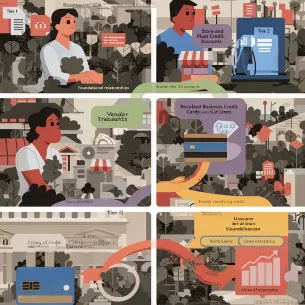
Building strong business credit follows a progression through four tiers: business fundability score.
- Tier 1 - Vendor Trade Credit / Starter Net 30 Accounts: Entry-level net 30 accounts like Uline and Quill that report to major bureaus without requiring personal guarantees.
- Tier 2 - Store & Fleet Credit Accounts: Credit accounts with stores and fuel providers such as Home Depot Pro and gasoline fleets, expanding credit diversity.
- Tier 3 - Revolving Business Credit Cards and Cash Flow Lines: Obtain revolving credit lines, helping cash flow management and credit score enhancement. Look for the best starter business credit cards to complement your vendor accounts.
- Tier 4 - Unsecured Bank Loans & Lines of Credit: Higher-level unsecured financing options unlocked by strong credit profiles established in earlier tiers.
Following this roadmap allows businesses to strategically build and use credit for growth.
Comparison Table: Tier 1 vs Tier 2 Net-30 Vendor Accounts
Underwriting & Paydex 80+ Roadmap
Achieving an 80+ Paydex score is a critical milestone for unlocking premium financing opportunities. Here is a roadmap to guide you through underwriting thresholds and maintaining prompt payment discipline:
- Establish Business Legitimacy: Secure EIN, D-U-N-S Number, registered business entity status, and a dedicated business bank account.
- Open Tier 1 Vendor Accounts: Start with no personal guarantee net 30 vendor accounts, ensuring they report to major bureaus.
- Consistent Payment Discipline: Always pay invoices within net 30 terms, ideally 10-20 days early to maximize your Paydex score, moving towards a 100 rating.
- Season Trade Lines: Allow accounts to mature over time, typically 6-12 months of regular, on-time payments enhances your overall credit profile.
- Expand Credit Mix: Add store/fleet credit (Tier 2), then business credit cards and unsecured credit lines to deepen your profile.
- Monitor and Manage Scores: Regularly review your Paydex, Intelliscore Plus, and Commercial Credit Score to ensure accurate reporting and identify improvement areas.
Following this disciplined underwriting and payment plan is key to unlocking financing without personal guarantees and favorable business credit terms.
Additionally, VIP Business Credit offers clear and upfront information on program costs; you can review details about their transparent program pricing to better plan your credit-building journey.
How Net 30 Vendor Accounts Report to Business Credit Bureaus

Understanding the reporting mechanics of net 30 accounts is vital for maximizing credit-building impact. Vendors report key data to the commercial credit bureaus, which affect scoring systems:
- Dun & Bradstreet: Uses the Paydex Score, a 0-100 score evaluating payment timeliness. Paying invoices 10-20 days early increases this score significantly.
- Experian Business: Calculates the Intelliscore Plus based on payment history, credit utilization, and other factors.
- Equifax Commercial: Employs the Commercial Credit Score measuring payment behavior and financial stability.
Timely reporting by vendors, especially for starter and tier 1 accounts, is key to accelerating credit establishment.
Steps to Open Your First Net 30 Vendor Account and Get It Reporting

- Research Suitable Vendors: Use the list above to find vendors that fit your industry and credit-building goals.
- Prepare Essential Business Documentation: Ensure you have your EIN, D-U-N-S Number, business registrations, and financials at hand.
- Complete Applications Accurately: Filling out vendor applications with precise data avoids delays.
- Make Strategic First Purchases: Meet minimum order requirements to activate the account and establish a payment history.
- Pay On or Before Due Dates and Monitor Reporting: Confirm that payments are made timely and check your business credit reports within 30-60 days for accurate reporting.
Strategies for Maximizing Your Credit Scores with Net 30 Vendor Accounts

- Make Timely Payments: This is the most critical factor in establishing excellent credit. Paying 10-20 days before the due date can help you achieve an 80+ Paydex score.
- Maintain Low Credit Utilization: Keep balances below 30% of credit limits to positively impact scores.
- Build a Diverse Credit Mix: Use multiple vendors reporting to different bureaus and supplement with the best starter business credit cards.
- Monitor Accounts Regularly: Check your Dun & Bradstreet Paydex, Experian Intelliscore, and Equifax Commercial score for accuracy and improvements.
Common Challenges and Solutions in Vendor Credit Reporting

Some challenges include reporting inaccuracies, inconsistent vendor reporting, and managing payment schedules. To mitigate these: working capital and good financial management are essential.
- Check Reports Regularly: Identify and dispute errors promptly.
- Select Reliable Vendors: Confirm reporting frequency before opening accounts.
- Use Payment Reminders or Software: Avoid missed or late payments with automated alerts.
Trade Credit vs. Vendor Credit: What Business Owners Need to Know

Trade credit is a broad category encompassing all credit suppliers extend to businesses, whereas vendor credit is more specifically credit provided by vendors or suppliers often under net terms like net 30. Vendor credit usually has structured reporting enabling business credit growth and typically does not require personal guarantees if tier 1 criteria are met.
Choosing the Right Credit Type for Building Business Credit

Select credit types aligned to your business goals and ensure you choose vendors who report payments to major bureaus. Prioritize vendor accounts with no personal guarantee requirements and reasonable approval standards for startups, and consider pairing them with the best starter business credit cards.
Frequently Asked Questions About Net 30 Vendor Accounts
Do net 30 accounts require a personal guarantee?
Not all net 30 accounts require a personal guarantee. Many tier 1 vendor accounts for startups do not, provided your business meets legitimacy criteria such as having an EIN, D-U-N-S Number, and established business contact information.
How fast do net 30 vendors report to credit bureaus?
Reporting timelines vary by vendor but typically occur monthly or quarterly. You can expect reports to appear within 30 to 60 days after the payment is made.
How many net 30 accounts do I need to get an 80 Paydex score?
While there is no fixed number, maintaining at least 3 to 5 active net 30 accounts with consistent on-time payments—and paying early—helps achieve a strong Paydex score of 80 or higher.
Can a brand-new LLC qualify for net 30 accounts?
Yes, many vendors offer net 30 accounts to new LLCs without prior credit history, especially tier 1 vendors. Approval may depend on providing proper documentation and business legitimacy factors.
Additional Resources for Building Business Credit

Explore these valuable resources to further your credit-building knowledge:
- Building business credit for a new LLC
- Business credit score ranges
- Complete guide to building business credit
- Separating business and personal credit
Take the Next Step Toward Stronger Business Credit in Northern Virginia
Building business credit through net 30 vendor accounts is a proven, low-risk way to grow your company's financial standing—especially if your business operates in vibrant Northern Virginia business hubs like Sterling, Fairfax, Loudoun, or Arlington. Doing it strategically with the right vendors and best starter business credit cards makes all the difference.
VIP Business Credit has helped thousands of entrepreneurs establish tier 1 vendor accounts, navigate the four credit tiers, and unlock premium financing on their own merits.
About the Author

This comprehensive guide was authored by Lee Johnson, Co-Founder & CEO of VIP Business Credit, a seasoned Real Estate Investor, Business Growth Strategist, and Master Certified Professional Coach with more than 500 coaching hours and over 25 years of professional experience. He holds a Bachelor of Science from Fairleigh Dickinson University and a Master of Business Administration from the University of Phoenix. Since 2005, Lee has built a personal real estate investment portfolio exceeding 1,700 units valued at approximately $254 million across multiple U.S. markets, and has supported thousands of entrepreneurs nationwide in establishing net 30 accounts, vendor trade lines, and building strong, tiered business credit profiles that unlock premium financing opportunities. The VIP Business Credit team is headquartered in Sterling, VA.
Connect with Lee and VIP Business Credit:
- 📞 Phone: (571) 248-3863
- ✉️ Email: [email protected]
- 📅 Schedule A Business Financial Health Strategy Call
Conclusion
Building strong business credit doesn7t happen overnight, but a net 30 vendor account gives startups and growing businesses a reliable, low-risk starting point. By establishing accounts with tier 1 vendors like Uline, Quill, and Grainger, meeting the documentation and legitimacy criteria vendors expect, and consistently paying on or before each due date—ideally 10-20 days early—a business can build the payment history that fuels its Paydex, Intelliscore, and Commercial Credit Score. From there, progressing through the four tiers���from starter vendor trade lines to store and fleet credit, revolving business credit cards (including the best starter business credit cards), and eventually unsecured loans and lines of credit���allows a business to access increasingly favorable financing on its own credit merit, separate from the owner7s personal credit.


