Expansion Loans: Business Loans for Expansion Strategy
Expansion Loans: Business Loans for Expansion Strategy
Business loans for expansion strategy combine SBA 7(a) and SBA 504 financing with EIN-based business credit, protecting personal assets. VIP Business Credit's business credit scan matches owners to pre-qualified funding options in 2-5 minutes, mapping the fastest path to commercial real estate, equipment, or hiring capital.
Key Takeaways on Expansion Loans, Business Growth Funding, and Scaling Capital
- SBA 7(a) loans provide funding for expansion needs like real estate and equipment purchases; contact VIP Business Credit for details on loan amounts.
- SBA-guaranteed loans offer competitive rates with lower down payments and flexible overhead requirements for growing businesses seeking business growth funding.
- VIP Business Credit connects entrepreneurs to over 1,000 national and local lenders for expansion loan and scaling capital financing options.
Why Do Growing Businesses Need Expansion Loans and Business Growth Funding?
Growth demands cash before it delivers revenue. Purchasing commercial real estate, upgrading equipment, and hiring new team members all require capital that most companies don't have sitting in a checking account. Expansion loans exist to close that gap, giving business owners a way to fund big moves without draining reserves meant for daily operations.
Expanding a business is exciting, but the excitement comes with a price tag. New locations, updated machinery, and larger teams typically carry considerable costs that catch owners off guard if they haven't planned ahead. A solid small business expansion financing strategy, built around suitable business growth funding and scaling capital, turns those costs from a threat into a manageable line item.
What Can Expansion Financing Actually Pay For in Terms of Business Growth Funding?
Business growth funding covers a wide range of needs tied to scaling a company. Common uses include:
- Buying or renovating commercial real estate
- Upgrading equipment and machinery
- Hiring and onboarding new employees
- Opening additional locations
Each of these moves strengthens long-term earning potential, but each also requires capital up front.
How Do Owners Find the Right Lender for Growth Capital and Expansion Loans?
Finding the right fit matters as much as finding the funds. Loan products, rates, and terms vary widely depending on the lender and the stage of the business. VIP Business Credit connects business owners to a network of more than 1,000 national and local lenders, matching each company with scaling capital suited to its size, sector, and risk profile.
Without the right match, owners risk overpaying or getting stuck with terms that limit future flexibility. Working through a broad lender network reduces that risk considerably.
For owners exploring other funding needs, VIP Business Credit also offers tailored solutions for marketing loans and specialized support for retail store growth financing, complementing expansion loan strategies.

What Are Expansion Loans, Business Growth Funding, and Scaling Capital Exactly?
Expansion loans finance a specific stage of a company's life: growth. A restaurant owner opening a second location, a retailer entering a new regional market, a contractor adding a fleet of vehicles — all of these fall under the same funding category. Unlike a general working capital loan meant to cover payroll or inventory gaps, an expansion loan targets a defined growth project with a clear return on investment.
Owners considering this path won't find it limited to one type of lender. These products come from traditional banks, SBA-backed programs, online lenders, and nonprofit lending organizations, each with its own underwriting style and timeline. A community bank might move slowly but offer lower rates. An online lender might approve faster but at a higher cost.
Where Can a Business Owner Actually Get Expansion Loans and Business Growth Funding?
No single source dominates the expansion loan market. Coverage spans four main channels, each serving different business profiles:
- Traditional banks — often the most competitive pricing, but slower approval and stricter documentation
- SBA-guaranteed lenders — government-backed programs designed for long-term, lower-risk growth financing
- Online lenders — faster decisions, useful when timing matters more than rate
- Nonprofit lenders — mission-driven financing, frequently aimed at underserved business owners
Is Every Expansion Loan Structured the Same Way for Scaling Capital?
No. Terms, collateral requirements, and repayment structures shift based on lender type and business risk profile. This is where business growth funding stops being a one-size-fits-all decision.
VIP Business Credit approaches this variability directly by matching each financing strategy to a company's stage, industry, and risk profile rather than pushing a single product. A five-year-old manufacturer and a two-year-old service business need different paths to scaling capital. The right lender match depends on getting that assessment right from the start.
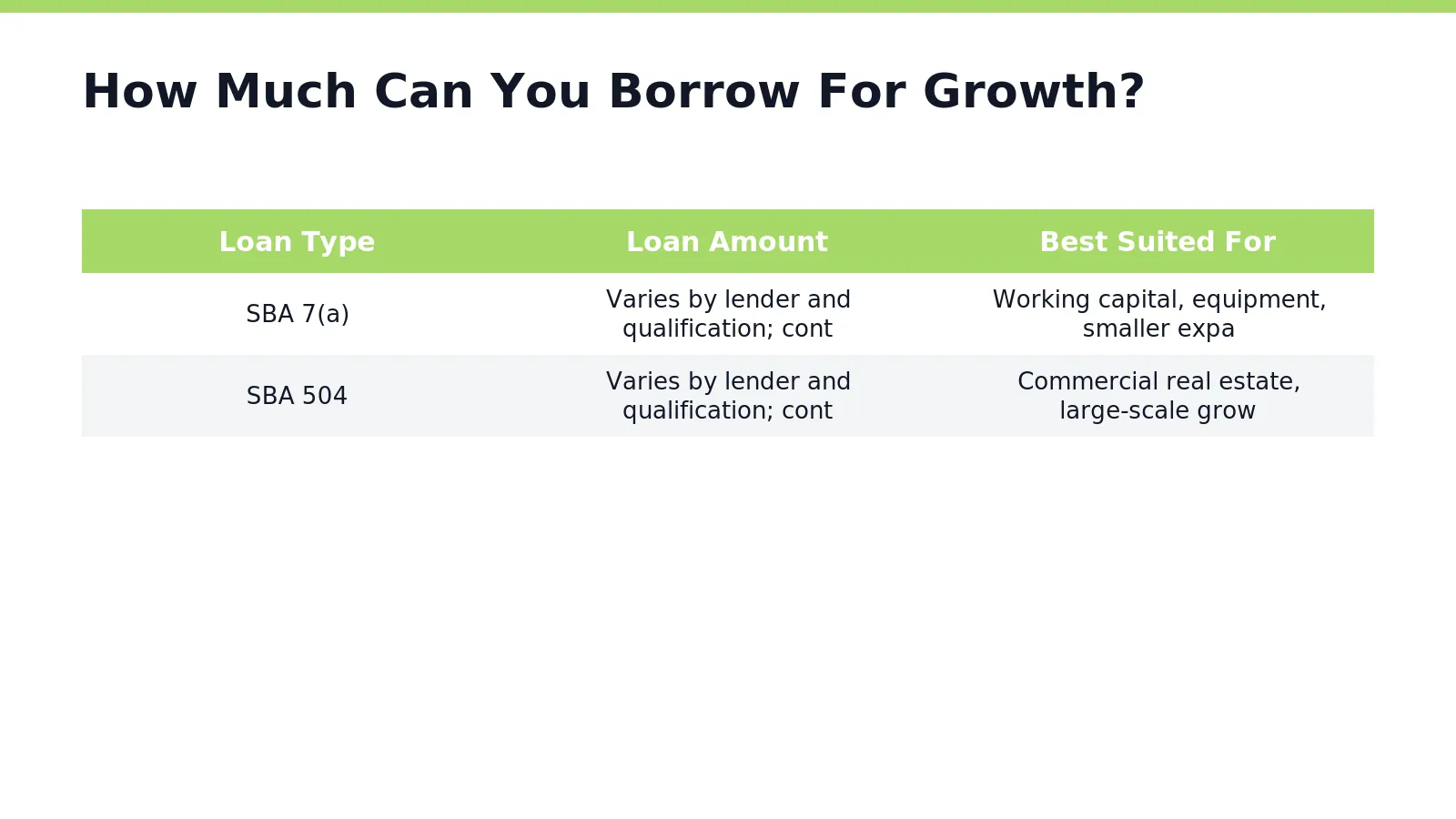
Loan size for business expansion depends heavily on the product chosen. SBA 7(a) loans provide
How Much Can You Borrow for Expansion Loans and Business Growth Funding?
Loan size for business expansion depends heavily on the product chosen. SBA 7(a) loans provide funding for expansion needs like real estate and equipment purchases. SBA 504 loans provide funding for larger projects like real estate purchases or major facility upgrades. Contact VIP Business Credit for details on specific loan amounts. That range matters because a new location build-out and a full-scale manufacturing expansion carry very different price tags.
Matching the loan type to the project size is where planning pays off. A company opening a second retail location has different capital needs than one purchasing a warehouse. Here's a general breakdown of how these two SBA-backed options compare:
Does an Owner Need a Large Cash Reserve to Qualify for Expansion Loans and Scaling Capital?
Not necessarily. Many expansion loans require only a minimal equity injection from the business owner, rather than a large upfront cash contribution. This structure allows owners to preserve working capital for day-to-day operations while still pursuing business growth funding for bigger projects.
Lower equity requirements open the door for companies that are cash-flow healthy but asset-light. A business owner does not need deep personal reserves to pursue a meaningful expansion. Instead, the loan structure itself shoulders more of the financial weight.
Finding the right amount of scaling capital starts with matching the borrower to the right lender. VIP Business Credit connects clients to a broad network of national and local lenders, allowing loan size and structure to be matched to the specific scope of a growth project. A single-location café expanding to a second storefront has different borrowing needs than a regional distributor buying new warehouse space. Working with a network this wide means the loan amount fits the plan, not the other way around.

Which Expansion Loan Type Fits Your Business Growth and Scaling Capital Needs?

No single loan works for every expansion plan. The right fit depends on how much capital a business needs, how fast it needs that capital, and what collateral sits on the balance sheet. Some owners find that [business lines of credit](https://www.vipbizfunds.com/business-credit) for expansion suit an ongoing project better than a lump-sum term loan, since a credit line can be drawn as costs arise rather than all at once. Matching the loan structure to the growth goal protects cash flow and keeps personal assets out of the equation.
Expansion loans backed by the Small Business Administration deserve a close look for owners weighing long-term cost. SBA-guaranteed loans generally carry rates and fees comparable to non-guaranteed loan products, so borrowers don't pay a steep premium for the government backing. Some SBA programs go further, offering lower down payments, more flexible overhead requirements, and no collateral requirement at all. That combination makes SBA options attractive for owners who want business growth funding without tying up equipment or real estate as security.
Is an SBA Loan Always the Cheapest Option for Expansion Business Growth Funding?
Not necessarily, but SBA-guaranteed loans generally match the rates and fees of non-guaranteed alternatives. That makes them competitive rather than automatically cheapest. The real advantage often shows up in structure — lower down payments and reduced collateral demands — not just in the interest rate.
How Does a Business Owner Know Which Lender to Approach First for Scaling Capital?
Owners rarely need to guess. VIP Business Credit connects clients to a lender network spanning traditional banks, alternative finance providers, and specialized programs. A business gets matched to the option built for its stage and risk profile.
Owners chasing scaling capital for a new location or equipment upgrade benefit most from comparing structures before committing, rather than defaulting to the first offer that arrives.
SBA Loan Program Facts
SBA Loan Program Facts
The SBA 7(a) program is the SBA's flagship offering, providing financing for general business purposes such as working capital, equipment purchases, and debt refinancing, backed by a federal guaranty of up to 85 percent on qualifying loans. The SBA 504 program is built for fixed-asset financing, commercial real estate, and major facility upgrades, pairing a certified development company with a private lender to deliver long-term, below-market rates on qualifying projects.
Both programs typically carry rates and fees comparable to conventional commercial loans, since the government guaranty reduces lender risk rather than the borrower's cost of capital. Eligibility for either program generally hinges on business size standards, credit history, and the ability to demonstrate repayment capacity through cash flow, factors VIP Business Credit's Business Credit Advisors help owners assess before an application goes in.
Why Build Business Credit Before Borrowing Expansion Loans and Business Growth Funding?

Lenders trust businesses that have already separated personal and business finances before they ever request a loan application. Skipping that step forces owners to lean on personal credit and personal guarantees, putting homes, savings, and personal credit scores on the line every time the business needs capital. Building a lender ready business profile tied to the company itself removes that exposure and supports better access to expansion loans and scaling capital. It gives lenders a clearer picture of the business as its own entity.
VIP Business Credit builds this separation by tying credit to a company's EIN, its Employer Identification Number, instead of the owner's Social Security number. That structure keeps personal liability out of the equation as a business pursues expansion loans, credit lines, or other business growth funding. Entrepreneurs across Northern Virginia and the greater Washington, DC region work with VIP Business Credit to establish this EIN-based foundation before approaching lenders for scaling capital.
Does Business Credit Actually Affect Loan Approval for Expansion Loans and Business Growth Funding?
Yes. Underwriters look for consistency across a business's identity data, and mismatched addresses, phone numbers, or business names raise red flags. Consistent, accurate business identity information—paired with reported trade credit—signals to lenders that a company is lower risk. That lower-risk profile translates directly into better approval odds and terms.
What Happens If a Business Skips Building Business Credit Before Seeking Scaling Capital?
Skipping credit-building means facing lenders with a thin or nonexistent business file. Owners then get evaluated almost entirely on personal credit, which limits borrowing capacity and keeps personal assets exposed. A business with its own established credit history, by contrast, can qualify for larger amounts without the owner co-signing every dollar.
- Separates personal assets from business risk
- Strengthens lender confidence through consistent identity data
- Builds a track record that supports larger funding requests
Establishing this foundation early gives growing businesses a stronger position when it's time to negotiate financing terms.
How Does Your Credit Position Get Scored for Expansion Loans and Business Growth Funding?

Lenders assess a business through data most owners never see: payment history, trade lines, and how underwriters interpret them behind the scenes. Proprietary scoring tools translate that hidden data into plain terms, showing exactly how underwriters view a business. Eligibility gaps exist, and which funding products actually fit. Without that visibility, a business owner pursuing expansion loans applies blind, hoping for approval rather than knowing where the file stands. That guesswork costs time and, often, a shot at better rates.
A structured credit scan closes that gap. It reveals specific weaknesses in a company's credit file. Lays out a roadmap for pursuing business growth funding with clearer expectations. Instead of vague advice, owners get a direct picture of what's holding a file back and what steps close those gaps.
What Does a Business Credit Scan Actually Check for Scaling Capital?
A scan reviews the credit signals lenders weigh most heavily, then flags where a business qualifies for pre-approved options. The process runs in just 2 to 5 minutes and carries zero impact on the owner's personal credit score. That speed matters for entrepreneurs juggling daily operations who can't afford a drawn-out application process just to learn where they stand.
Why Does Score Visibility Matter Before Applying for Expansion Loans?
Applying without this insight risks wasted applications and unnecessary credit inquiries. Knowing the score position first lets an owner target lenders likely to approve the request, rather than applying broadly and hoping.
The payoff extends beyond a single loan. Once a business understands its scoring position, it can build toward larger amounts of scaling capital over time, using each approval to strengthen the next application:
- Immediate visibility into eligibility gaps before submitting any application
- Pre-qualified matches based on actual underwriting criteria, not guesswork
- A documented path for improving credit standing ahead of future funding needs
When Does an Expansion Loan Make Sense in Your Business Growth Funding Strategy?

Stable cash flow paired with a clear growth strategy signals the right moment for an expansion loan. Businesses without either piece in place face a different risk: taking on debt before the operation can support it. That gap is where owners lose ground, not from lack of ambition, but from timing that outpaces revenue.
A well-developed plan matters as much as the cash flow itself. Lenders want to see how new capital turns into new revenue, whether that means a second location, updated equipment, additional staff, or a fleet of vehicles for a growing service business. Knowing how to finance business growth starts with that plan: business growth funding works best when the strategy behind it is specific and measurable, not aspirational.
How Do Business Credit Advisors Help With Timing for Scaling Capital?
Local Business Credit Advisors offer personalized, concierge-level guidance to owners weighing an expansion decision. They help evaluate whether a business is ready, not just eligible, for new financing. This kind of guidance reduces the chance of borrowing too early or choosing the wrong structure entirely.
What Role Does Cash Flow Play Before Borrowing Expansion Loans?
Cash flow strategy determines whether scaling capital strengthens a business or strains it. Working capital needs to be available before it's urgently needed, not scrambled together after a shortfall hits. Sound cash flow planning ensures funds are on hand when growth demands them, rather than after the opportunity has already passed.
Consider readiness across these markers before pursuing expansion loans and related business growth funding:
- Consistent, predictable revenue over recent months
- A documented plan for how new capital will be used
- Existing working capital reserves, not dependence on the loan alone
- A clear repayment timeline tied to projected growth
Owners who meet these markers tend to approach expansion from strength. Those who don't often benefit more from shoring up cash flow first, then revisiting financing once the foundation is steady.
What's Your Next Step Toward Scaling Capital and Business Growth Funding?

Scaling begins with a clear picture of where a business stands and where the capital should come from. Securing growth capital means weighing expansion loans against other financing paths with a partner who explains options plainly, not a broker chasing a quick commission. VIP Business Credit builds its process around transparent, no-surprise pricing. Clients understand costs and terms before committing to any product.
That transparency reflects a longer-term philosophy. Rather than treating each loan as a one-off transaction, VIP Business Credit positions itself as an ongoing partner in a company's financial growth. This matters because business growth funding rarely happens once and then stops. Most companies return for additional capital as revenue, locations, or equipment needs expand.
Is Business Expansion Financing Only for Established Companies?
No. VIP Business Credit's approach works for two distinct stages of business life. Newer ventures seeking their first approvals get guidance suited to limited credit history, while established firms pursuing scaling capital receive strategies built around stronger financials and growth ambitions. Both groups need different documentation and different lender relationships, and the right partner adjusts accordingly.
Where Can a Business Owner Start the Conversation About Expansion Loans and Business Growth Funding?
Business owners ready to discuss expansion financing can connect with VIP Business Credit at its Sterling, Virginia office, located at 21000 Southbank St Ste 106-380, Sterling VA 20165. A local address matters for owners who value in-person conversations alongside digital tools.
The path forward depends on the business itself:
- New ventures typically need help establishing initial credit approvals before pursuing larger financing.
- Established firms typically need strategies for scaling, consolidating costs, or expanding into new markets.
Neither path is generic. Matching the right stage to the right funding strategy protects personal assets while building a credit profile lenders trust for years to come.
FAQ on Expansion Loans, Business Growth Funding, and Scaling Capital
How much funding is available through SBA expansion loans?
SBA 7(a) loans provide funding for expansion needs like real estate and equipment purchases. SBA 504 loans provide funding for larger projects like real estate purchases or major facility upgrades. Contact VIP Business Credit for details on loan amounts available for your business.
What can expansion financing cover?
Expansion financing covers buying or renovating commercial real estate, upgrading equipment and machinery, hiring new employees, and opening additional business locations.
How does VIP Business Credit help owners find the right loan for scaling capital?
VIP Business Credit connects business owners to a network of more than 1,000 national and local lenders, using its business credit scan to match companies with pre-qualified funding options tailored to their expansion loans and business growth funding needs.
Conclusion
In closing, securing the right business loan for expansion requires matching your growth strategy with lenders who understand your industry and financial position. By building a strong, EIN-based business credit profile and understanding how underwriters evaluate your company, you position yourself to access favorable terms and capital when you need it most. The path forward combines clear planning, solid financial fundamentals, and partnership with advisors who guide you through the lending landscape with transparency and expertise.
About The Author
Lee Johnson is the Founder of VIP Business Credit, a seasoned Real Estate Investor, Business Growth Strategist, and Master Certified Professional Coach. Bringing over 25 years of experience in business finance and credit strategy, Lee specializes in guiding entrepreneurs to build fundable, lender-ready business credit profiles tied to an EIN rather than personal SSNs, separating business and personal liabilities.
Contact VIP Business Credit
- 📞 Phone: (571) 248-3863248-3863)
- ✉️ Email: [email protected]
- 📅 Consultation: Schedule A Business Financial Health Strategy Call
- 🌐 Website: https://vipbizfunds.com
- 🎯 [FREE Business Success Scan](https://vipbizfunds.com/bizscan): FREE Business Success Scan
- 📍 Service Area: Serving Sterling, VA and businesses nationwide


