Establishing Vendor Credit Lines: Net 30 Accounts
Establishing Vendor Credit Lines: Net 30 Accounts
Establishing vendor credit Net 30 accounts begins with applying to easy-approval vendors like Crown Office Supplies, Uline, or Amazon Pay by Invoice. VIP Business Credit recommends these accounts because they report payment activity to business credit bureaus, building a credit file without a personal guarantee. Vendor credit lines separate business and personal finances effectively.
Key Takeaways
- Net 30 vendor accounts give businesses 30 days from the invoice date to pay for purchases.
- Vendors that report payment history to business credit bureaus turn every paid invoice into a credit-building event.
- EIN-only vendor credit lines remove the personal guarantee barrier that blocks many new business owners.
- Each on-time payment strengthens the business credit file, allowing lenders to evaluate the business on its own record.
What are net 30 vendor accounts?
Net 30 vendor accounts are trade credit arrangements that give a business 30 days from the invoice date to pay for purchases. These accounts serve as a foundational tool to build business credit when vendors report on-time payment history to business credit bureaus.
A business buys needed supplies now and pays later. That simple structure creates breathing room for cash flow while simultaneously generating a credit record. According to Nav, accounts that report payment history to business credit bureaus help establish business credit history when reported and paid on time.
How do net 30 accounts help a new business?
New businesses often lack the credit history lenders require. Net 30 accounts solve this problem by creating a trackable payment record. Office Garner notes that net 30 accounts give businesses 30 days to pay after invoicing, and when the activity is reported to business credit bureaus, it helps build a business credit file.
The process works in three steps:
- Apply for a net 30 vendor account with a supplier that reports to business credit bureaus.
- Purchase inventory, office supplies, or equipment the business already needs.
- Pay the full invoice within 30 days to establish a positive payment history.
What makes a net 30 vendor different from a regular supplier?
A regular supplier may offer payment terms without reporting them. A net 30 vendor that reports to bureaus turns every paid invoice into a credit-building event. VIP Business Credit helps entrepreneurs across Northern Virginia and the Greater Washington, DC region build EIN-based business credit, protect personal assets, and access funding through these vendor credit lines.
Business owners seeking to establish trade references benefit from selecting vendors that report to major business credit agencies. A detailed breakdown of qualifying vendors appears in this net 30 vendor account guide. The right accounts transform routine supply purchases into measurable credit milestones.

Why start with EIN-only vendor credit lines?
EIN-only vendor credit lines remove the personal guarantee barrier that blocks many new business owners. Many vendors don't require a business credit history or require only basic business information, making these accounts accessible for new businesses. Starting with EIN-only accounts protects personal assets while establishing a separate business credit identity.
What does EIN-only approval actually mean?
Some net 30 vendor accounts are application basis EIN only, with no personal guarantee and no personal credit check. The vendor evaluates the business entity itself, not the owner's personal credit file. This separation matters for veteran entrepreneurs who want to keep personal finances insulated from business activity.
How do EIN-only accounts lead to better funding terms?
Building EIN-based business credit faster enables access to capital at lower rates and better terms. The sequence works like this:
- Open EIN-only net 30 accounts with vendors that report payment history.
- Pay each invoice within the 30-day window to establish positive tradelines.
- Build a business credit profile that stands independent of personal credit.
- Apply for larger funding through VIP Business Credit's network of over 1,000 national and local lenders, including options tailored for Virginia businesses.
Each on-time payment strengthens the business credit file. Lenders then evaluate the business on its own record, not the owner's personal score.
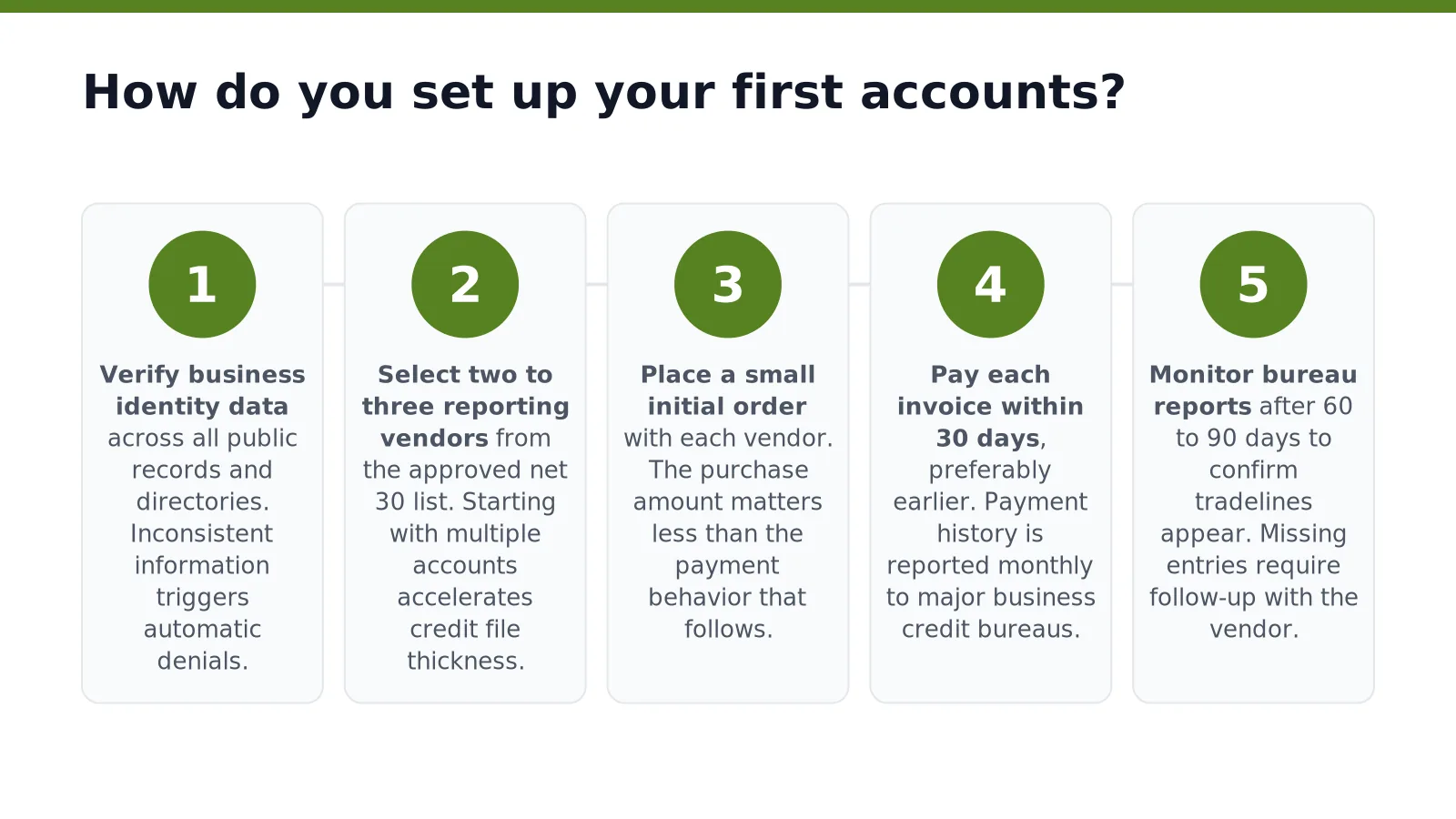
How do you set up your first accounts?
Setting up initial net 30 vendor accounts requires selecting vendors with easy approval and confirmed bureau reporting. The best vendor credit lines for new businesses report payment history to Equifax Business, Creditsafe, and FairFigure, which helps build business credit from the first on-time payment.
What vendors offer the easiest approval for new businesses?
US businesses, including newly formed LLCs, qualify for net 30 accounts with no minimum time in business. A list of the best net 30 accounts focuses on vendors with easy approval for business accounts with credit terms. These vendors report payment history to credit bureaus, turning routine supply purchases into credit-building transactions.
What documentation is needed before applying?
Preparation streamlines the application process. Business owners should gather three items before submitting any vendor application:
- An active Employer Identification Number (EIN) from the IRS
- A verified business address and phone number listed with 411 directory assistance
- A business bank account opened under the legal business name
VIP Business Credit's proprietary tools provide insight into how lenders view a business, helping owners identify gaps before applying and reducing the risk of rejection that delays credit-building timelines.
How does the setup process work step by step?
Follow this sequence to establish the first tradelines correctly:
- Verify business identity data across all public records and directories. Inconsistent information triggers automatic denials.
- Select two to three reporting vendors from the approved net 30 list. Starting with multiple accounts accelerates credit file thickness.
- Place a small initial order with each vendor. The purchase amount matters less than the payment behavior that follows.
- Pay each invoice within 30 days, preferably earlier. Payment history is reported monthly to major business credit bureaus.
- Monitor bureau reports after 60 to 90 days to confirm tradelines appear. Missing entries require follow-up with the vendor.
Each completed cycle strengthens the business credit profile. This routine transforms supply purchases into measurable credit milestones.
What habits build a strong Paydex score?
A strong Paydex score requires consistent on-time payments to vendors and suppliers. Three core habits drive this result: maintaining accurate business identity data, establishing vendor credit lines with reporting suppliers, and paying every invoice before the due date.
Why do payment timing and consistency matter most?
Dun & Bradstreet calculates the Paydex score on a rolling basis. A single late payment drops the score immediately. Suppliers report payment behavior monthly, and the score reflects the most recent data. Businesses that pay promptly on time achieve a benchmark score of 80, while those paying early can reach a perfect score of 100. Those that pay late see scores fall to 50 or below. The difference determines whether lenders approve applications or deny them.
How do reporting vendors affect the score?
Not all net 30 vendor accounts report to business credit bureaus. Only accounts with vendors that actively report payment history contribute to the Paydex score. Business owners must verify reporting status before opening accounts. VIP Business Credit identifies credit gaps across 125 factors affecting lender decisions, then delivers a step-by-step roadmap. This analysis reveals which vendors report and which do not, eliminating wasted effort on non-reporting accounts. Consistent payment across multiple accounts builds a file that lenders trust.
Follow these steps to build business credit through disciplined habits:
- Verify business identity data across all registrations and bureau records.
- Open net 30 accounts exclusively with vendors that report to major business credit bureaus.
- Pay every invoice within the agreed terms, preferably before the due date.
- Monitor business credit reports regularly to confirm accurate reporting.
Consistent business identity data, established trade credit lines, and strong bureau reporting habits improve scores over time. Regular credit monitoring catches errors before they damage the score. The system helps businesses secure maximum funding while achieving financial stability. VIP Business Credit, located in Sterling, VA, connects business owners to over 1,000 national and local lenders for ongoing capital access.
What mistakes slow your credit progress?
Late payments on net 30 vendor accounts create lasting damage. Vendors often serve as credit references for future applications, so one missed deadline hurts approval odds with new suppliers. Small business owners lose momentum when a single late invoice blocks the next vendor credit lines opportunity.
Why do late payments hurt more than owners expect?
A vendor reference carries weight beyond the original purchase. When a new supplier reviews an application, that supplier checks payment history with existing trade partners. A 30-day term paid on day 45 signals risk. The vendor reports the delay, and the next approval gets harder.
What happens when owners skip the preparation step?
Owners who rush into applications without verifying business identity data face repeated rejections. Each denial wastes time and leaves a paper trail. VIP Business Credit's local Business Credit Advisors guide clients step-by-step through preparation, so funding roadblocks never surface alone. The company's office at 21000 Southbank St Ste 106-380, Sterling VA 20165 serves as a resource for Northern Virginia entrepreneurs.
To build business credit without these setbacks, follow this sequence:
- Verify the business name, address, and EIN match across all state and federal records.
- Open two or three starter net 30 accounts with vendors that report to business bureaus.
- Pay every invoice before day 30, not on day 30.
- Request a credit reference from each vendor after three on-time payments.
- Review the vendor credit line building process before adding higher-limit accounts.
VIP Business Credit operates with a focused team of 3 employees, which keeps guidance personal and consistent. Owners who skip these steps repeat the same application cycle without progress.
FAQ
What net 30 vendors does VIP Business Credit recommend for beginners?
VIP Business Credit recommends Crown Office Supplies, Uline, and Amazon Pay by Invoice because they report payment activity to business credit bureaus.
How do net 30 accounts help a new business build credit?
Net 30 accounts create a trackable payment record. EIN-only vendor credit lines remove the personal guarantee barrier. EIN-only vendor credit lines remove the personal guarantee barrier, protecting personal assets while establishing a separate business credit identity.
Conclusion
Establishing net 30 vendor accounts is a deliberate process that rewards preparation over speed. Verify business identity data first, select vendors that report payment history, and pay every invoice before the due date. Each on-time payment builds a credit file lenders trust, turning a simple office supply order into a foundation for future capital access.


