Business Debt Consolidation: Simplify Your Finances
Business Debt Consolidation: Simplify Your Finances
Business debt consolidation loans combine multiple obligations, credit cards, merchant cash advances, lines of credit, into one monthly payment, ideally with a shorter term and lower total interest than existing debts. VIP Business Credit connects owners to lenders through its network of 1,000+ options, matching consolidation terms to the business's EIN-based credit profile and repayment capacity.
Key Takeaways
- Business debt consolidation loans combine multiple debts into one single monthly payment for simplification.
- VIP Business Credit connects entrepreneurs to over 1,000 national and local lenders for consolidation options.
- Consolidation loans save money when the repayment period is shorter than existing debt timelines.
What Is Business Debt Consolidation?
Business debt consolidation rolls multiple outstanding balances, credit card debt, lines of credit, or installment loans, into one new loan with a single monthly payment. Instead of tracking five due dates and five interest rates, a business owner manages one. Left unconsolidated, scattered debts drain cash flow and make it harder to spot which obligation is actually costing the most.
How does loan consolidation business work for small companies?
A loan consolidation business arrangement replaces several smaller debts with one larger loan sized to pay them all off at once. The new loan then becomes the only payment obligation going forward. For this to actually help, the new terms need to beat the old ones on rate, term length, or both.
Companies carrying a mix of revolving credit and installment debt often turn to consolidation for structure. VIP Business Credit, headquartered in Sterling, Virginia, works directly with business owners looking to simplify that debt picture. Rather than acting as a single lender, the firm connects clients to a network of more than 1,000 national and local lenders, widening the pool of consolidation options available for a given business's size and risk profile.
Are debt relief loans the same as consolidation loans?
Not exactly. Debt relief loans are often discussed alongside consolidation. Consolidation specifically means combining existing balances into one new loan, not forgiving or reducing what's owed. The distinction matters when comparing offers.
For business owners across Northern Virginia and the Greater Washington, DC region, VIP Business Credit pairs this consolidation guidance with a broader goal: building credit under the company's own EIN. That separation protects personal credit while giving the business a standing of its own with lenders, a foundation that matters long after any single consolidation loan is paid off.

When Should You Consolidate Business Debt?
The right moment for business debt consolidation arrives when multiple high-interest loans or credit lines start squeezing a company's cash flow. Juggling several obligations at once compromises the money available for payroll, inventory, and growth. A business owner carrying three or four separate payments each month often loses track of due dates, rates, and total exposure, which makes the case for consolidation stronger by the week. Business credit cards and loan payments stacking up at the same time can feel unmanageable for a lot of owners, and that feeling of being buried under separate statements is itself a signal worth acting on, not just an inconvenience to tolerate.
How do owners know their cash flow is at risk?
Warning signs include rising minimum payments, tightening margins, and a growing reliance on new credit just to cover old debt. A cash flow review focused on keeping working capital available before a shortfall hits, rather than scrambling once one occurs, helps catch these patterns early.
Common triggers that point toward loan consolidation business strategies include:
- Three or more active business debts with different due dates and rates
- Minimum payments consuming a large share of monthly revenue
- Reliance on short-term credit to cover recurring expenses
- Difficulty tracking total debt exposure across accounts
Is consolidation only for businesses in financial trouble?
No. Healthy companies use debt relief loans and consolidation strategically to simplify operations, not just to escape distress. For business owners across Northern Virginia and the Greater Washington, DC region, consolidating debt alongside building EIN-based credit standing creates a stronger foundation for future financing, well before a crisis forces the decision.

How Does Loan Consolidation Business Financing Work?
Loan consolidation business financing replaces a tangle of balances, due dates, and interest rates with one account and one monthly payment. The process mirrors how a person might consolidate personal credit cards into a single loan, just applied at the company level. Instead of tracking five or six payment dates, a business owner manages one.
That shift matters most for owners juggling credit cards, lines of credit, or short-term advances with different terms. Each account carries its own rate, its own due date, and its own risk of a missed payment. Combining them into one structured loan removes that complexity and often reduces the chance of a late payment slipping through.
Does Consolidating Business Debt Actually Lower Costs?
Sometimes. Replacing multiple monthly payments with a single, well-structured account can help a business secure a lower interest rate or more favorable repayment terms than it had across its original debts. Savings are not automatic, though. The outcome depends on the rate offered, the term length, and how the new loan compares to what the business currently owes.
Finding the right structure requires matching a business to the lender built for its situation. VIP Business Credit connects clients to a network of more than 1,000 lending options, spanning traditional banks, alternative finance providers, and specialized debt relief loans programs. That range matters because a retail business carrying merchant cash advance debt needs a different solution than a construction company managing multiple equipment lines.
Who Guides a Business Through the Process?
Local Business Credit Advisors at VIP Business Credit work directly with each client, reviewing current obligations and identifying which consolidation path fits the business's stage, sector, and risk profile. This concierge-level guidance helps owners avoid common mistakes, like trading short-term relief for a longer, costlier repayment term. The goal is a plan that strengthens cash flow today while building a stronger credit profile for tomorrow.
What Types of Debt Relief Loans Are Available?
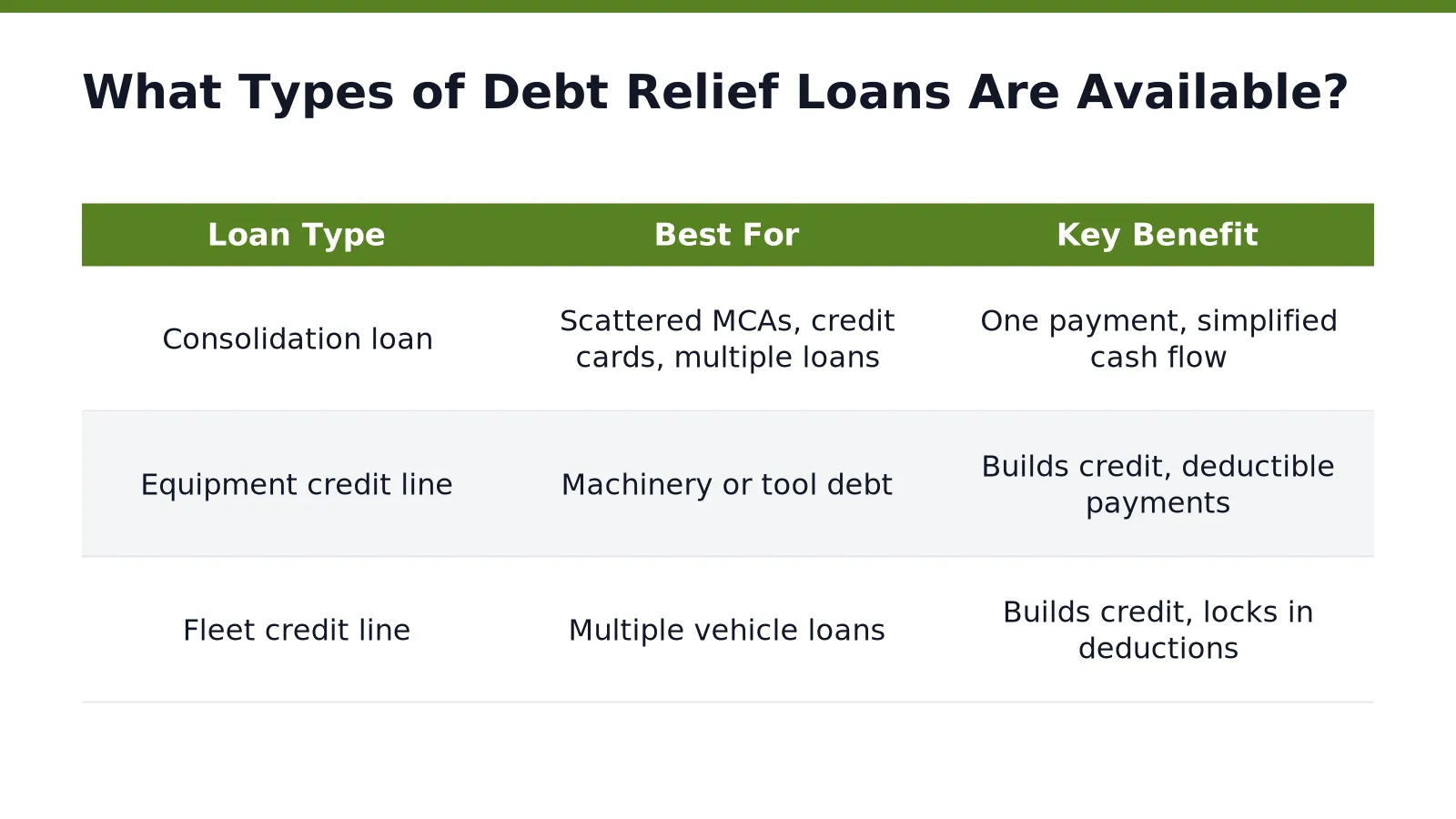
Three main structures cover most situations: consolidation loans, equipment-based credit lines, and fleet credit lines. Each addresses a different kind of debt pressure, and matching the structure to the actual problem determines whether a business saves money or simply moves it around.
A consolidation loan, sometimes called a debt administration loan, rolls multiple loans or cash advances into one manageable payment. Instead of tracking five due dates and five interest rates, an owner makes a single payment on a single schedule. This structure works well for businesses juggling scattered merchant cash advances alongside credit card balances.
No single loan fits every business, though. Loan consolidation business strategies have to account for the specific mix of debts a company carries, along with its cash flow timing and growth goals. A retail business with seasonal revenue needs different terms than a contractor with steady monthly billing.
Can Equipment Financing Replace High-Interest Debt?
Yes, equipment-based credit lines often replace costlier revolving debt tied to machinery or tools. A business gets the equipment it needs immediately, builds payment history on its credit profile, and deducts the payments as a business expense. That combination turns a liability into a credibility-building asset.
What About Businesses Carrying Vehicle Debt?
Fleet credit lines solve a narrower but common problem: multiple vehicles financed separately at different rates. Consolidating that debt into one fleet credit line lets a company finance several vehicles under one structure, build business credit in the process, and lock in tax deductions tied to those payments.
Comparing these options side by side:
Debt relief loans work best when the structure matches the debt, not the other way around.
Which Lenders Offer Business Debt Consolidation Loans?
No single bank holds a monopoly on business debt consolidation. Strong consolidation lenders tend to extend loans with repayment terms stretching five years or longer. Contact VIP Business Credit for specific pricing. That size and timeline matter because a shorter payoff window usually signals a program built to replace revolving, high-interest balances rather than add another short-term obligation.
For a small business owner juggling credit card balances and a merchant cash advance, the real question isn't which single lender to approach. It's which lender fits the company's revenue pattern, time in business, and credit profile. VIP Business Credit connects clients to more than 1,000 national and local lenders instead of pushing one institution's product on every applicant.
How does VIP Business Credit match businesses to the right lender?
Each financing strategy VIP Business Credit arranges gets matched to a business's specific stage, sector, and risk profile. A seasonal retailer with strong cash flow during peak months needs different terms than a service company with steady, year-round revenue. That matching process is why working through a broad network beats cold-calling banks one at a time.
Why does pricing transparency matter when comparing consolidation lenders?
Hidden fees can erase the savings a lower interest rate promises. VIP Business Credit emphasizes transparent, no-surprise pricing, and the firm positions itself as a long-term partner rather than a transactional broker. That distinction matters for owners comparing debt relief loans against a straightforward loan consolidation business offer. The lowest advertised rate isn't always the lowest total cost.
Business owners should expect lender options to include:
- Traditional banks offering longer terms for established companies
- Alternative finance providers serving businesses with shorter track records
- Specialized programs matched to industry or risk profile
How Do You Qualify for Consolidation Loans?
Qualification depends on the mix of debts a company already carries and how clearly that picture comes across to a lender. Most applicants arrive with more than one obligation on the books, which makes the review process layered rather than simple.
What debts do lenders look at during qualification?
Business owners pursuing business debt consolidation often hold a business loan, a business line of credit, or both at the same time. Lenders typically ask for statements on each of these before structuring a new offer. Charges run up on business credit cards add another layer that underwriters weigh carefully, since revolving balances carry different risk signals than term loans. A company juggling all three, loan, line of credit, and card balances, presents a more complex file, and lenders want a full accounting before extending debt relief loans.
Why does knowing the company's credit standing matter before applying?
Underwriters form a view of a business long before a loan officer reads the application. VIP Business Credit's proprietary scoring tool gives owners that same view in advance, showing how a lender is likely to size up the company's file. Seeing the score first lets an owner correct weak spots before submitting paperwork, rather than discovering them through a denial letter.
Preparation improves outcomes in a loan consolidation business strategy, and it starts with an honest inventory:
- List every active loan, credit line, and card balance.
- Review how underwriters are likely to read that combination.
- Identify which programs are a fit right now.
- Note which ones need more groundwork first.
A pre-qualification workflow organizes this process. It separates programs an owner qualifies for today from ones that require additional steps. It points to specific actions that widen those options over time. That clarity turns qualification from a guessing game into a plan.
What Risks Come With Debt Consolidation Loans?
Two math problems determine whether business debt consolidation actually helps a company, and getting either one wrong turns relief into a trap. A consolidation loan only pays off when its repayment period runs shorter than what the existing debts would otherwise demand. Skip that comparison, and a business owner risks trading several manageable problems for one larger, longer one.
The second calculation matters just as much. Total interest paid over the new loan's term should land below what the business would have paid under its current cards, lines, or merchant cash advances. A lower monthly payment can look appealing on paper, but stretching that payment across more years often means paying more in interest overall.
Does a Lower Monthly Payment Always Mean a Better Deal?
No. A smaller payment that extends across a longer term can quietly cost more in total interest than the original debts combined. Business owners should compare full repayment timelines and total interest, not just the monthly figure, before signing.
How Does Consolidation Affect Business Credit Standing?
Consolidation works best when it strengthens the company's credit profile, not just its cash flow. Building credit under the business's own EIN, rather than the owner's personal Social Security number, helps separate personal and business liability during this process. That separation protects personal assets if the business later faces repayment strain.
Before signing a new agreement, owners should weigh:
- Whether the repayment term is genuinely shorter than existing debt timelines
- Whether total interest costs drop, not just the monthly payment
- Whether the loan reports to business credit bureaus under the company's EIN
Debt relief loans and loan consolidation business strategies only deliver value when both the term and the interest math favor the borrower. Anything short of that trades one debt problem for a slower-moving version of the same one.
How Can VIP Business Credit Help You?
VIP Business Credit guides business owners through every stage of business debt consolidation, from the first credit review to final loan placement. The firm is based in Sterling, Virginia, serving business owners across the Greater Washington, D.C. region, with services also reaching clients digitally across the country. A business owner in another state receives the same guided process as one across town from the Sterling office.
How does the scan work?
A quick scan matches a business to pre-qualified funding options in just a few minutes. The process carries zero impact on personal credit, which matters for owners already managing tight cash flow. Results arrive fast, showing qualifying loans, lines of credit, and vendor terms side by side. Owners walk away with a clear snapshot of where their business stands before committing to any loan consolidation business strategy.
Who guides the consolidation process?
Local Business Credit Advisors handle the advisory side of the relationship. Each advisor offers personalized, concierge-level guidance rather than a one-time transaction. This structure supports a long-term partnership, not a quick referral and goodbye. Owners juggling multiple credit cards or merchant cash advances benefit from having one point of contact who understands their full debt picture over time.
The firm's approach blends three core elements:
- Broad lender access across traditional banks and alternative finance providers
- Purpose-built software that reveals credit gaps and funding matches
- Guided execution from advisors who stay involved through closing
Together, these elements help owners separate personal liability from business debt. That separation protects personal assets while the business works toward debt relief loans that fit its actual repayment capacity. Growth that follows consolidation tends to be steadier when it rests on this kind of foundation. Owners seeking solid footing after years of costly short-term borrowing find structure, not shortcuts, in this process.
Contact
- 📞 Phone: +1 (571) 248-3863
- ✉️ Email: [email protected]
- 📅 Consultation: Schedule Personalized Support
- 🌐 Website: vipbizfunds.com
- 🎯 FREE Business Funding Pre-Qualification Scan: Start Your Scan
FAQ
What is business debt consolidation?
Business debt consolidation combines multiple debts, credit cards, merchant cash advances, lines of credit, into one new loan with a single monthly payment, ideally featuring a shorter term and lower total interest than the original obligations.
How does VIP Business Credit assist with consolidation?
VIP Business Credit connects entrepreneurs to its network of over 1,000 national and local lenders, matching consolidation terms to the business's EIN-based credit profile and repayment capacity.
When should a business consider debt consolidation?
Consolidation makes sense when multiple high-interest loans or credit lines squeeze cash flow, compromising funds available for payroll, inventory, and growth. When owners lose track of several due dates, rates, and balances at once, it's a strong signal that one simplified payment would serve the business better.
Conclusion
In closing, business debt consolidation loans represent a strategic opportunity to simplify your financial obligations, reduce interest costs, and free up cash flow for growth. By consolidating multiple debts into a single, manageable payment, you strengthen your balance sheet and demonstrate financial discipline to lenders, a critical step in building a stronger business credit profile. The right consolidation strategy, paired with intentional credit management, positions your business for sustainable expansion and long-term financial stability.
About The Author
Lee Johnson is the Co-Founder and CEO of VIP Business Credit, bringing over 25 years of professional experience in business funding, real estate, and credit-building strategy. He holds a Bachelor of Science from Fairleigh Dickinson University and a Master of Business Administration from the University of Phoenix, and he is a Certified Professional Coach with more than 500 coaching hours. That combination of formal education and hands-on experience shapes the guidance VIP Business Credit offers business owners working through consolidation, credit building, and financing decisions.


