Virginia Business Loan Application: How to Apply for a Virginia Small Business Loan
Virginia Business Loan Application: How to Apply for a Virginia Small Business Loan
By *VIP Business Credit* Editorial Team Updated 2026-09-03
Applying for a small business loan in Virginia involves a comprehensive, carefully structured multi-step process designed to thoroughly assess your business's financial health, creditworthiness, and overall suitability for borrowing. This detailed guide offers an expert, step-by-step roadmap to effectively navigate the Virginia business loan application process—covering everything from essential documentation preparation to verification of business good standing with the Virginia State Corporation Commission (SCC), understanding and meeting precise business loan requirements VA, mastering the commercial loan application process Virginia, and making the most of SBA funding programs with a focused SBA loan application checklist VA. Northern Virginia entrepreneurs and business owners will find exclusive, targeted insights and valuable resources, including comprehensive details on state agencies such as the Virginia Department of Small Business and Supplier Diversity (SBSD) that support financing goals for a broad range of industries and business sizes. For entrepreneurs interested in establishing or improving their business credit and evaluating lending opportunities, resources on fundability assessments and local lending options like Loudoun County small business loans are integral to a successful application.
Key Takeaways

- VIP Business Credit connects Virginia entrepreneurs to over 1,000 vetted national and local lenders for diverse business financing options, ensuring access to capital tailored to local market conditions, including the Northern Virginia region.
- Thorough, comprehensive preparation of financial and legal documents—including tax returns, Profit & Loss (P&L) statements, balance sheets, detailed bank statements, and debt schedules—is crucial to satisfy strict business loan requirements VA and meet lender expectations.
- Confirming your business's good standing with the Virginia State Corporation Commission (SCC) is a vital prerequisite. Leveraging resources available through the Virginia Department of Small Business and Supplier Diversity (SBSD) enhances your eligibility and competitiveness.
- Understanding, monitoring, and improving critical business credit scores such as the Paydex Score (Dun & Bradstreet) and the FICO Small Business Scoring Service (SBSS) significantly strengthen your application and lender confidence.
- Evaluating lender underwriting criteria—including Debt Service Coverage Ratio (DSCR), collateral requirements, cash flow analysis, and business age—is essential to align your application with lender preferences and maximize approval chances.
- VIP Business Credits local presence in Sterling, VA, offers expert, personalized guidance throughout the nuanced commercial loan application process Virginia, especially valuable for Northern Virginia enterprises navigating region-specific requirements.
Comprehensive Step-by-Step Guide on How to Apply for a Small Business Loan in Virginia

Successfully completing the **Virginia business loan application** requires understanding the full breadth of statewide and regional factors, meeting all business loan requirements VA, preparing exhaustive documentation, and choosing lending partners strategically. Below is a detailed guide aligned with regional funding standards, including SBA loan application checklist VA essentials and a full timeline for your Virginia small business loan pursuit.
Step 1: Assess Your Business Financing Needs and Clearly Define the Loan Purpose
- Precisely determine capital requirements. Critically analyze your current business plan, operational budget, and financial forecasts. Calculate the exact funding amount necessary to meet your objectives without overextending your financial position, reducing unnecessary interest costs and improving loan terms.
- Clearly articulate the specific loan purpose. Typical funding needs include working capital boosts, equipment acquisition, inventory buildup, property investments, or debt restructuring. Knowing your purpose helps select the right loan programs and lenders.
- Establish a realistic funding timeline. Prioritize lenders who can accommodate your temporal needs, considering the intricacies of the commercial loan application process Virginia.
Step 2: Pre-Application Stage 1 Establish Virginia SCC Good Standing and Prepare Organizational Essentials
Before submitting applications, confirm your business is officially in good standing with the Virginia State Corporation Commission (SCC). This verification ensures compliance with state laws, official registration, and eligibility to engage in legal business activities. Obtaining and including this certificate is often mandatory for lenders in Virginia.
Additional pre-application essentials include:
- Organizational Documents: Articles of incorporation, operating agreements, partnership agreements, or any legal formation documents.
- EIN Confirmation: Validation of your Employer Identification Number issued by the IRS.
- Commercial Bank Account Statements: Recent 3 to 6 months of statements demonstrating business cash flow and transactional consistency.
These elements collectively establish your business's legitimacy and financial operational foundation required by lenders.
Step 3: Meticulously Prepare a Comprehensive Financial Documentation Package
Lenders require rigorously detailed financial documentation to thoroughly evaluate your business's creditworthiness and operational viability. Align your documentation with the stringent business loan requirements VA and expectations set forth by lenders active in the Virginia market:
- Business Tax Returns (Federal and State, last 3 years): These reflect business income, taxes paid, and form a baseline for financial verification.
- Personal Tax Returns (last 3 years): Often required for business owners, especially for smaller or newer businesses.
- Profit & Loss (P&L) Statements Year-to-Date (YTD): Provide detailed monthly or quarterly summaries of revenues, costs, and net income, demonstrating profitability trends.
- Balance Sheets: Present your current financial position showing assets, liabilities, and equity—critical for lender risk evaluation.
- Debt Schedules: Itemize all outstanding debts, terms, and current balances, essential for calculating your Debt Service Coverage Ratio (DSCR).
- Accounts Receivable and Payable Aging Reports: Detail outstanding invoices and liabilities to reflect cash flow timing and operational health.
Ensure absolute accuracy and consistency across all documents, as discrepancies can delay or derail your loan application.
Step 4: Obtain, Review, and Optimize Business Credit Scores Including Paydex and FICO SBSS
Lenders rely heavily on certain credit scores to gauge the risk of lending to your business. Proactively obtain and analyze your credit profile using these key scoring systems:
- Paydex Score (Dun & Bradstreet): Scores above 80 indicate excellent payment performance, reflecting prompt payment to vendors and suppliers.
- Intelliscore Plus (Experian Business): Predicts likelihood of severe delinquency, helping lenders assess risk level.
- FICO Small Business Scoring Service (SBSS): A preferred scoring model utilized by SBA and many commercial lenders assessing overall credit risk and likelihood of default.
Review reports regularly to identify and correct errors or disputes. Strengthening these scores prior to applying greatly enhances lender confidence and improves loan terms.
Step 5: Understand and Evaluate Lender Underwriting Criteria Critical to Virginia Businesses
Lenders apply detailed underwriting standards combining universal and Virginia-specific factors. Key criteria to understand and meet include:
- Debt Service Coverage Ratio (DSCR): Typically lenders require a minimum DSCR of 1.25, meaning your net operating income should cover debt obligations by at least 125%, indicating solid repayment ability.
- Collateral Requirements: Real estate, equipment, inventory, and accounts receivable often serve as security; understanding lender policies on collateral is crucial.
- Cash Flow and Profitability Analysis: Historical and projected operating cash flows are scrutinized closely to ensure sustainable debt servicing.
- Business Age and Revenue Stability: Lenders generally prefer businesses older than two years with steady or increasing revenue streams, consistent with business loan requirements VA and typical NOVA [business funding](https://getcash.vipbizfunds.com/) requirements.
Use VIP Business Credits extensive lender-matching technology to find those with underwriting criteria best aligned to your business profile and regional economic conditions.
Step 6: Complete Pre-Qualification and Consult a Dedicated Business Credit Advisor
Participate in a thorough pre-qualification process to determine eligibility for various loan products based on your documentation and credit profile. This strategic filtering accelerates application success by targeting lenders suited to your financial situation. VIP Business Credits Sterling, VA advisors provide expert insights tailored to the commercial loan application process Virginia and local lender preferences.
Step 7: Assemble and Carefully Review Your Loan Application Package
A well-organized application package substantially improves approval prospects. Essential elements include:
- Accurately completed and signed loan application forms following lender instructions.
- All financial documentation as detailed in Step 3.
- Official Virginia SCC Certificate of Good Standing.
- Clear loan purpose statement aligned with your financial and business strategy.
- Comprehensive business credit reports with explanations for any negative or disputed items.
Have your package reviewed by experienced advisors to correct potential errors or omissions before submission.
Step 8: Submit Your Virginia Business Loan Application Efficiently and Responsively
Submit the complete application package using the lenders preferred method, whether online portal, email, or physical delivery. Maintain detailed records of submissions and communications. Promptly respond to follow-up lender requests for additional information or clarifications to avoid delays.
Step 9: Monitor Application Underwriting Progress and Evaluate Loan Offers
- Track underwriting status via lender portals or direct communication.
- Respond swiftly to additional document requests.
- Critically compare loan offers, focusing on interest rates, repayment terms, fees, prepayment options, and collateral requirements before deciding.
Step 10: Close the Loan and Manage Compliance and Post-Funding Responsibilities
After approval and signing, maintain punctual payments and transparent communication with your lender. VIP Business Credit remains available to assist with credit building, refinancing, and future capital acquisition to support your business growth.
Virginia Loan Application Document Checklist

Preparing the following documents is essential to meet lender requirements and streamline application processing:
- Virginia State Corporation Commission (SCC) Certificate of Good Standing
- Articles of Incorporation/Organization, Operating Agreements, Partnership Agreements
- Employer Identification Number (EIN) Confirmation
- Commercial bank statements (3-6 months)
- Business Tax Returns (Federal and State, last 3 years)
- Personal Tax Returns (last 3 years)
- Year-to-Date Profit & Loss (P&L) Statements
- Current Balance Sheet
- Debt Schedule
- Accounts Receivable Aging Report
- Accounts Payable Aging Report
- Business Credit Reports including Paydex Score and FICO SBSS score
- Clear Loan Purpose Statement
Virginia Small Business Loan Application Timeline

- Pre-Application Preparation (113 weeks): Verify SCC status, gather organizational documents, obtain credit reports, prepare financial statements.
- Loan Pre-Qualification (1 week): Submit preliminary financial information for lender pre-screening via VIP Business Credit.
- Application Submission (12 weeks): Assemble documentation package and submit to chosen lenders.
- Underwriting Review (24 weeks): Lenders analyze application, verify documents, perform credit checks, and assess financials relative to underwriting criteria including DSCR.
- Term Sheet and Negotiation (1 week): Receive conditional loan offers, review terms, negotiate if necessary.
- Loan Closing and Funding (12 weeks): Sign agreements, fulfill any closing conditions, and receive funds.
Comparison of Virginia Commercial Loan Options

Step-by-Step Virginia Commercial Loan Underwriting Process
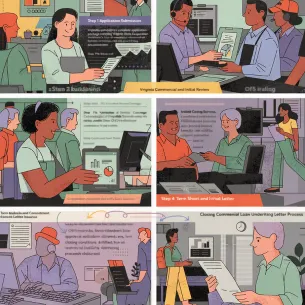
- Application Submission: Borrower submits complete application package including SCC certificate and financial documentation.
- File Setup and Initial Review: Lender opens file, verifies completeness, and assigns loan officer.
- Credit Underwriting: Detailed risk analysis including DSCR computation, credit score analysis (Paydex and FICO SBSS), collateral evaluation, and business operations review.
- Term Sheet / Commitment Letter Issuance: Lender provides conditional loan approval terms outlining interest rate, repayment schedule, fees, and collateral requirements.
- Closing & Funding: Execution of loan documents, fulfillment of closing conditions, and disbursement of loan proceeds to the borrower.
Contact & Consultation

If you are ready to take the next critical step in your Virginia business loan journey, connect with VIP Business Credit for tailored assistance designed to meet the nuanced business loan requirements VA and expertly navigate the commercial loan application process Virginia. Our team specializes in personalized guidance to help optimize your chances of loan approval and funding success.
- 📞 Phone: +1 (571) 248-3863
- ✉️ Email: [email protected]
- 📅 Schedule a Consultation: Schedule A Business Financial Health Strategy Call
- 🌐 Website: vipbizfunds.com
- 📍 Serving: Sterling, VA, and the surrounding Northern Virginia area
Why Preparation Is Paramount in the Virginia Business Loan Application Process

The difference between loan approval and denial frequently comes down to the level of detailed preparation. Accurate financial documentation, strong business credit profiles reflecting solid Paydex and SBSS scores, a clear understanding of Debt Service Coverage Ratio (DSCR) requirements, and strategic targeting of lenders aligned with business loan requirements VA all improve outcomes. VIP Business Credits deep roots and on-ground expertise across Northern Virginia empower clients to cut through complex underwriting standards inherent in the commercial loan application process Virginia, leading to faster approvals, optimized interest rates, and enhanced loan structuring options.
Frequently Asked Questions (FAQ)
What documents are essential for a Virginia business loan application?
Applicants must provide complete business tax returns (federal and state) for the past 3 years, personal tax returns for business owners (last 3 years), Profit & Loss statements YTD, detailed balance sheets, recent bank statements (covering 3-6 months), comprehensive debt schedules, accounts receivable and payable aging reports, proof of good standing from the Virginia SCC, a clear written statement of the loan purpose, and up-to-date business credit score reports including Paydex and FICO SBSS.
How critical are business credit scores like Paydex and SBSS in the Virginia business loan application?
These business credit scores are fundamental indicators used by lenders to evaluate repayment risk. High and accurate scores increase the probability of approval and enable negotiation for favorable loan terms and interest rates.
What specific evaluation criteria do lenders in Northern Virginia frequently emphasize?
Lenders prioritize the Debt Service Coverage Ratio (DSCR), assessing whether your cash flows sufficiently cover debt obligations (typically requiring DSCR > 1.25), collateral availability, consistent and growing cash flow metrics, and business longevity usually exceeding two years, aligned with business loan requirements VA.
How does the commercial loan application process Virginia differ from processes in other states?
Virginias loan process incorporates unique regulatory checks, including mandatory good standing verification with the SCC and use of state-specific resources such as the Virginia Department of Small Business and Supplier Diversity. These regional nuances and economic factors shape lender underwriting and program availability, distinguishing the commercial loan process VA from procedures elsewhere.
Conclusion

Securing a small business loan in Virginia necessitates a highly structured, detail-oriented approach emphasizing thorough documentation, strategic lender selection, and deep understanding of essential underwriting criteria such as DSCR and key credit scores like the Paydex and SBSS. This comprehensive guide covering how to apply for a small business loan in Virginia, the specific business loan requirements VA, and the complete commercial loan application process Virginia equips entrepreneurs with the knowledge and tools to confidently pursue needed capital. Utilizing dedicated local resources such as VIP Business Credit and the Virginia Department of Small Business and Supplier Diversity ensures specialized support designed for Northern Virginias dynamic business landscape, maximizing your funding success potential.
To view application support options, explore our Virginia loan advisory pricing.
About The Author
Lee JohnsonCo-Founder & CEO of VIP Business Credit | Master Certified Professional Coach
Lee Johnson brings over 25 years of experience in business funding, credit building, and generational wealth strategies. He holds a Bachelor of Science from Fairleigh Dickinson University and an MBA from the University of Phoenix. As a Master Certified Professional Coach with over 500 coaching hours, Lee specializes in empowering entrepreneurs to establish strong business credit profiles tied to their EIN, separating personal liability and unlocking long-term funding. In addition to his advisory work, Lee is a seasoned real estate investor managing a portfolio of over 1,700 units valued at approximately $254M across multiple U.S. markets.
Research & Sources
This guide's underwriting benchmarks and compliance steps are grounded in publicly available standards from the agencies and credit bureaus referenced throughout:
- U.S. Small Business Administration (SBA): The SBA 7(a) loan program sets guaranty and underwriting standards that many Virginia commercial lenders follow or benchmark against, including documentation and creditworthiness expectations referenced in the SBA loan application checklist above.
- Virginia State Corporation Commission (SCC): The SCC maintains the official business registration and good-standing records that Virginia lenders require applicants to verify before underwriting begins.
- Virginia Department of Small Business and Supplier Diversity (SBSD): SBSD provides state-level resources and programs supporting small business financing readiness across Virginia, including Northern Virginia.
- Dun & Bradstreet: The Paydex Score, produced by Dun & Bradstreet, is a widely used trade-payment-history metric that commercial lenders reference when evaluating a business's payment reliability.
- FICO: The FICO Small Business Scoring Service (SBSS) is a standardized credit risk score used by the SBA and numerous commercial lenders to evaluate small business loan applications, including those processed through SBA-guaranteed programs.
These sources reflect the general standards and benchmarks lenders apply; specific thresholds and terms can vary by lender and individual applicant profile, so applicants should confirm current requirements directly with their chosen lender or advisor.


