The Essential Business Loan Checklist
The Essential Business Loan Checklist
Essential business loan applications require organized documentation: business name, address, Tax ID or EIN, formation date, and entity type, plus employee counts and a detailed use-of-proceeds breakdown. VIP Business Credit's business credit scan identifies credit gaps in minutes, matching owners to pre-qualified loans and lines of credit before lenders ever review a formal application.
Key Takeaways
- Organize business fundamentals: name, address, Tax ID, establishment date, and employee count documentation.
- Compile financial statements, bank statements, and tax returns covering the last two years minimum.
- Prepare a detailed fund-use description explaining exactly how loan proceeds support your business goals.
- Build EIN-based business credit before applying to strengthen your profile with over 1,000 lenders.
Why Does a Loan Checklist Matter Before Applying?
A loan checklist matters because it shows business owners what to gather before applying, not simply what a lender's form requests on page one. Lenders review far more than a signature line. They want proof that a business can repay, and that proof lives in documents that take time to organize. Without preparation, approval odds and loan amounts both suffer.
Missing, inconsistent, or outdated paperwork stands out as the most common reason applications stall after submission, according to the Small Business Loan Application Checklist. A single outdated bank statement or a mismatched business address can stop underwriting cold. That delay often costs weeks, and in a competitive market, weeks matter.
What Happens When Application Prep Is Skipped?
Skipping application prep forces owners to scramble mid-process, often while a lender's offer sits on the table waiting for documents. Lenders may lower the requested amount or deny the file outright rather than chase paperwork. Thorough preparation, by contrast, signals a business that runs its finances with discipline.
How Does Checklist Prep Build Funding Readiness?
A checklist builds funding readiness by turning a vague task into a concrete sequence of steps. VIP Business Credit connects applicants to over 1,000 national and local lenders, which widens the pool of realistic options before paperwork ever starts. That access matters less without organized records behind it.
VIP Business Credit pairs that lender network with purpose-built software and guided support from advisors. The combination helps owners move through a complex funding marketplace with more clarity, more speed, and fewer costly surprises along the way.

What Business Information Do Lenders Need First?
Lenders start with basic identity details: the business's legal name, its physical and mailing address, a working phone number, and the primary contact person. These items sound simple, but missing or mismatched entries stall an application before underwriting even begins. Business owners who treat this stage casually often lose weeks waiting on document requests that proper application prep would have prevented.
Identity consistency matters more than most owners realize. A verified office address, listed the same way across every document, is exactly the kind of basic detail lenders and credit bureaus check first. When a business address varies between a loan form, a bank statement, and a state filing, underwriters flag it as a red flag rather than a clerical slip.
Why does address consistency affect loan approval?
Address mismatches signal instability to underwriters, even when the business itself is sound. Lenders use these details to confirm the company is real, reachable, and properly registered. A single inconsistency can trigger manual review, adding days or weeks to a decision that otherwise moves quickly.
VIP Business Credit guides entrepreneurs across Northern Virginia. The Greater Washington, DC region through this exact step, helping them build credit tied to the business itself rather than the owner's personal Social Security number. Operating out of Sterling, Virginia, the firm brings direct, on-the-ground familiarity with how regional lenders evaluate these early details.
A strong loan checklist should confirm the following before an application goes anywhere near a lender:
- Legal business name matches state registration exactly
- Physical and mailing addresses are current and identical across all records
- Phone number and primary contact are active and monitored
- Business identity details match bank and bureau records
Getting these fundamentals locked down early builds genuine funding readiness, turning a shaky first impression into a credible one. Lenders reward clarity. Owners who provide it upfront move through underwriting faster and with fewer surprises.

Which Financial Statements Belong in Your Prep?
Three documents matter most: profit and loss statements, balance sheets, and cash flow projections. Lenders use these to measure financial health before approving any request. Missing or outdated versions slow down underwriting and raise red flags about a business's stability.
Profit and loss statements show revenue trends over time. Balance sheets reveal what a business owns versus what it owes. Cash flow projections demonstrate whether a business can cover loan payments going forward. Together, these three pieces form the financial core of any loan checklist, sitting alongside business details, bank statements, tax returns, and ownership records that lenders review as a complete package.
What if cash flow looks inconsistent?
Inconsistent cash flow does not automatically disqualify an application, but it does require explanation. Strong application prep means addressing gaps before a lender spots them, not after. Structured cash flow strategies help keep working capital available when it's actually needed, rather than scrambling to find it once a shortfall hits.
How do financial statements affect approval odds?
Clean, current statements signal a business is organized and low-risk. Lenders read financial statements as a direct measure of funding readiness, since disorganized books suggest disorganized operations. A pre-qualification review can help owners see which programs they already qualify for based on their current financials. Which ones require stronger numbers first.
That distinction matters. An owner who knows the gap between "qualified now" and "qualified later" can fix weak spots before submitting anything. Waiting until a lender flags the problem costs time, and sometimes costs the deal entirely.
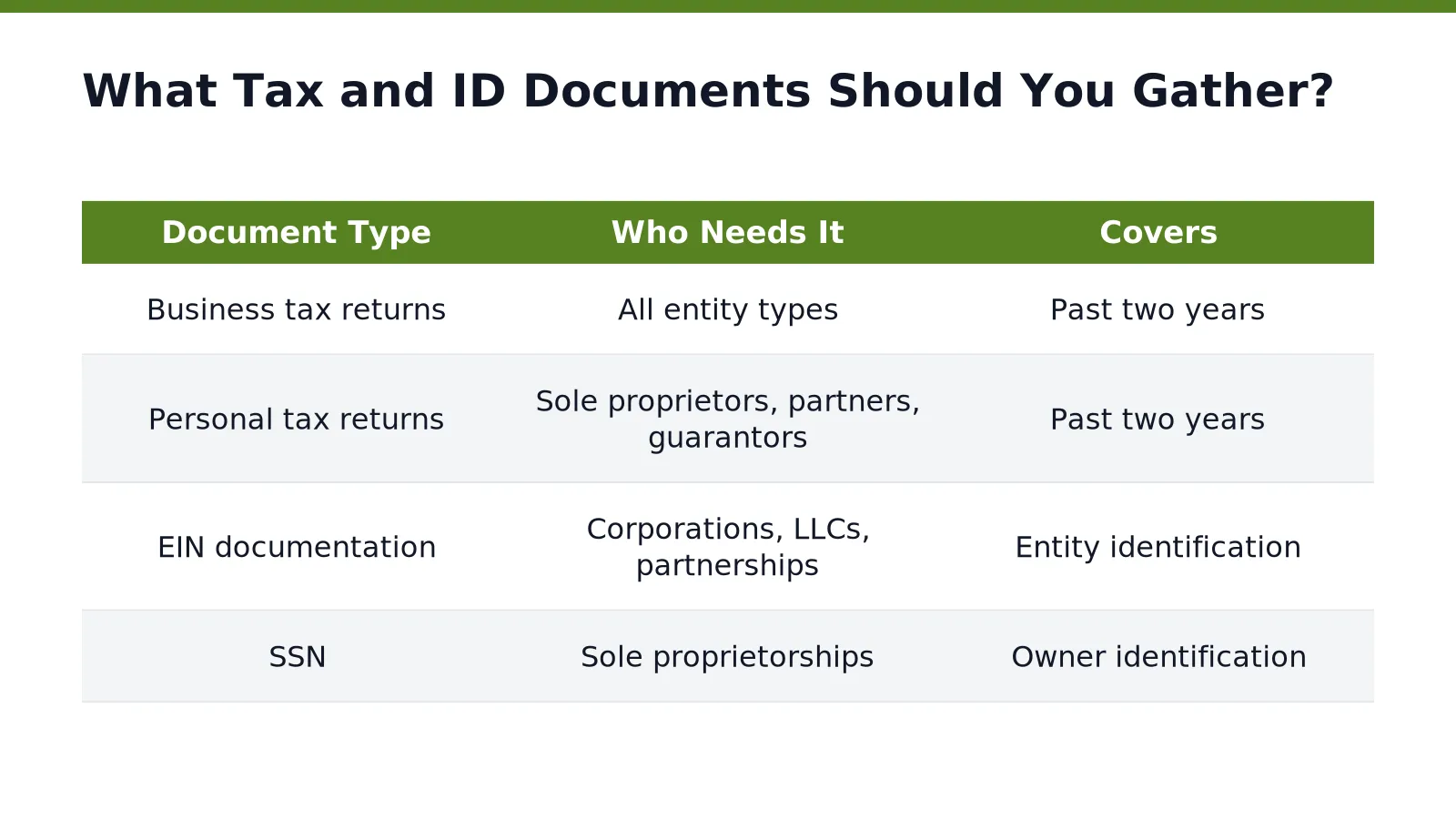
What Tax and ID Documents Should You Gather?
Tax and identification records confirm who owns a business and how it earns money. Lenders use these documents to verify income claims made elsewhere in a loan application. Missing even one piece in this part of the loan checklist often stalls a file before an underwriter ever reviews the numbers.
Most lenders request two years of tax filings, covering both the business and the owner personally. This dual requirement exists because many small businesses report income that flows directly to the owner's personal return, especially sole proprietorships and partnerships. Reviewing both filings together lets a lender see the full financial picture rather than a partial one.
What ID Numbers Do Lenders Ask For?
Every application requires a Tax ID Number, also called an Employer Identification Number (EIN), or a Social Security Number for businesses operating as sole proprietorships. This number identifies the business as a distinct entity in lending and credit systems. Building credit under an EIN, rather than relying solely on a personal Social Security Number, helps separate personal and business liability, a strategy central to sound funding readiness.
A simple reference table helps organize this stage of application prep:
Why Does Credit Structure Matter Here?
Lenders weigh not just whether tax and ID documents exist, but how they reflect the business's credit standing. VIP Business Credit guides clients toward higher loan amounts. Stronger credit lines by first building a solid business credit profile under the EIN before pursuing larger financing requests.
How Do You Prove Real Funding Readiness?
Proof of funding readiness comes from matching documentation to what a lender actually checks before approval. A business credit scan can match a company to pre-qualified funding options within minutes, carrying zero impact on personal credit scores. That combination of speed and safety gives owners a real-time view of where their business stands before a formal application ever goes out.
Lenders do not request the same documents from every applicant. Credit score, cash flow consistency, time in business, and existing debt load all shape what a lender asks for and how closely they evaluate it. A newer company with thin credit history faces more scrutiny than an established one with years of clean cash flow. Understanding this variability is a critical part of smart application prep.
What Tools Help Measure Funding Readiness?
A dedicated platform built around a Capital-Ready Score and related tools shows business owners how underwriters actually view their company. These tools flag eligibility gaps before a lender does, which prevents wasted applications and unnecessary credit inquiries.
Why Does a Step-by-Step Process Matter?
A structured, sequential process gives owners a clear path to strengthen their credit standing over time. Rather than guessing at what to fix, owners follow defined steps that build toward qualifying for better terms, higher limits, and lower rates.
The difference between a strong and weak application often comes down to preparation, not luck. Owners who treat a loan checklist as a diagnostic tool, not just a paperwork formality, catch weaknesses early. They see where cash flow needs shoring up, where time-in-business gaps exist, and where debt load might concern an underwriter. That clarity turns a reactive scramble into a deliberate, confident submission.
What Debt and Ownership Details Do Lenders Check?
Lenders examine a business's full debt picture before approving new financing. That means current obligations, past loans, and anything pending, including SBA loans and other government-backed debt. Skipping this step is a common reason applications stall after submission.
A thorough loan checklist treats debt disclosure as non-negotiable. Underwriters cross-check what an applicant reports against what bureau data and bank statements show. Gaps between the two raise red flags fast.
Why does use of proceeds matter to lenders?
Lenders want a clear, itemized answer to one question: where is the money going? Applicants should break down every applicable line item, whether that's equipment, inventory, working capital, or expansion costs. Show the total requested. A vague or incomplete answer signals weak application prep and slows the review.
This is also where funding readiness gets tested in practice. A business that can explain its debt load. Its spending plan in specific terms looks lower-risk to an underwriter than one offering broad generalities.
How does bureau monitoring support debt and ownership documentation?
Bureau-monitoring tools track the accounts and data lenders rely on when scoring a business. This gives owners a preview of what underwriters will see before they see it. Debt entries and ownership records can be corrected ahead of submission rather than discovered mid-review.
Working with a wide lender network adds another layer of protection. VIP Business Credit connects clients to over 1,000 national and local lenders. Debt and ownership documentation can be matched to the specific program built for that profile instead of forced into a one-size-fits-all application. Common documentation points include:
- Current, prior, and pending business debt, including government-backed loans
- Full use-of-proceeds breakdown with itemized amounts and a grand total
- Ownership structure and percentage breakdowns across all owners
- Existing liens or outstanding obligations tied to business assets
Each of these pieces tells a lender something different, and missing even one can delay a decision.
Which Lenders Fit Your Business Stage and Risk?
Lender fit depends on two factors: how long a business has operated and how much risk it carries on paper. A newer company with thin credit history needs a different door than an established firm with five years of clean revenue. VIP Business Credit connects clients to a broad network spanning traditional banks, alternative finance providers, and specialized lending programs, matching each business to options suited to its stage rather than forcing a one-size-fits-all application.
Documentation requirements shift depending on which lender category a business approaches. Traditional banks and SBA lenders typically ask for more paperwork upfront, from tax returns to detailed financial statements. Online and alternative lenders often start with a lighter file. Knowing this difference early saves wasted hours during application prep.
Should a newer business apply at a bank first?
Probably not. Banks and SBA programs favor businesses with longer track records and heavier documentation on hand. A newer business often finds faster traction with alternative lenders, then builds toward bank-level credit over time.
How does loan strategy change as a business grows?
Strategy shifts as risk profile improves. Once a strong credit profile has been secured, VIP Business Credit works to secure the highest loan amounts at the best available terms the business now qualifies for. Early-stage borrowing focuses on access; later-stage borrowing focuses on price and limit.
None of this needs to be navigated alone. Local Business Credit Advisors from VIP Business Credit provide concierge-level guidance, helping owners read their own risk signals accurately before submitting a single document. That guidance often separates a declined file from an approved one, strengthening overall funding readiness at every stage.
What Happens After You Submit the Application?
Submission starts a lender review stage, not a final answer. Underwriters verify business records, pull credit files, and confirm the numbers reported on the application match supporting documents. Getting a small business loan can look overwhelming at this point. The process stays manageable when the paperwork was organized correctly before anyone hit "submit."
A completed loan checklist pays off here. Lenders cross-check bank statements, tax filings, and ownership details against the application itself. Gaps or mismatches trigger follow-up requests, which slow approval and sometimes raise doubts about funding readiness.
How long does loan review usually take?
Timelines vary by lender type and loan size, so no single number applies across the board. Traditional banks and SBA programs tend to review more slowly because they request deeper documentation. Online and alternative lenders often move faster since their initial requirements are lighter.
What if the lender requests more documents?
Follow-up requests are routine, not a red flag. Applicants who kept thorough application prep materials on hand, such as updated financial statements and ownership records, respond quickly and keep the file moving.
Strengthening a business profile before submission reduces these back-and-forth delays. VIP Business Credit helps business owners build consistent identity data and trade credit reporting habits. Lenders view the company as lower risk from the first review.
The firm's approach includes:
- Transparent, no-surprise pricing instead of hidden broker fees
- Long-term advisory support rather than a one-time transaction
- Business loans and lines of credit matched to the applicant's profile
- Education and coaching on underwriting criteria through its credit-building program
Business owners who understand what happens after submission approach the waiting period with more confidence and fewer unanswered questions.
FAQ
What documents belong on a business loan checklist?
A complete checklist includes business name, address, Tax ID or EIN, formation date, entity type, employee counts, a detailed use-of-proceeds breakdown, financial statements, bank statements, and tax returns covering at least two years.
Why does address consistency affect loan approval?
Underwriters check an address across every document, and variations between a loan form, bank statement, and state filing signal a red flag rather than a clerical slip, stalling the application before underwriting begins.
How does VIP Business Credit help with loan application prep?
VIP Business Credit's business credit scan identifies credit gaps in minutes and matches owners to pre-qualified loans. Lines of credit across its network of over 1,000 national and local lenders before formal review.
Conclusion
In closing, a thorough application checklist transforms the loan process from overwhelming to manageable. By organizing your financial records, verifying your business identity data, and understanding what lenders evaluate, you position your company as a credible borrower. This preparation work, done before you apply, accelerates approval timelines and strengthens your negotiating position. The effort you invest now in building a complete, accurate application profile pays dividends not just in securing capital. In establishing the business credit foundation that fuels long-term growth and financial independence.


