The Complete Credit Building Checklist
The Complete Credit Building Checklist
Business credit building follows a clear sequence: register the business entity, obtain an EIN, open a dedicated business bank account, secure a D-U-N-S Number, establish trade lines with vendors that report payment history, apply for a business credit card, and monitor your credit score through tools like VIP Business Credit's pre-qualification scan to track progress and close eligibility gaps.
Key Takeaways
- Establish your EIN first, then register your business to create a foundation for credit building.
- Open a business bank account and maintain separate finances from personal accounts immediately.
- VIP Business Credit connects you to over 1,000 national and local lenders for financing opportunities.
What Do You Need Before Building Business Credit?
Four foundational pieces come first: a formal business structure, separate identifying numbers for the company, a clear timeline expectation, and access to lenders suited to the business's stage. Skipping any of these leaves gaps that lenders notice immediately. A business credit profile built on a shaky foundation rarely survives underwriting scrutiny.
Patience matters more than most founders expect. Building business credit is a gradual process, not a one-time task completed in an afternoon. It takes consistent effort over months, not a single application or signup. Entrepreneurs who treat it as a quick fix often abandon the work before results appear.
How long does it take to build business credit?
Timelines vary by industry and starting point, but credit profiles develop in stages, not overnight. Businesses that stay consistent with reporting and payment history tend to see steadier progress. Expecting instant results sets founders up for frustration rather than a workable credit building checklist.
Who can help a business get started?
Local guidance makes a measurable difference for founders navigating lender requirements for the first time. VIP Business Credit works with entrepreneurs across Northern Virginia and the Greater Washington, DC region to establish credit tied to the company's EIN rather than the owner's Social Security number. That separation protects personal assets while the business builds its own track record.
Before diving into the specific business credit steps, founders should confirm three things:
- A registered legal entity with consistent business identity details across every listing
- Clear goals for financing, whether that means a working capital line or equipment funding
- Access to a lender network broad enough to match the business's sector and risk profile
A strong foundation sets up real score improvement later, the kind that opens doors to better financing, steadier cash flow, and lasting growth.
How Do You Build Your Business Foundation First?
A proper business foundation starts with registering the company correctly and locking in identity details that match across every record. Nav's 2026 guide on establishing business credit lists this foundation step first, ahead of registering for an EIN or opening tradelines. Skipping this groundwork creates mismatched records that confuse lenders later and stalls every later step in the process.
Lenders and vendors pull data from multiple sources before extending credit, and inconsistent information raises red flags immediately. A business name spelled one way on a loan application and another way on a state filing looks sloppy, even when the business itself is sound. This is why the first entry in any serious credit building checklist focuses on consistency: the same legal name, the same address, the same phone number, everywhere the business appears.
A verifiable address matters more than most founders realize. A registered office location, rather than a residential address or a shared mailbox, signals legitimacy to underwriters reviewing a file. This single detail often separates a business that reads as established from one that reads as a side project.
Why Does a Business Need Its Own Credit Identity?
Separating personal and business liability requires credit tied to the company's EIN (Employer Identification Number) rather than the owner's Social Security number. Building files under the EIN keeps personal assets out of the underwriting conversation entirely. This separation forms the backbone of long-term score improvement. Every tradeline opened afterward strengthens the business profile instead of the owner's personal report.
Founders who want their foundation set correctly from day one should confirm the following before moving to later business credit steps:
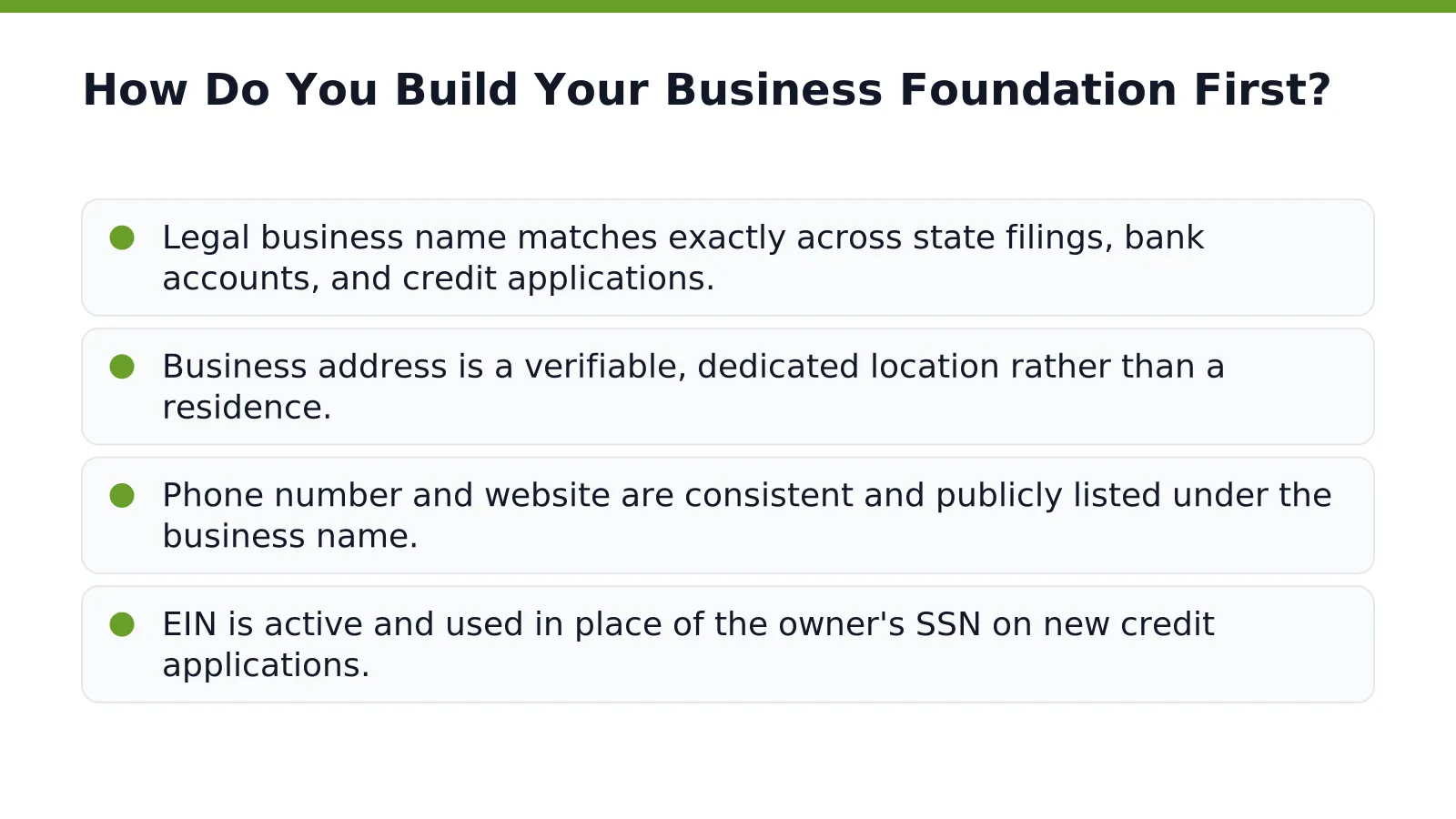
- Legal business name matches exactly across state filings, bank accounts, and credit applications.
- Business address is a verifiable, dedicated location rather than a residence.
- Phone number and website are consistent and publicly listed under the business name.
- EIN is active and used in place of the owner's SSN on new credit applications.

Why Do You Need an EIN and D-U-N-S Number?

An Employer Identification Number and a D-U-N-S Number give a business its own identity in the eyes of lenders, separate from the owner's Social Security number. Establishing this foundation is the second step in Nav's seven-step framework for building business credit, following the formation of the company itself. Without these two identifiers, a business cannot build a credit file that stands apart from the founder's personal history.
What does an EIN actually do for a business?
The EIN works like a Social Security number for the company. It allows banks, lenders, and vendors to track payment history under the business name instead of the owner's name. This separation protects personal assets while giving the company room to build its own track record.
Why does a D-U-N-S Number matter alongside the EIN?
A D-U-N-S Number creates a file that major commercial credit bureaus use to score and track a company's payment behavior. Lenders pull this file when deciding how much credit to extend and on what terms. Together, the EIN and D-U-N-S Number form the backbone of any serious credit building checklist.
Business credit tied to the EIN rather than the owner's SSN often comes with an added benefit, much of it is available without a personal credit check, which matters for founders who want to protect their personal score while still accessing working capital. VIP Business Credit's core focus centers on helping clients secure high-limit loans and revolving credit lines under the business's own identity, not the owner's. Purpose-built tools reveal exactly how underwriters view a company at this stage, surfacing gaps before they become denials. These early business credit steps set the stage for every later move toward score improvement, from vendor accounts to larger lines of credit.
Which Tradelines Should Report to Build Credit?

Tradelines should report to the major business credit bureaus, Dun & Bradstreet, Experian, and Equifax, turning everyday payments into a visible, verifiable track record. Nav's 2026 guide on establishing business credit lists securing tradelines that report as the third step in the sequence, right after forming the business entity and securing federal identification numbers. Skipping this step leaves a company invisible to underwriters, no matter how reliable its payment habits actually are.
Not every account reports, so business owners need to choose deliberately rather than assume, and two categories stand out for combining real operational need with consistent reporting activity. Equipment credit lines let a company acquire machinery, technology, or tools immediately while building a payment history through regular installments. The equipment gets put to work right away, and the resulting lease or loan payments can often be deducted as a business expense. This structure solves two problems at once: operational capacity today, credit history tomorrow.
Fleet credit lines serve a similar purpose for businesses that depend on vehicles. Trucking companies, delivery services, and contractors can finance multiple trucks, vans, or cars under one arrangement, strengthening the credit file with every payment while locking in tax deductions tied to vehicle ownership.
How many tradelines does a business need to start seeing results?
There is no fixed number, but variety matters more than volume. A mix of equipment financing, fleet accounts, and vendor terms gives bureaus a fuller picture of repayment behavior across different credit types, and finding the right tradelines often comes down to access. VIP Business Credit connects businesses to over 1,000 national and local lenders, widening the pool of qualifying equipment, fleet, and vendor options available for building a credit file that lenders trust.
How Do You Open a Business Credit Card?

Opening a business credit card starts with confirming the company's legal structure and EIN are established, then applying through a card issuer that reports to commercial credit bureaus. This step ranks fourth among the core business credit steps that move a company from an unproven file to an active credit profile. Skipping it leaves a business without a trade line lenders can evaluate, which stalls approval odds on larger financing later.
A business card, once opened and used responsibly, creates the payment history that lenders and suppliers rely on when deciding whether to extend credit. Every on-time payment reported to a bureau adds evidence that the company manages debt reliably. Missed or late payments do the opposite, and that damage shows up fast in a company's file.
Before applying, founders benefit from knowing where the business currently stands. A quick scan of the company's credit position reveals gaps, such as missing bureau records or thin trade history, and maps out which card products are realistic fits. Applying blind, without that visibility, often leads to declined applications that leave a hard inquiry on file for no benefit.
What Should a Business Do Before Applying for a Credit Card?
Confirm the business has a dedicated EIN, a business bank account, and a consistent legal name and address across all registrations. Lenders cross-check this information, and mismatches slow approval or trigger denial.
- Verify the EIN and formation documents are current and match bank records.
- Run a quick credit pre-qualification scan to identify gaps before submitting an application.
- Select a card issuer known to report to commercial bureaus.
- Use the card for recurring expenses and pay the balance on time every cycle.
A structured credit building checklist paired with hands-on coaching gives business owners more than a card approval. It pairs product selection with education on underwriting standards, helping owners understand what drives score improvement over time rather than guessing at it.
What Payment Habits Raise Your Credit Score?

Timely payments raise a business credit score faster than any other single habit. Nav's 2026 guide on establishing business credit places this fifth in its seven-step framework, naming it a direct driver of score improvement. Lenders and bureaus track payment timing closely. Consistent on-time or early payments signal low risk far more effectively than account age or credit limit alone.
Late payments damage a credit file in ways that take months to repair. A single missed due date can erase progress built over a year of clean reporting. Scrambling to cover an invoice after the fact also strains working capital that a business needs for payroll, inventory, or growth.
Why Does Cash Flow Matter for Payment Timing?
Cash flow determines whether a business can pay on time or early, not just whether it intends to. Working capital needs to be available before a due date arrives, not after a shortfall forces a late payment, and structured cash flow planning keeps funds positioned ahead of obligations so payments go out on schedule instead of under pressure. Businesses that review upcoming obligations weekly catch funding gaps while there is still time to act, rather than discovering a shortfall the day a payment is due.
How Can Business Owners Track Payment Impact on Their Score?
Tracking payment behavior requires visibility into how lenders actually view the account. A proprietary scoring tool gives owners a clear picture of how timing, utilization, and reporting accounts shape lender decisions. This kind of insight turns a vague goal like "pay on time" into a measurable part of a broader business credit steps strategy.
Following a disciplined credit building checklist means treating payment timing as a core task, not an afterthought:
- Confirm due dates for every reporting tradeline.
- Set payments several days ahead of the deadline.
- Monitor cash flow weekly to catch shortfalls early.
- Review score changes after each reporting cycle.
A fast pre-qualification scan can also show, within minutes and without affecting personal credit, which funding options already match a business's current payment history.
How Do You Monitor and Improve Your Score?

Score improvement rests on two closing moves in the business credit steps: adding new tradelines and checking reports on a fixed schedule. A business that skips either one risks losing ground it already earned, since lenders adjust their view of risk the moment new data appears.
The sixth step calls for adding further tradelines to diversify the credit mix a company carries. Relying on a single vendor account or one credit card tells lenders very little about how a business handles different types of obligations. A broader mix, spanning trade credit, revolving lines, and installment accounts, gives underwriters more evidence to work with.
- Add at least one new tradeline that reports to the major business bureaus.
- Space out applications so inquiries don't cluster and raise red flags.
- Confirm each new account actually appears on the business credit file before counting it as progress.
- Set a recurring date, such as monthly or quarterly, to pull and review all reports.
Why Does Diversifying Tradelines Matter for Score Improvement?
A mixed credit profile signals stability rather than dependence on one lender or vendor. Underwriters compare account types the same way they compare payment history, so variety strengthens the file. Businesses that stop at one or two tradelines often plateau, while those that add appropriate accounts continue climbing.
What Should Ongoing Monitoring Actually Track?
The final step is regularly checking and monitoring business credit reports and scores for accuracy. Monitoring tracks accounts and data from the bureaus lenders actually use when making funding decisions, not just a summary number. Errors, outdated balances, or missing payments can quietly drag a score down if nobody catches them.
Interpreting a sudden score shift or a confusing bureau entry is rarely straightforward. Local Business Credit Advisors provide personalized, concierge-level guidance for exactly these moments, helping a business owner decide whether a change calls for a dispute, a new application, or patience. That kind of steady, informed support turns monitoring from a chore into a genuine credit building checklist item worth keeping.
What Mistakes Slow Down Business Credit Building?

Four errors stall most credit applications before they ever reach a lender's desk. Skipping the process entirely tops the list: nearly every highly successful business in the United States has established business credit, and companies that delay this work compete against rivals who already carry lender-ready profiles. Founders who treat credit as optional lose access to financing windows that better-prepared competitors capture first.
A second mistake is approaching credit building as a single transaction instead of an ongoing relationship. A broker who disappears after one funding round leaves a business exposed the next time capital is needed. A long-term partner, by contrast, tracks changes in a company's profile and adjusts strategy as the business grows, which protects progress made on earlier business credit steps.
Hidden fees cause the third derailment. Pricing surprises buried in loan terms or advisory contracts erode trust and often force owners to abandon a strategy midstream. Transparent, no-surprise pricing keeps a plan intact from application through approval.
Fourth, business owners sometimes assume only large firms with sprawling teams can deliver real guidance. A small, focused advisory team of three employees proves otherwise, offering concierge-level attention that mass-market brokers rarely match.
Why Does Skipping a Credit Building Checklist Hurt Score Improvement?
Jumping straight to loan applications without following a structured credit building checklist leaves gaps that lenders notice immediately. Missing steps, such as inconsistent business information or no trade credit history, slow score improvement and increase the odds of denial.
Does Working With a Larger Team Guarantee Better Results?
Team size alone does not determine outcomes. A compact, dedicated advisory group often delivers more consistent, personalized support than a large call-center-style operation handling high volumes of unrelated clients.
FAQ
What is the correct sequence for building business credit?
Register the business entity, obtain an EIN, open a dedicated business bank account, secure a D-U-N-S Number, establish reporting trade lines with vendors, apply for a business credit card, and monitor your business credit score to track progress.
Why does the business foundation step come first?
Registering the company correctly and locking in consistent identity details across every record prevents mismatched information that confuses lenders and vendors, which stalls every later step in the credit building process.
How does VIP Business Credit support entrepreneurs building credit?
VIP Business Credit helps entrepreneurs in Northern Virginia and the Greater Washington, DC region build EIN-based credit, connects them to over 1,000 national and local lenders, and tracks progress through its business credit score monitoring tool.
Conclusion
In closing, building business credit follows a clear, methodical path, one that separates your personal finances from your company's identity and positions your business as a credible borrower in the eyes of lenders. Each step you take, from establishing your EIN to reporting trade credit and monitoring your business credit score, strengthens your foundation and opens doors to better financing options. The work is straightforward and manageable when you follow this checklist with consistency. Your commitment to these fundamentals today directly shapes the capital opportunities and growth potential your business will access tomorrow.
About the Author
Lee Johnson is a seasoned Real Estate Investor, Business Growth Strategist, and Master Certified Professional Coach whose mission is to help entrepreneurs achieve financial freedom. Lee has guided thousands of business owners through the process of establishing vendor trade lines, net-30 accounts, and building strong business credit profiles that unlock better financing. Lee and the VIP Business Credit team are based in Sterling, VA, and serve business owners nationwide.
Contact
- 📞 Phone: +1 (571) 248-3863
- ✉️ Email: [email protected]
- 📅 Consultation: Schedule a Free Consultation
- 🌐 Website: vipbizfunds.com
- 🎯 FREE Business Funding Pre-Qualification Scan: Start Your Free Scan
Serving Sterling, VA, and the surrounding Northern Virginia and Greater Washington, DC region, including Ashburn, Tysons, Reston/Herndon, Arlington, Fairfax County, and Washington, DC.


