The Business Fundability Checklist
The Business Fundability Checklist
When it comes to a comprehensive business fundability checklist, a thorough financial health check is essential. This includes reviewing cash flow statements, tracking business credit scores like Paydex, separating personal and business liability through an EIN, and monitoring lender-visible bureau data. VIP Business Credit's proprietary scoring and scanning tools help identify credit gaps quickly, providing business owners with a clear roadmap toward achieving funding readiness assessment and eligibility.
Key Takeaways
- Conduct annual financial checkups to monitor cash flow, profitability, and overall business performance metrics as part of your ongoing business fundability checklist.
- Review your EIN-based business credit profile at least once yearly with professional guidance to maintain a proactive financial health check.
- Evaluate portfolio investments and financial goals quarterly to ensure alignment with business objectives and enhance your funding readiness assessment.
What Will This Financial Health Checklist Help You Achieve?
This checklist offers business owners a structured way to understand exactly where their company stands financially—an integral part of any effective business fundability checklist. It exposes the gaps lenders will identify before they get flagged in an underwriting review, allowing you to address issues proactively. Skipping this review carries real costs: businesses that never assess their financial position risk applying for funding they aren’t positioned to receive, wasting valuable time and potentially damaging their credit standing in the process. A clear, regular financial health check changes that outcome significantly.
VIP Business Credit, a Sterling, Virginia-based finance enablement firm, developed this framework to help entrepreneurs and small to midsize businesses secure capital while building lender-ready credit profiles tied directly to the company. The goal isn’t just organizing paperwork—it’s to provide owners with a robust business fundability checklist that translates financial habits into the terms lenders truly evaluate.
Working through each item accomplishes three key objectives within your funding readiness assessment:
- Identifies weak spots in cash flow, documentation, or credit history before a lender does.
- Builds a repeatable habit of reviewing the business’s numbers regularly, not just reacting annually.
- Creates a foundation for a broader financial health check that supports long-term borrowing power, not just one-time loan approvals.
Who Benefits Most from This Checklist?
Newer ventures seeking their first approvals and established firms looking to scale, consolidate costs, or expand with better-priced capital both benefit tremendously from this checklist. Both groups require the same essential starting point: an honest and comprehensive look at current financial standing through a detailed business fundability checklist and financial health check.
Is This Only Useful Before Applying for Funding?
No. Treating this as a one-time task before a loan application overlooks the greater value. When used regularly, the checklist becomes an ongoing funding readiness assessment, ensuring opportunities aren’t missed just because paperwork wasn’t prepared in time. Managing business finances becomes manageable with a clear and strategic checklist of essentials.
What Records and Tools Should You Gather First?
Three fundamental documents form the foundation of any reliable business fundability checklist and financial health check: a cash flow statement, a profit and loss statement, and a balance sheet. Together, they reveal the comprehensive story of a company’s financial health, showing how money moves in and out and what the business owns versus owes. Without these, completing an effective financial health check is impossible, and lenders will immediately identify those gaps.
Collecting the right materials follows this order:
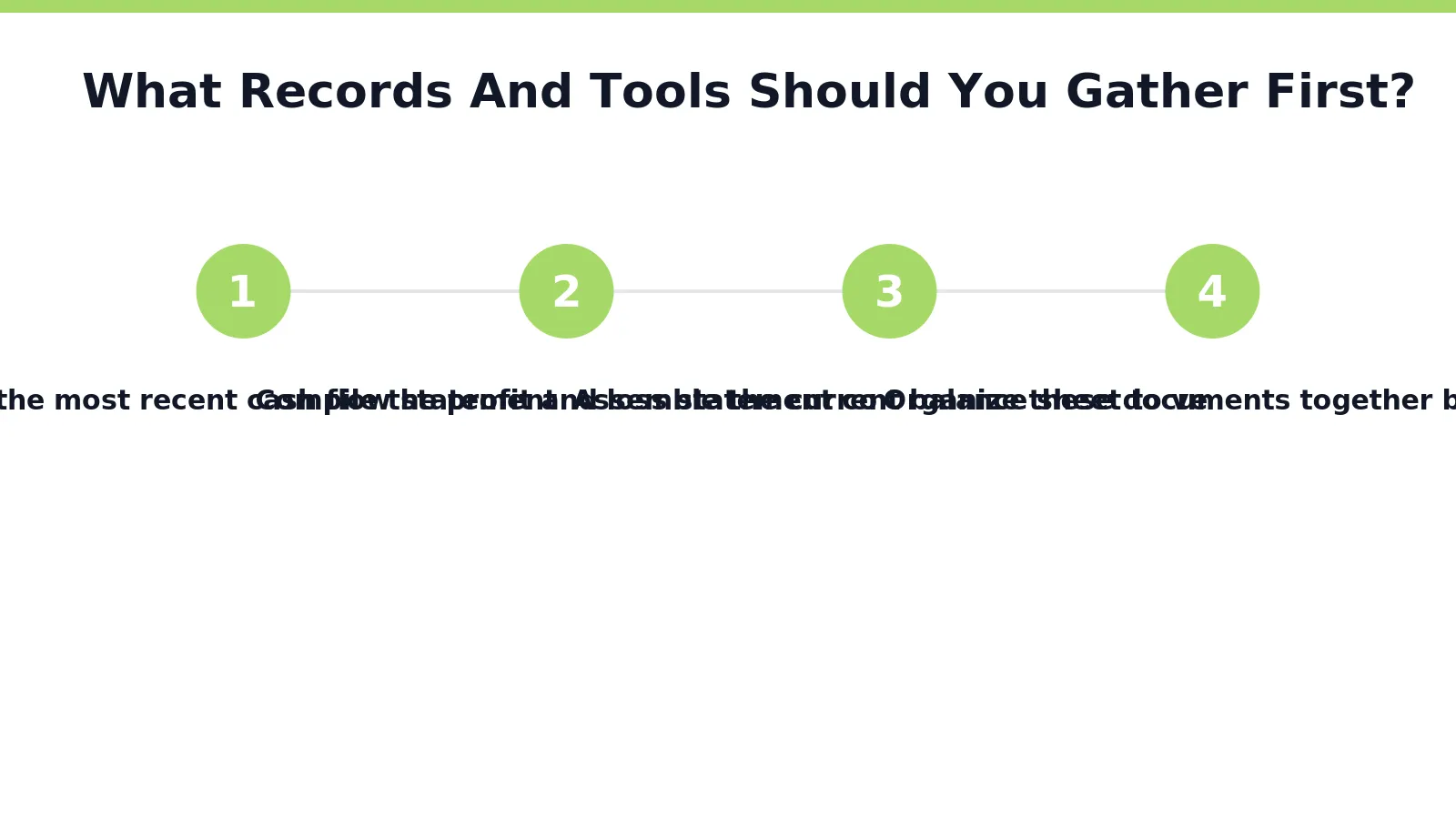
- Pull the most recent cash flow statement to identify liquidity trends crucial to your business fundability checklist.
- Compile the profit and loss statement covering at least the past year to assess profitability thoroughly.
- Assemble the current balance sheet to verify assets against liabilities and ensure financial stability.
- Organize these documents carefully before beginning your comprehensive financial health check.
Why Does Document Order Matter?
Reviewing cash flow first reveals if daily operations can support debt repayments, a critical insight in your funding readiness assessment. Profit and loss data then shows whether the business is truly profitable versus simply being cash-rich, clarifying the financial picture. Lastly, the balance sheet completes the assessment by confirming long-term stability and leverage.
What Tools Help Beyond the Paperwork?
A structured funding readiness assessment gains strength from lender-matching support. Business owners gain access to a broad network of national and local lenders, including banks, alternative finance providers, and specialized programs—all accessible once documentation is in place. A pre-qualification workflow then clarifies which programs are currently accessible, which require additional preparation, and what steps expand options down the line.
Local Business Credit Advisors offer concierge-level guidance, assisting owners in collecting and organizing the correct paperwork. Their expertise transforms a stack of financial records into a comprehensive, lender-ready package aligned with your business fundability checklist.

How Do You Read Your Core Financial Statements?
The cash flow statement, profit and loss statement, and balance sheet together reveal a company’s genuine financial position. Business owners who skip this integrated financial health check often discover funding gaps only after receiving a lender’s denial. Reading all three in tandem, rather than isolation, provides the backbone of any highly effective business fundability checklist.
What Does Each Financial Statement Measure?
Each statement answers a critical question about the company’s finances, but none offers the complete picture alone.
- Cash flow statement: Illustrates how cash moves in and out month by month, reflecting operational liquidity essential for a funding readiness assessment.
- Profit and loss statement (income statement): Displays earnings or losses over a specific period, measuring profitability.
- Balance sheet: Details what the business owns and owes at a point in time, reflecting financial solidity.
Ignoring any of these creates blind spots. For example, a business may be profitable on paper but experience cash shortages; or it may have strong cash flow yet carry debt that outweighs assets. Reviewing all three side-by-side gives owners a complete financial health check, vital before engaging lenders.
Why Do Lenders Review These Three Statements Together?
Lenders interpret these documents collectively to assess risk, not just revenue figures. Underwriters rarely approve financing based on a single strong number without full context.
Dedicated review tools add tremendous value here. Platforms designed for business fundability checklists feature scanning and scoring tools that demonstrate how underwriters view your financials, transforming raw data into a transparent picture of eligibility. Coupled with a broader funding readiness assessment, these tools help owners identify and rectify credit gaps before lenders do, preventing declines and improving borrowing terms.
How Do You Complete a Cash Flow Health Check?
Initiate a cash flow health check by gathering the last several months of bank statements and meticulously mapping every dollar entering and leaving the business. Cash flow acts as the lifeblood of any company, making this review indispensable within your financial health check. Without it, owners risk uncertainty about liquidity, exposing the business to seasonal downturns or slow-paying clients that quietly drain reserves.
Complete this process as a structured financial health check, following these steps:
- Collect three to six months of cash flow statements, bank records, and invoicing history.
- Classify inflows and outflows by source, distinguishing operating cash from financing or investment activity.
- Analyze monthly inflows versus outflows to detect consistent gaps or slow payment periods.
- Calculate cash reserves relative to monthly operating expenses.
- Flag months where reserves cover less than three months of expenses.
- Develop a plan to build reserves or secure a credit line before shortfalls occur.
How Much Cash Reserve Should a Small Business Keep?
A sound cash reserve should cover three to six months of operating expenses. This ensures the business can absorb fluctuations and unexpected costs without urgent financing, a key component of any business fundability checklist.
Why Does Cash Flow Matter More Than Profit on Paper?
A company can be profitable yet still run out of cash if payments lag expenses. Regular review and optimization of cash flow statements clarify where cash originates and flows daily, which is more critical than the income statement alone. A strong cash flow strategy ensures working capital is available before it’s needed, not after a shortfall forces a scramble. Building this habit significantly strengthens your business credit readiness and funding readiness assessment.
How Do You Assess Your Business’s Credit Position?
Assessing credit standing means evaluating your company's credit profile exactly as an underwriter would, rather than from an owner’s perspective. VIP Business Credit’s proprietary scoring tools show precisely how lenders view credit eligibility before applications are submitted. Skipping this vital step results in guesswork that often leads to denied applications, which adversely impact your credit record and future financing chances.
The assessment employs a suite of connected tools rather than a single score. The scoring engine, funding explorer, funding manager, and bureau insights collaborate to identify eligibility gaps and match financing options fitting your current standing. Specifically, each tool answers a unique question:
- Scoring engine — Displays your current credit standing as lenders see it today, crucial in your business fundability checklist.
- Funding explorer — Reveals financing options tailored to your credit profile.
- Funding manager — Tracks ongoing applications and accounts.
- Bureau insights — Monitors data lenders obtain from credit bureaus, informing your financial health check.
What’s the Fastest Way to Check Funding Eligibility?
Speed is critical when capital is needed quickly. A brief scan can match your business to pre-qualified funding options within minutes without impacting personal credit. This swift funding readiness assessment provides a realistic starting point, replacing blind applications with informed strategy.
Why Does a Credit Position Check Matter Before Applying for Financing?
Applying without credit position review often results in wasted applications and unnecessary credit inquiries. Conducting a comprehensive financial health check, including scoring and bureau data analysis, uncovers weaknesses like thin trade history before the lender does. Completing this business fundability checklist step empowers owners with knowledge of lender fit, protecting the credit file and saving time spent on speculative applications.
How Do You Complete a Funding Readiness Assessment?
Completing a thorough funding readiness assessment requires following five essential steps: gathering financial records, separating personal and business credit, reviewing lender criteria, matching financing options, and developing an EIN-based credit profile. Omitting any step exposes the business to denied applications and lost growth opportunities. Follow this sequence for a comprehensive understanding of your position before lenders:
- Gather core financial documents first. Pull cash flow statements, profit and loss reports, and current balance sheets before pursuing financing.
- Separate personal and business liability. Establish credit tied to the business’s EIN rather than personal Social Security numbers, safeguarding personal assets and building distinct business credit.
- Review lender and product criteria. Different lenders weigh revenue, time in business, and credit history variably; understanding these differences prevents wasted applications.
- Match the business to the appropriate financing strategy. VIP Business Credit connects clients to over 1,000 national and local lenders, ranging from traditional banks to alternative providers, ensuring alignment with your business fundability checklist and funding readiness assessment.
- Build and maintain an EIN-based credit profile. Cultivate strong trade lines and timely payments to enhance borrowing power continuously.
FAQ
What Documents Do I Need for a Business Financial Health Checklist?
A cash flow statement, a profit and loss statement, and a balance sheet form the foundation. Together, these documents depict cash movement, expenditure, and net assets versus liabilities—essential to any financial health check.
How Often Should I Review My Business Credit Profile?
Review your EIN-based business credit profile at least annually with professional guidance. VIP Business Credit recommends annual financial checkups covering cash flow, profitability, and performance metrics for ongoing funding readiness assessment.
How Can VIP Business Credit Help Identify Funding Gaps Quickly?
VIP Business Credit’s Fundability Score and Business Fundability Scan identify credit gaps in 2–5 minutes, offering a swift and accurate business fundability checklist. Based in Sterling, VA, the firm connects business owners to over 1,000 national and local lenders.
Contact and Strategy Consultation
Ready to enhance your business fundability checklist and complete your financial health check? Our expert team is here to help you develop your funding readiness assessment and secure the capital your business deserves.
Phone: (571) 248-3863Email: H[email protected]chedule a Strategy Call: Schedule A Business Financial Health Strategy Call
About The Author
Lee Johnson is a Master Certified Professional Coach and the Founder of VIP Business Credit. With extensive verified expertise in business finance and credit building, Lee has helped countless entrepreneurs and business owners improve their financial positions and successfully navigate the complexities of lending to maximize their funding readiness assessment and business fundability checklist.


