The Business Financial Health Checklist
The Business Financial Health Checklist
A business financial health checklist covers cash flow statements, balance sheets, debt-to-income ratios, and credit bureau reporting under the company's EIN. VIP Business Credit offers a readiness scan that reviews these factors, revealing credit gaps, matching businesses to pre-qualified funding options, and protecting personal credit from impact.
Key Takeaways
- Conduct annual financial checkups to monitor cash flow, profitability, and overall business stability consistently.
- Track seven essential financial health elements including budgeting, debt management, and expense monitoring regularly.
- Connect with over 1,000 national and local lenders through VIP Business Credit's network.
What Will This Checklist Help You Accomplish?
A completed checklist gives business owners a clear, documented picture of financial health, turning scattered bank statements and gut instinct into an organized record lenders can actually evaluate. Skipping this step carries a real cost: companies that never examine their numbers closely tend to discover cash shortages, credit gaps, or reporting errors only after a lender has already said no. The checklist exists to catch those problems earlier, when they are still fixable.
Completing a thorough business assessment also builds the habit of reviewing company finances on a set schedule rather than only during a crisis. Seven Elements of Good Financial Health compares this practice to an annual physical: small issues, caught early, rarely become serious ones. A business that skips its yearly checkup risks the financial equivalent of a missed diagnosis, a problem that grows quietly until it forces an expensive, disruptive fix.
Why Does a Readiness Check Matter Before Seeking Funding?
A readiness check matters because lenders evaluate a business on documented numbers, not intentions. Owners who review cash flow, credit standing, and liability structure before applying arrive prepared instead of reactive. This preparation shortens the path between identifying a gap and closing it.
VIP Business Credit, based in Sterling, Virginia, built its advisory approach around this exact need, drawing on direct knowledge of regional small-business financing patterns across Northern Virginia and the Greater Washington, DC area. The firm's core focus centers on a specific structural goal:
- Review current cash flow and credit accounts to establish a baseline.
- Identify where personal and business finances remain mixed.
- Build credit under the company's EIN rather than the owner's Social Security number.
- Separate personal liability from business liability going forward.
Completing these steps protects personal assets while positioning the company for stronger lending terms.

What Tools and Records Do You Need First?
Three core financial statements unlock the full story of a company's financial health before any checklist review begins. Without them, a readiness check turns into guesswork, and guesswork leads owners to miss gaps lenders will spot immediately.
Gather these records before starting a structured business assessment:
- Pull the balance sheet first. It shows exactly what the business owns and owes at a specific point in time, forming the backbone of the review.
- Collect the profit and loss statement to track revenue and expenses over a set period.
- Assemble a cash flow statement showing how money moves in and out of the business.
- Set aside recent lender statements, tax filings, and vendor payment records for cross-reference.
Each document answers a different question. The balance sheet reveals net worth at a glance. The profit and loss statement explains whether operations generate real profit. The cash flow statement exposes timing problems that profit alone never shows.
What If the Records Are Incomplete or Outdated?
Incomplete records don't disqualify a business from review, but they do slow it down. Start with whatever statements exist, then flag the gaps for a bookkeeper or advisor to fill before applying for financing.
Where Can Owners Get Help Organizing These Records?
Owners who want a structured readiness check without assembling every document manually can work with VIP Business Credit, which connects clients to more than 1,000 national and local lenders for side-by-side comparison. The firm's Sterling, Virginia office also gives Northern Virginia business owners a direct point of contact for in-person guidance while they organize these records.
How Do You Review Your Cash Flow Statement?
A cash flow statement review starts with one question: does money coming in cover money going out, month after month? Cash flow functions as the lifeblood of a business, which is why checking it first reveals whether daily operations can stand on their own. Business owners who skip this step often discover trouble only after it becomes a crisis.
The review follows a logical order:
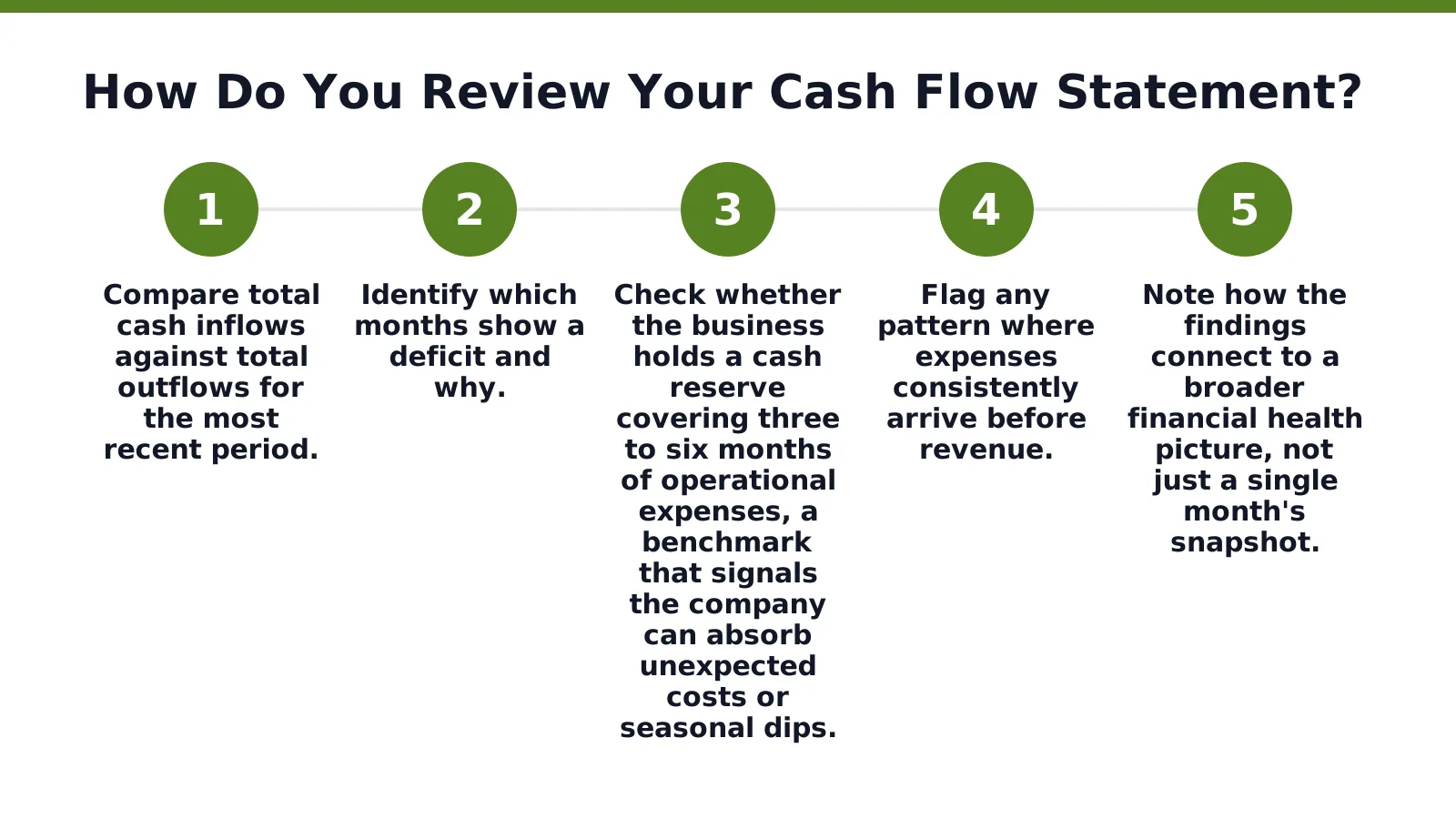
- Compare total cash inflows against total outflows for the most recent period.
- Identify which months show a deficit and why.
- Check whether the business holds a cash reserve covering three to six months of operational expenses, a benchmark that signals the company can absorb unexpected costs or seasonal dips.
- Flag any pattern where expenses consistently arrive before revenue.
- Note how the findings connect to a broader financial health picture, not just a single month's snapshot.
What Does a Strong Cash Reserve Look Like?
A strong reserve covers three to six months of normal operating expenses. This cushion lets a business manage fluctuations and unplanned costs without scrambling for emergency funding. Owners should treat this number as a non-negotiable line item in any business assessment, not an afterthought.
Why Review Cash Flow Before Seeking Funding?
Lenders want to see working capital available before it's needed, not after a shortfall forces a panicked application. Controlling cash flow supports growth because it puts resources in place ahead of demand. This kind of forward-looking readiness check separates businesses that scale smoothly from those that stall waiting on approval.
Interpreting these numbers alone can be difficult, especially for owners juggling daily operations. Local Business Credit Advisors offer concierge-level guidance, helping translate raw cash flow data into a clear read on where the business stands and what steps come next.
How Do You Analyze Profit and Loss Trends?
Analyzing profit and loss trends means comparing revenue. Expense figures across several periods to spot patterns before they become problems. The profit and loss statement shows precisely how much money a business made or lost during a specific period. Stacking several of these statements side by side reveals whether margins are climbing, holding steady, or sliding. Lenders read these same patterns when they evaluate financial health, which makes this comparison a core piece of any serious business assessment.
A disciplined review follows a repeatable sequence rather than a one-time glance:
- Pull profit and loss statements for at least three consecutive periods.
- Line up revenue figures month over month to identify growth or decline.
- Separate fixed costs, such as rent, from variable costs, such as materials.
- Calculate net margin for each period and note the direction of change.
- Flag any period where expenses grew faster than revenue.
This kind of step-by-step process turns raw numbers into a roadmap owners can actually use, moving them from scattered data toward qualifying for stronger loan terms and higher credit limits.
Why Track Multiple Periods Instead of One Statement?
A single profit and loss statement only captures a snapshot. Multiple periods expose whether a dip was a one-time event or the start of a trend, which matters enormously once a lender starts underwriting an application. Reviewing trends regularly also functions as an ongoing readiness check, keeping a business prepared before it ever applies for capital.
Does Pricing Transparency Affect Trend Tracking?
Yes. Working with a partner that offers transparent, no-surprise pricing rather than a one-off transactional arrangement keeps the cost side of the ledger predictable across every period being compared. That consistency makes multi-period trend analysis far more reliable. Hidden fees won't distort the numbers owners are trying to read.
How Do You Assess Your Balance Sheet Strength?
Balance sheet strength depends on three measurable factors: how much debt sits on the business versus the owner personally, how reliable the company's savings cushion is, and how many financing paths remain open if conditions change. A business carrying debt tied to its EIN, rather than an owner's Social Security number, presents a cleaner liability picture to lenders. That separation matters because underwriters weigh personal exposure differently than corporate exposure when deciding how much risk to take on.
Why does separating business and personal debt matter?
Debt that stays tied to the company's EIN keeps personal liability out of the underwriting conversation entirely. VIP Business Credit works with entrepreneurs across Northern Virginia and the Greater Washington, DC region specifically to build this kind of EIN-based credit profile, which strengthens the balance sheet by drawing a clear line between what the business owes and what the owner owes personally.
What role does a savings reserve play in balance sheet strength?
A funded reserve account works the same way for a business as it does for an individual: it is the foundation of financial security. Without one, short-term cash gaps turn into long-term credibility problems. Owners evaluating their numbers should look for three things:
- Consistency of identity data across bank records, vendor accounts, and business registrations
- Trade credit reporting that reflects on-time payment history to credit bureaus
- Reserve depth relative to monthly fixed obligations
Keeping business identity information consistent, and making sure trade accounts report payment activity, helps lenders, card issuers, and vendors view the company as a lower-risk partner. Once those signals are in order, a thorough business assessment should include a readiness check against actual lending criteria, not assumptions. Access to more than 1,000 national and local lenders allows that balance sheet profile to be matched against financing products the business genuinely qualifies for, rather than products it merely hopes to qualify for. That matching step turns a static balance sheet review into a practical, fundable strategy.
How Do You Run a Business Assessment for Funding Readiness?
A business assessment for funding readiness starts with a readiness check that compares a company's credit profile against what lenders actually require. This single step exposes the gap between where a business stands today and where it needs to be for approval. Skipping this step leaves owners guessing, often applying for products they are not yet positioned to win.
The process follows a clear sequence:
- Run the scan. A readiness scan shows exactly where a business stands with lenders and reveals the specific credit gaps separating it from approval.
- Review the results without risk. This type of financial health scan matches a business to pre-qualified funding options within minutes, and it carries zero impact on the owner's personal credit.
- Study the underwriting view. A dedicated scoring tool, paired with a funding explorer, funding manager, and bureau insights, shows how underwriters actually view the business and pinpoints where eligibility gaps exist.
- Sort the options. A pre-qualification workflow separates financing programs into three groups: products the business qualifies for now, products needing more preparation, and the concrete actions that open up future options.
What Does a Funding Readiness Scan Actually Reveal?
A readiness scan reveals credit gaps standing between a business and loan approval, not just a generic score. It shows which lenders are likely to approve the business today and which require additional groundwork first. Owners get a roadmap, not just a number.
How Long Does a Business Assessment Take?
The scan portion of the business assessment takes only minutes to complete. Results arrive fast enough to review before a funding deadline, and checking them never touches personal credit.
Once the sorting step is complete, owners know exactly which category their business falls into. That clarity turns a vague funding search into a short, prioritized action list grounded in actual underwriting criteria.
How Do You Complete a Credit Readiness Check?
Completing a credit readiness check requires five sequential steps, moving from data review to lender matching. Business owners who skip steps often apply before gaps are fixed, which costs approval odds and pricing. A structured process builds genuine financial health instead of guesswork.
- Review business identity data. Confirm the company's legal name, address, and phone number match exactly across every registration, license, and vendor account. Inconsistent records are one of the most common reasons underwriters flag a file as higher risk.
- Audit trade credit reporting. Check whether vendor accounts and credit lines are reporting payment history to the bureaus lenders actually pull. Accounts that never report do nothing to build a credit profile, no matter how long they've been open.
- Run a structured business assessment. Compare current credit standing against what target lenders require, using a step-by-step process rather than scattered applications. This clarity is what separates owners who qualify for better terms, higher limits, and lower rates from those who get declined.
- Confirm pricing and partnership terms. Before moving forward with any advisor or lender, verify that pricing is transparent with no hidden surprises. A readiness check conducted honestly favors a long-term partnership over a one-time transaction.
- Build the credit profile first, then pursue top-tier financing. The strongest approach establishes a solid business credit foundation before pursuing the largest loan amounts at the best available terms, not the other way around.
Why Does Order Matter in a Readiness Check?
Sequence matters because each step feeds the next. Identity consistency supports accurate trade reporting, and accurate reporting is what a lender actually underwrites against. Skipping ahead to apply for premium financing before the foundation is solid typically produces denials or weak terms.
What Happens After the Readiness Check Is Complete?
Once the assessment confirms the business profile is accurate and reporting properly, the company matches to financing options suited to its risk profile. This staged approach, moving from foundation to funding, protects personal liability while positioning the business for stronger approvals over time.
What Mistakes Should You Avoid Along the Way?
Four missteps undermine most readiness efforts: treating review as a one-time task, skipping a cash buffer, overlooking equipment financing, and ignoring fleet options. Each one quietly erodes a company's standing with lenders, even when revenue looks strong on paper. Business owners who correct these patterns put themselves in a far stronger position before approaching any funding source.
The most frequent error is running a financial health review once and considering the job finished. Seven Elements of Good Financial Health compares this to a yearly physical checkup: skipping it doesn't cause immediate harm, but problems accumulate unnoticed. A single snapshot can't catch shifting cash patterns or new liabilities that surface months later.
Why does cash reserve size matter so much?
A thin cash cushion turns ordinary slow seasons into emergencies. Your Essential Financial Health Checklist: A Guide for Business Stability and Growth recommends holding reserves that cover three to six months of operating expenses, which gives a company room to absorb fluctuations and unexpected costs without scrambling for emergency credit.
Beyond cash habits, many owners overlook financing tools that build credit while serving an operational need. Two commonly missed opportunities during a business assessment:
- Equipment credit lines: Acquiring needed equipment now, building credit through regular use, and deducting payments as business expenses.
- Fleet credit lines: Financing multiple vehicles at once while building business credit and locking in tax deductions.
Should equipment and fleet financing be part of a readiness check?
Yes. A thorough readiness check should weigh whether equipment or vehicle needs can double as credit-building opportunities rather than standalone expenses. Treating these purchases as isolated costs, instead of strategic financing moves, leaves credit-building potential on the table and slows a company's path toward stronger lender terms.
FAQ
What does a business financial health checklist cover?
It covers cash flow statements, balance sheets, debt-to-income ratios, and credit bureau reporting under the company's EIN. These elements give business owners a documented, organized picture of financial stability that lenders can evaluate.
What records should a business gather before starting the checklist?
Gather the balance sheet, profit and loss statement, cash flow statement, and recent lender statements. These documents form the backbone of an accurate financial health review and prevent guesswork.
How does VIP Business Credit help with this process?
VIP Business Credit offers a readiness scan that evaluates key financial factors, revealing credit gaps and matching businesses to pre-qualified funding options. The company also connects entrepreneurs to over 1,000 national and local lenders.
Conclusion
In closing, a comprehensive financial health checklist transforms abstract concerns into concrete, manageable actions that strengthen your business from the inside out. By systematically reviewing cash flow, debt obligations, credit positioning, and operational efficiency, you build the clarity and credibility that lenders and vendors expect. This disciplined approach protects your personal assets, positions your company for sustainable growth, and ensures you're making decisions from a position of strength rather than crisis. Start today, your business's financial foundation depends on the attention you give it now.


