Strategic Business Funding Strategy for Growth
Strategic Business Funding Strategy for Growth
Strategic funding approaches combine credit separation, lender matching, and data-driven scoring. VIP Business Credit's Business Fundability Scan matches business owners to pre-qualified funding options in 2 6 minutes with zero personal credit impact, revealing gaps against a network exceeding 1,000 lending options while building EIN-based credit that protects personal assets from business liability.
Key Takeaways
- Different business stages require tailored financing strategies aligned with your growth trajectory and capital needs.
- VIP Business Credit connects entrepreneurs to over 1,000 national and local lenders for funding access.
- Strong EIN-based business credit directly impacts your ability to secure favorable financing terms and rates.
Why Does a Business Funding Strategy Matter Now?
Timing shapes outcomes for small-to-midsize business owners chasing growth capital. A clear business funding strategy determines whether a company gets matched with the right lender or stalls out after one rejection. Market conditions shift constantly, and lenders tighten or loosen criteria based on risk appetite, industry trends, and economic pressure. Owners who wait for the "perfect" moment often miss windows when capital is most accessible.
One frequent misstep stands out among entrepreneurs seeking funding: giving up after a single lender says no. That first rejection often has nothing to do with the strength of the business. It might reflect a lender's narrow underwriting focus. Closing the door after one attempt eliminates dozens of better-suited options still on the table.
What Happens When a Business Skips a Funding Strategy?
Skipping preparation before approaching lenders lowers approval odds significantly. Hundreds of reputable lenders operate in today's marketplace, each with different requirements, and businesses that walk in unprepared struggle to stand out. Preparing with the right strategies beforehand improves the likelihood of securing capital for business growth, expansion, or day-to-day operations.
A structured approach matters because no two lenders evaluate risk the same way. Consider the difference preparation makes:
- Unprepared approach: Apply to one bank, get denied, stop searching.
- Strategic approach: Build a documented plan, compare multiple lender types, apply where fit is strongest.
VIP Business Credit connects business owners to more than 1,000 national and local lenders, replacing single-source guesswork with real options. Operating out of Sterling, Virginia, the firm brings direct market knowledge of regional lending relationships alongside its national network. That combination gives business owners a genuine commercial financing roadmap instead of a single shot in the dark.

What Funding Stage Matches Your Business Today?
Growth stage determines financing choice. A business needs different financial structures at different stages of growth. The capital that launches a company from a garage looks nothing like the funding required to scale an established operation. Matching the right tool to the right moment protects both cash flow and credit standing.
What financing works best for a brand-new business?
Founders in the earliest phase often rely on self-funding and bootstrapping. This approach lets an owner maintain full control of the vision without answering to outside investors. It also builds a financial track record lenders will review later, once the business seeks larger credit lines.
How does financing change as a business grows?
Once revenue stabilizes, the goal shifts from personal investment to a structured business funding strategy built around the company's own credit profile. VIP Business Credit designs each strategy around a company's specific stage, sector, and risk profile, rather than offering a single product to every applicant. That distinction matters: a seasonal retailer and a growing logistics firm carry different risks, and their financing should reflect that.
Owners evaluating their current position can generally sort into three broad categories:
- Startup stage 6 limited credit history, reliance on founder funds, early emphasis on separating business and personal finances.
- Growth stage 6 established revenue, need for working capital, first real opportunity for a formal commercial financing roadmap.
- Scale stage 6 proven track record, focus on larger credit lines and cost-efficient capital for expansion.
Securing capital for business growth at any of these points works best with guidance built for that specific phase. VIP Business Credit pairs proprietary technology with direct advisory support, helping owners see exactly where they stand and what step comes next. That combination turns a confusing lending landscape into a clear, sequential plan.

How Does EIN-Based Credit Protect Your Finances?
An Employer Identification Number (EIN) creates a legal separation between a business's debts and an owner's personal finances. Credit built under the EIN stands apart from a founder's Social Security number. A slow sales quarter or a missed vendor payment does not automatically drag down the owner's personal credit score. Without that separation, every business risk becomes a personal one. A debt collector can chase a founder's mortgage rate, auto loan terms, and even future job applications.
VIP Business Credit builds this separation for entrepreneurs across Northern Virginia and the Greater Washington, DC region. Instead of relying on personal guarantees tied to an owner's SSN, the firm structures credit around the company's own EIN. That shift changes who carries the risk when a business hits a rough patch.
Why does separating business and personal credit matter?
Mixing the two exposes personal assets 6 homes, savings, retirement accounts 6 to business liabilities. A business funding strategy built on EIN-based credit keeps that risk contained to the company itself. Founders who skip this step often discover the gap only after a lender or landlord runs a personal credit check tied to business debt.
The firm's core focus centers on securing capital for business growth through high-limit loans. Credit lines, all while keeping that liability wall intact. This approach lets owners pursue larger financing amounts without stacking risk onto their personal credit history.
What role do lender networks play in this protection?
A wider lender network means more paths to EIN-qualified financing, not just personal-guarantee products. Clients gain access to a broad mix of lenders, including:
- National and regional banks
- Alternative finance providers
- Specialized lending programs
That range supports a stronger commercial financing roadmap, one where each product matches the business's actual credit profile rather than the owner's personal one.
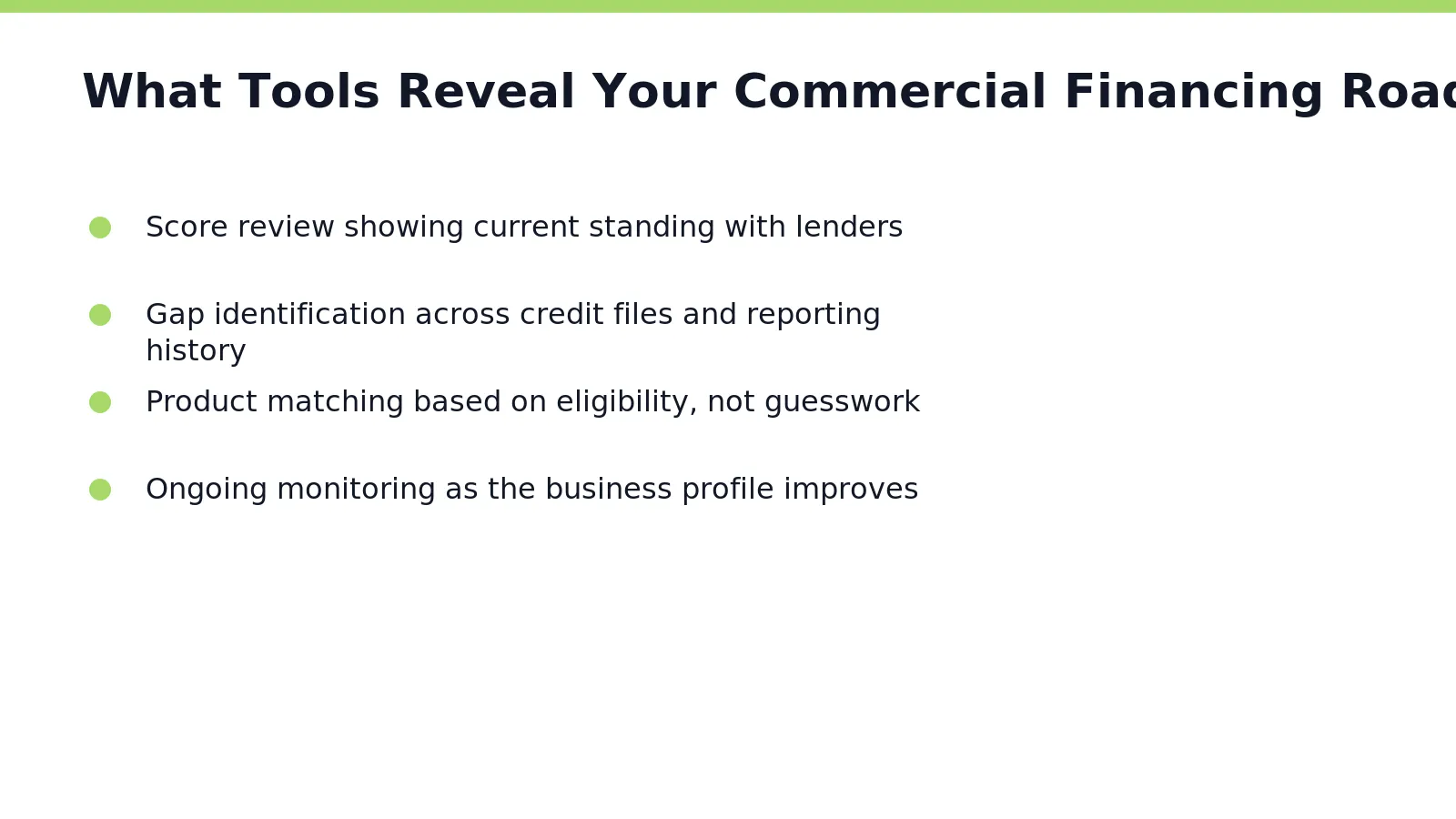
What Tools Reveal Your Commercial Financing Roadmap?

A proprietary scoring tool shows business owners exactly how underwriters view their credit position, translating lender-side data into a picture any founder can understand. That single insight changes how an owner approaches the next twelve months of growth. Without it, most business owners apply for financing blind, guessing at their standing until a denial letter arrives.
VIP Business Credit's scan reveals credit gaps in a company's file. Delivers a clear roadmap for building toward stronger approval odds. Rather than leaving owners to interpret raw bureau data, the scan translates that information into specific next steps. This matters for a growing company deciding whether to pursue a line of credit now or wait six months to strengthen its file first.
The scoring tool sits inside a broader platform built to guide each stage of a business funding strategy. Several connected tools work together to identify eligibility gaps. Surface lending products matched to a company's actual profile, rather than a generic list of options.
How does the scan help with securing capital for business?
The scan matches a business to pre-qualified funding options within minutes, with zero impact on personal credit. That speed matters for owners who need to move quickly on an equipment purchase or a seasonal cash flow gap. Securing capital for business growth starts with knowing which doors are realistically open before an application ever gets submitted.
What makes up a full commercial financing roadmap?
A complete commercial financing roadmap combines the scoring insight, the gap analysis, and matched product recommendations into one sequence:
- Score review showing current standing with lenders
- Gap identification across credit files and reporting history
- Product matching based on eligibility, not guesswork
- Ongoing monitoring as the business profile improves
Each piece builds on the last, giving owners a plan instead of a single transaction.
Ready to Build Your Funding Strategy?
Stop guessing which lenders fit your business. Schedule a free consultation with VIP Business Credit and get a clear, personalized roadmap to the financing options that match your stage and goals.
Which Financing Options Fit Small Business Owners?

Four financing paths cover most small business needs: commercial loans, equipment credit lines, fleet credit lines, and structured cash flow support. Each one solves a different problem, and matching the right tool to the right stage protects an owner from overpaying or overextending.
Established businesses with strong credit histories often move fastest through commercial loans. These products typically carry faster approval and funding timelines than alternative financing routes, which matters when a growth opportunity has a narrow window. Owners without a solid credit history behind the business, though, usually find this path slower or costlier.
Which financing option builds business credit fastest?
Equipment and fleet credit lines double as credit-building tools, not just funding sources. An equipment credit line lets a business acquire needed machinery immediately, build credit through regular use, and deduct the payments as a business expense. Fleet credit lines work the same way for vehicles: a company finances several trucks or vans at once, builds its credit profile with each payment, and locks in tax deductions along the way.
What keeps a business from running out of working capital?
Cash flow shortages catch even profitable businesses off guard. Structured cash flow management ensures working capital arrives when a business actually needs it, not after a shortage has already stalled payroll or inventory orders.
Choosing among these options starts with an honest look at current credit standing and near-term equipment or vehicle needs. A business funding strategy built around the right combination avoids the trap of taking whatever financing is offered first.
How Can Startups Secure Early-Stage Capital?

New tech ventures face funding as one of the biggest hurdles standing between an idea and a scalable company. Capital shortages stop promising businesses before they ever reach their first paying customer. Many startups launch with far less cash on hand than they actually need to reach their first paying customer, according to a report on tech startup funding strategies. That gap forces founders to build a deliberate business funding strategy rather than relying on hope and hustle alone.
Early capital usually starts small and personal. Pre-seed funding covers initial expenses before a company qualifies for formal seed rounds. It often comes from personal savings, family, or close contacts rather than institutional lenders. This stage tests the business concept and buys time to build proof of traction.
What Should a Startup Have Ready Before Approaching Lenders?
A written business plan matters more than most founders expect. This document guides an owner through every stage of starting and running the company, from initial structure decisions to long-term growth planning. Lenders and investors use it to judge whether a founder understands the market, the numbers, and the path forward.
How Does Fundability Planning Help a New Business?
Newer companies benefit from seeing their funding options mapped out early, before cash runs short. A scan-based review of a business's credit position gives an immediate look at qualifying loans, credit lines, and vendor terms, letting founders plan financing moves in advance instead of scrambling later.
Securing capital for a business at this stage means combining three moves:
- Building a pre-seed cushion from savings or close contacts
- Drafting a business plan that speaks directly to lender criteria
- Reviewing available loan, credit line, and vendor-term options before capital runs out
Together, these steps form the foundation of a commercial financing roadmap that carries a startup from its first dollar toward sustainable, scalable growth.
Why Avoid the High-Interest Lender Trap?

High-interest lenders prey on urgency. Small business owners who abandon their search after one rejection often land on online lenders charging annual rates that climb past 50%, according to the OCIE SBDC Finance Center's February 2025 survey of small business owners. That single misstep turns a short-term cash gap into a long-term drag on profit margins.
A rushed application rarely produces a sound business funding strategy. Owners under pressure skip the comparison shopping that protects their bottom line, accepting the first "yes" instead of the best terms. The cost shows up months later in payment schedules that strangle cash flow.
Local Business Credit Advisors change that dynamic. Concierge-level guidance from an advisor familiar with a client's market helps owners slow down and evaluate multiple offers before committing. This kind of support turns securing capital for business growth into a deliberate process rather than a panic response.
What makes a lender trustworthy?
A trustworthy lender explains rates, fees, and repayment terms upfront, with nothing buried in fine print. Transparent, no-surprise pricing signals a partner focused on long-term success, not a one-time transaction.
How does an advisor prevent costly mistakes?
An advisor reviews a business's credit position before recommending any product, matching the company to lenders suited to its stage and risk profile. That review anchors a realistic commercial financing roadmap instead of a reactive scramble.
Warning signs of a high-cost lender:
- Vague or shifting rate disclosures
- Pressure to sign within hours
- No explanation of total repayment cost
- Reluctance to discuss alternatives
Working with an advisor who prioritizes clear pricing and steady partnership keeps owners out of the high-interest trap entirely.
What's Your Next Step Toward Funding?

Momentum beats hesitation when capital is on the line. Small and midsize business owners who wait for perfect conditions often lose ground to competitors who move first with a clear plan. Building a sound business funding strategy starts with an honest look at where a company stands today, not where an owner hopes it will be in six months.
Lenders and investors are not making a leap of faith. Small Business Administration guidance notes that investors want confidence they will see a return before committing capital. That confidence comes from documentation: a credit profile, a repayment history, and a plan that shows how borrowed funds turn into revenue.
Where can owners find hands-on guidance for securing capital for business growth?
VIP Business Credit's office sits at a fixed address in Sterling, Virginia, giving local owners an actual place to sit down and talk through financing options. A team of three employees handles advisory work directly, which keeps conversations personal instead of routing owners through a call center. That structure suits founders who want a real point of contact rather than an automated portal.
Does an owner have to be based in Northern Virginia to get help?
No. While the firm is rooted in Northern Virginia, its services extend digitally to clients nationwide, connecting them with lenders across the country. Distance from the Sterling office is not a barrier to building a workable commercial financing roadmap.
The next step is simple:
- Review current credit standing, both business and personal.
- Document a plan that shows lenders a clear path to return.
- Connect with an advisor who can match the business to the right lender and structure.
FAQ
What happens after a lender rejects a funding application?
A single rejection reflects a lender's narrow underwriting focus, not the strength of the business. Owners keep exploring other lenders instead of stopping the search after one no.
How many lenders does VIP Business Credit connect entrepreneurs to?
VIP Business
Conclusion
In closing, securing business funding requires a deliberate strategy grounded in understanding how lenders evaluate your company's creditworthiness and financial health. By building a strong EIN-based business credit profile, aligning your funding approach with your growth stage, and connecting with the right lending partners for your specific needs, you position your business to access capital on favorable terms while protecting your personal assets. The path forward demands clarity about your financial position. Intentional action—but the result is sustainable growth powered by capital structured to support your vision.
For comprehensive planning solutions, explore our growth funding advisory packages to accelerate your expansion.
About The Author
Lee Johnson
Lee Johnson is a seasoned real estate investor, business growth strategist, and Master Certified Professional Coach with VIP Business Credit. Drawing on years of hands-on experience helping entrepreneurs build lender-ready credit profiles and secure high-limit financing, Lee's mission is to see business owners achieve financial freedom and long-term growth. His background in real estate investing and business coaching informs the practical, stage-by-stage approach VIP Business Credit brings to every client's funding strategy.
Contact
- 📞 Phone: +1 (571) 248-3863
- ✉️ Email: [email protected]
- 📅 Book a Consultation: Schedule online
- 🌐 Website: vipbizfunds.com
VIP Business Credit proudly serves Sterling, VA and business owners throughout the surrounding Northern Virginia and Greater Washington, DC area.


