SBA Loans Eligibility and Application Requirements
SBA Loans Eligibility and Application Requirements
SBA loan eligibility requirements depend on business operations, owner character, and ability to repay, with programs including 7(a), 504, and microloans offering competitive rates, low down payments, and flexible collateral rules. Applications require lender-specific documentation and financial records. VIP Business Credit's business credit scan tools identify credit gaps first, giving business owners a clear roadmap before approaching lenders for financing.
Key Takeaways
- SBA loans offer competitive interest rates and flexible terms with lower down payment requirements than traditional financing.
- Borrowers access three main SBA loan programs: 7(a) loans, 504 loans, and microloans for various business needs.
- SBA lenders use the Capital Access Financial System (CAFS) to originate and service loans through Electronic Lending platforms.
- Many SBA loans include ongoing counseling and educational support to help entrepreneurs successfully start and operate their businesses.
What Are SBA Loans and Who Qualifies?
SBA loans are government-backed financing programs that connect small business owners with capital through approved lenders, while keeping personal and business liability separate. Approval hinges on the business's own EIN-based credit profile rather than the owner's personal credit history alone. That structure protects personal assets from business debt exposure, a distinction that matters greatly to founders scaling past the startup phase.
Qualification rules follow a consistent pattern across most SBA programs. A business generally must meet three conditions to move forward.
- Fit within SBA size standards for the industry
- Demonstrate the ability to repay the loan
- Show a sound, legitimate business purpose for the funds
Businesses with credit challenges still have a path forward. Startup funding remains accessible even when an owner's personal credit score isn't strong, provided the business case holds up under lender review.
What Makes SBA Loans Different from Small Business Loans?
Small business loans from conventional lenders often demand larger down payments and stricter collateral terms. SBA-backed programs, by contrast, can offer lower down payments and more flexible overhead requirements. Some SBA loan structures eliminate the collateral requirement entirely, which widens access for newer or asset-light businesses.
How Does SBA Loan Eligibility Get Evaluated?
SBA loan eligibility isn't decided by a single lender working alone. VIP Business Credit connects business owners to a network spanning over 1,000 national and local lenders, widening the pool of SBA and non-SBA options available. This broad access allows each financing strategy to be matched against a business's stage, sector, and risk profile rather than forcing every applicant through one lender's narrow criteria. Working with a wider lender network increases the odds of finding a program suited to the business's actual financial picture, not just a generic approval checklist.

What Documents and Information Do You Need First?
Preparation starts with a checklist, not a filing cabinet. Every SBA-approved lender supplies a complete list of eligibility requirements specific to its own loan program before an owner gathers a single document. That checklist becomes the roadmap; nothing needs to be guessed at ahead of time.
Once the checklist arrives, the real evaluation begins. Lenders examine three core areas: how the business earns its income, who owns and controls it, and where it physically operates. Businesses also need to meet size standards set for their industry. Missing information in any of these three areas slows approval and can stall a deal before underwriting even starts.
What Should Business Owners Gather Before Applying?
Owners preparing for small business loans and seeking to understand how to apply for an SBA loan should organize records around the same three pillars lenders review. A practical starting set includes:
- Financial statements showing how the business generates revenue
- Ownership documentation confirming who controls the company
- Proof of business location and operating history
- Records supporting industry size classification
Assembling this early prevents last-minute scrambling once a lender's checklist arrives.
Does Preparation Involve More Than Paperwork?
Preparation extends beyond documents into credit positioning. Getting ready for SBA loans often overlaps with building a documented business credit file, since lenders weigh credit history alongside eligibility criteria. VIP Business Credit's offerings, including lines of credit and a structured credit-building program, pair education and coaching with document preparation. Owners understand underwriting criteria before they submit anything.
Local Business Credit Advisors provide concierge-level guidance throughout this assembly process, helping owners avoid gaps that could trigger delays. Transparent, no-surprise pricing lets owners budget for preparation costs upfront, with no hidden fees surfacing mid-application. Meeting SBA loan eligibility requirements becomes far less intimidating once the paperwork and the credit story are organized together.
How Do You Check Your SBA Loan Eligibility?
Checking eligibility starts with understanding where the rules come from. The U.S. Small Business Administration sets the core requirements for SBA loans, and approved lenders apply those standards to each application. SBA rules combine with lender-specific criteria to determine whether a business ultimately qualifies for a government-backed loan. Skipping this review wastes time on applications that were never positioned to succeed.
A structured readiness process turns that combination of rules into a manageable checklist. Business owners who follow a step-by-step approach to strengthening their credit profile position themselves for better terms, higher limits, and lower rates on small business loans. This preparation matters just as much for real estate purchases and equipment financing as it does for working capital needs.
What Does a Pre-Qualification Review Actually Show?
A pre-qualification review sorts SBA programs into two categories: those a business can access right now, and those that require more preparation first. This distinction matters because SBA loan eligibility isn't all-or-nothing. Owners get a clear picture of specific actions that expand which programs are open to them, rather than guessing which application to submit.
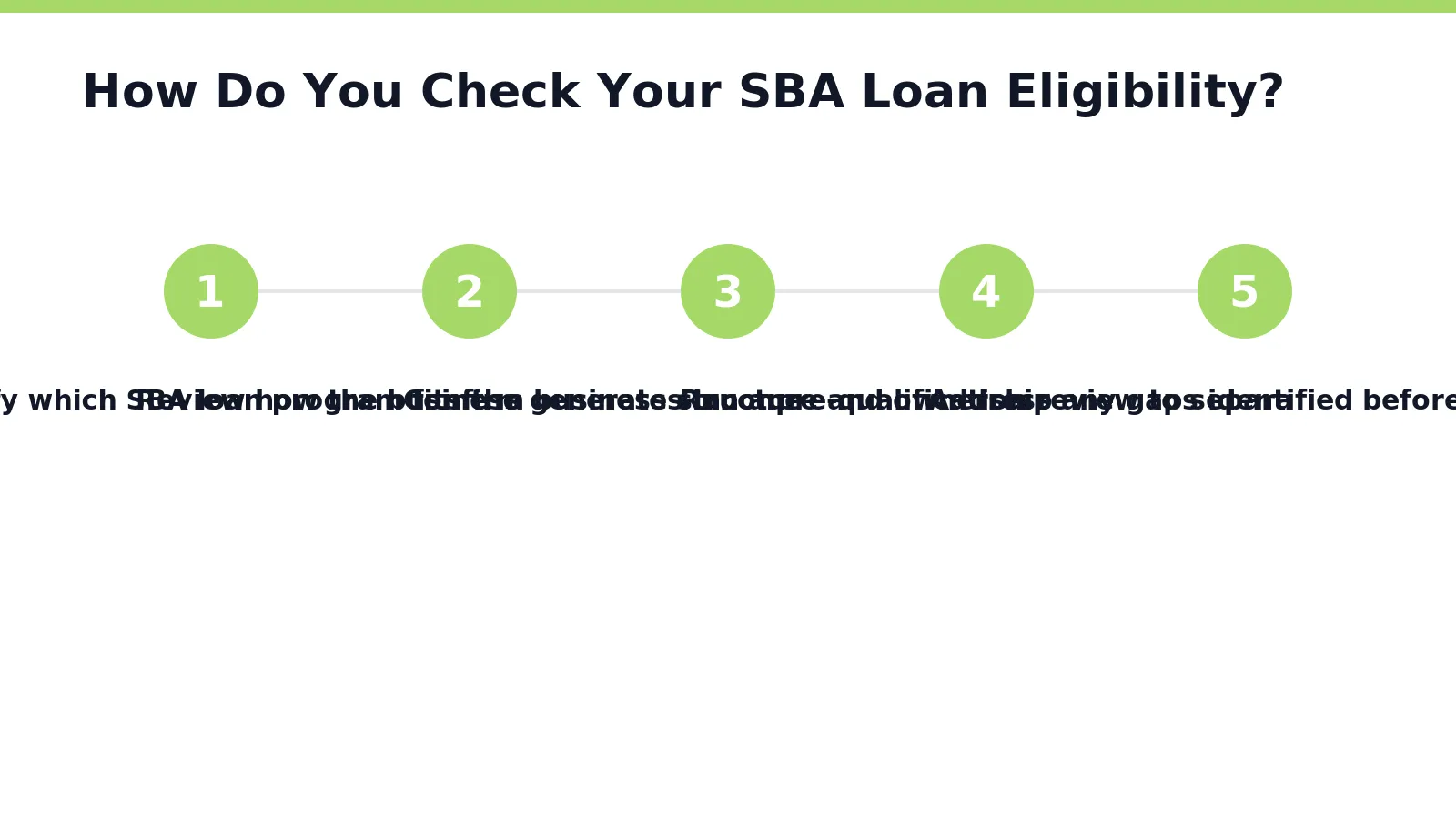
Steps to Confirm Eligibility
- Identify which SBA loan program fits the funding purpose, whether that's a 7(a) loan, a 504 loan, or a microloan.
- Review how the business generates income, since SBA size standards depend on revenue and industry classification.
- Confirm business structure and ownership details meet SBA character requirements.
- Run a pre-qualification review to separate immediately available programs from those needing more preparation.
- Address any gaps identified before submitting a formal application to a lender.
Owners located in Northern Virginia and the Greater Washington, DC region can get direct, local support building an EIN-based credit profile before they apply, giving lenders a stronger picture of business creditworthiness independent of personal credit history.
How Do You Choose the Right SBA Loan Program?
Matching a business to the correct program starts with the funding purpose. SBA loans span several core categories, including 7(a), 504, and microloans, and each one fits a distinct financial need. Picking the wrong program wastes weeks of paperwork on an application that never had a fit to begin with.
Follow this sequence when narrowing down options:
- Define the purpose of the funds first, whether that means working capital, real estate, or equipment.
- Match that purpose to a program type: 7(a) for general working capital, 504 for major fixed assets like real estate, and microloans for smaller startup needs.
- Compare rates and fees across guaranteed and non-guaranteed small business loans, since SBA-backed terms generally run competitive with conventional financing.
- Confirm business stage: newer ventures often target first-time approvals, while established firms may lean toward programs built for scaling, consolidating costs, or refinancing at better pricing.
- Review lender access before applying, since program availability varies by lender and by location.
Does Business Age Affect Program Choice?
Business age shapes which programs make sense at a given moment. A company applying for its first approval typically needs a different structure than a mature firm seeking to expand or refinance existing debt. Program selection accounts for both situations, whether a business is proving itself for the first time or scaling with stronger financials.
Do These Programs Work the Same Way Everywhere?
Program structure stays consistent nationally, but lender participation does not. Businesses rooted in Northern Virginia, including those across Loudoun County, gain the same nationwide lender network available to clients anywhere else. Combining broad lender access with guided support gives owners more clarity and speed when narrowing down the right SBA path.
How Do You Find an SBA-Approved Lender?
Finding an approved lender starts with the SBA's own matching system, then widens through broader lender networks and local advisory support. Skipping this search narrows access to competitive rates. Leaves qualified businesses working with a single bank instead of a full marketplace.
Every SBA-guaranteed loan moves through the Capital Access Financial System, known as CAFS. This is the backbone connecting approved lenders to SBA loan programs for origination and servicing. Understanding this system helps owners see why some banks process applications faster than others: those banks are plugged directly into SBA infrastructure.
What is SBA Lender Match?
Lender Match is the SBA's referral tool, built specifically to connect borrowers with participating lenders. Business owners submit basic information about their financing needs. The tool routes that request to lenders active in the program. It's a useful starting point, but it represents only one door into a much larger lending landscape.
Owners can strengthen their search with these steps:
- Submit a request through the SBA's Lender Match tool to surface initial matches.
- Expand the search beyond that single referral by connecting with a wider lender network, since options spanning more than 1,000 national and local lenders exist outside the SBA's own tool.
- Compare terms across multiple lenders rather than accepting the first offer.
- Work with a local advisor for concierge-level guidance while narrowing choices.
Small business loans carry different terms depending on the lender, so comparison matters more than speed. Owners in the Sterling, Virginia area, and beyond, can also meet in person with advisors familiar with regional lending patterns. That combination, a national network plus local guidance, gives owners more leverage than relying on one bank's decision alone.
How Do You Complete and Submit Your Application?
Completing an application means working through a lender's checklist step by step, then submitting documentation for underwriting review. SBA-approved lenders evaluate each file against a defined set of requirements before any application moves forward. Missing a single item on that checklist stalls the process and delays access to capital a growing business needs now.
Some requirements come directly from the federal program guidelines governing SBA loans. Others get added by the individual lender on top of that baseline. Together, these two layers determine whether a business qualifies for SBA-backed financing, which is why preparation matters as much as the paperwork itself.
What Steps Does the Application Process Involve?
The sequence below reflects how most small business loans move from initial review to funding decision.
- Confirm foundational readiness, including consistent business identity data and active trade credit reporting, since lenders read these signals as proof of lower risk.
- Gather financial documentation and match it to the specific lender's added criteria, not just the program's baseline rules.
- Submit the completed file for underwriting review.
- Track the decision and respond quickly to any follow-up requests from the lender.
How Does Support Improve SBA Loan Eligibility During Application?
Coaching on underwriting criteria strengthens a file before it ever reaches a lender's desk. Business credit advisors pair this education with access to loan. Credit line offerings, helping owners understand exactly what underwriters look for and why.
Pricing transparency during this stage matters too. No-surprise pricing structures let owners plan financing costs with confidence, reinforcing a long-term advisory relationship rather than a one-time transaction. That steady, informed approach turns a complex checklist into a manageable, step-by-step path toward funding.
What Happens After You Submit Your Application?
Submission triggers a review process, not an immediate decision. Underwriters examine financials, credit history, and business documentation before responding, and gaps in preparation often surface here. A pre-qualification workflow continues to play a role at this stage, helping owners see which programs they qualify for right away and which ones need more preparation first. That clarity keeps the process moving instead of stalling in guesswork.
Applicants should expect one of three outcomes: approval, a request for additional documentation, or a referral to a better-suited program. Requests for more paperwork are common, not a sign of failure. Lenders frequently ask for updated financial statements, clarification on ownership structure, or proof of collateral before finalizing terms.
What if the lender asks for more documents after review?
Follow-up requests are routine, especially for SBA loans, given the layered eligibility standards involved. Guided execution during this phase helps owners respond to underwriter questions with confidence instead of confusion. A structured, step-by-step readiness process supports applicants through each round of requests, working toward stronger terms, higher limits, and lower rates rather than settling for the first offer presented.
Does support end once the loan is approved?
Support does not stop at approval for many programs. Some small business loans, particularly those backed by the SBA, include ongoing counseling and education to help owners run the business well after funding arrives. Recipients can also tap counseling and training resources online, through live events, and through local SBA Resource Partners.
Owners preparing for this stage should keep documentation organized and responsive. Consider this sequence:
- Confirm receipt of the application with the lender.
- Respond quickly to any underwriter document requests.
- Review SBA loan eligibility requirements notes for any flagged gaps.
- Follow the readiness roadmap toward final terms.
What Mistakes Should You Avoid During the Process?
Five errors derail most applications before a lender even reviews the numbers. Each one is avoidable with the right preparation. Each carries a real cost: lost time, wasted paperwork, or a denial that could have been prevented.
Small business loans applicants often assume damaged personal credit rules them out entirely. That assumption is wrong. Businesses with imperfect credit histories may still qualify for startup funding, since lenders publish a full list of requirements specific to each loan product rather than relying on a single credit threshold.
A second mistake involves overlooking how a company earns its income, how ownership is structured, and where the business physically operates. SBA loan eligibility requirements hinges on all three factors together, not just revenue or time in business. Skipping this review before applying wastes weeks on a mismatched program.
Does the funding program fit a newer business or an established one?
Not every path suits every stage. A program built for firms scaling operations or consolidating costs won't move quickly for a business still chasing its first approval. Matching the funding approach to the company's actual stage, rather than its long-term ambitions, keeps the process on schedule.
Why does credit-building order matter?
Applying for SBA loans before establishing credit under the business's own EIN is a common misstep. Local advisors serving the Northern Virginia and Greater Washington, DC region routinely help owners build that EIN-based credit foundation first, which strengthens how lenders view the application later.
Owners also lose ground by handling complex applications alone. Working with a small, hands-on team means each file gets direct, individualized attention instead of disappearing into a large processing queue. That difference often separates a fast approval from a stalled one.
FAQ
What are the basic requirements to qualify for an SBA loan?
Businesses must fit within SBA size standards for their industry, demonstrate the ability to repay the loan, and show a sound, legitimate business purpose for the funds requested.
Do SBA loans require strong personal credit to get approved?
Approval centers on the business's own EIN-based credit profile rather than personal credit alone. Startup funding stays accessible even when an owner's personal credit score isn't strong.
What documents do lenders require during the SBA loan application process?
Every SBA-approved lender provides a complete checklist of eligibility requirements specific to its loan program. Lenders then examine how the business earns income and who owns and controls it.
Conclusion
In closing, SBA loan eligibility requirements and the application process demand careful attention to detail and honest self-assessment of your business's financial standing. By understanding the core requirements, solid credit, adequate collateral, and a clear repayment plan, you position yourself to navigate the underwriting process with confidence. The effort you invest in preparing your application and strengthening your business's financial profile directly shapes your approval odds. The terms you receive, making preparation the foundation of successful SBA financing.
About The Author
Lee Johnson is a seasoned Real Estate Investor, Business Growth Strategist, and Master Certified Professional Coach dedicated to helping entrepreneurs achieve financial freedom, scale sustainable businesses, and build lender-ready corporate credit profiles without personal liability. He brings extensive expertise in business finance, corporate credit coaching, underwriting criteria, and strategic funding facilitation.
Contact Us
- 📞 Phone: (571) 248-3863
- ✉️ Email: [email protected]
- 📅 Consultation: Schedule A Business Financial Health Strategy Call
- 🌐 Website: https://vipbizfunds.com
- 🎯 FREE Business Success Scan: FREE Business Success Scan
- Serving Sterling, VA and surrounding areas (Service Area Business - do not display street address).


