Sba 7a Loan: SBA 7(a) Loans: Flexible Funding for Small Business
Sba 7a Loan: SBA 7(a) Loans: Flexible Funding for Small Business
SBA 7(a) loans provide government-backed financing for eligible small businesses seeking working capital, real estate, equipment, and debt refinancing, with competitive rates and lower down payments than conventional options. VIP Business Credit connects clients to lenders offering these loans among 1,000+ funding options, matching each business's growth stage to the right structure and terms.
Key Takeaways
- SBA 7(a) loans offer competitive interest rates and fees comparable to traditional non-guaranteed business loans.
- Borrowers access lower down payments, flexible overhead requirements, and financing without collateral needs through 7(a) programs.
- VIP Business Credit connects entrepreneurs to over 1,000 national and local lenders offering SBA-guaranteed financing solutions.
- 7(a) loans fund business acquisitions, equipment purchases, refinancing, and expansion for Northern Virginia and Greater Washington, DC entrepreneurs.
What Is an SBA 7(a) Loan?
The sba 7a loan stands as the Small Business Administration's primary lending program, built to deliver financial assistance to small businesses across nearly every industry. Rather than lending money directly, the program operates through a loan guarantee: the SBA backs a portion of the loan, giving approved lenders the confidence to extend financial help to small businesses that carry special requirements or thinner credit histories.
This guarantee structure matters because securing the right financing remains a persistent hurdle for many small and mid-sized business owners. Traditional bank underwriting often screens out companies with limited collateral, seasonal revenue, or a short operating history. The 7(a) program closes that gap by shifting some of the lender's risk to the federal government, which is why it's frequently described as a government backed small business loan option.
How does the 7(a) loan support business growth?
The program exists to help companies obtain the capital needed to expand operations, hire staff, purchase equipment, or acquire another business. It's designed for owners who want to scale deliberately rather than stall out waiting for cash flow to catch up with opportunity.
Who typically uses this financing?
Business owners pursuing working capital, real estate purchases, refinancing, or ownership transitions commonly turn to this structure. Because it falls under sba commercial financing, it suits established companies as well as newer ventures building a credit foundation.
Common uses include:
- Expanding facilities or purchasing commercial real estate
- Bridging short-term cash flow gaps
- Refinancing existing business debt
- Acquiring equipment, inventory, or another company
Each use case shares the same underlying goal: giving small businesses room to thrive, scale, and reach new heights without personal assets absorbing every ounce of risk.
How Are 7(a) Loans Government Backed?
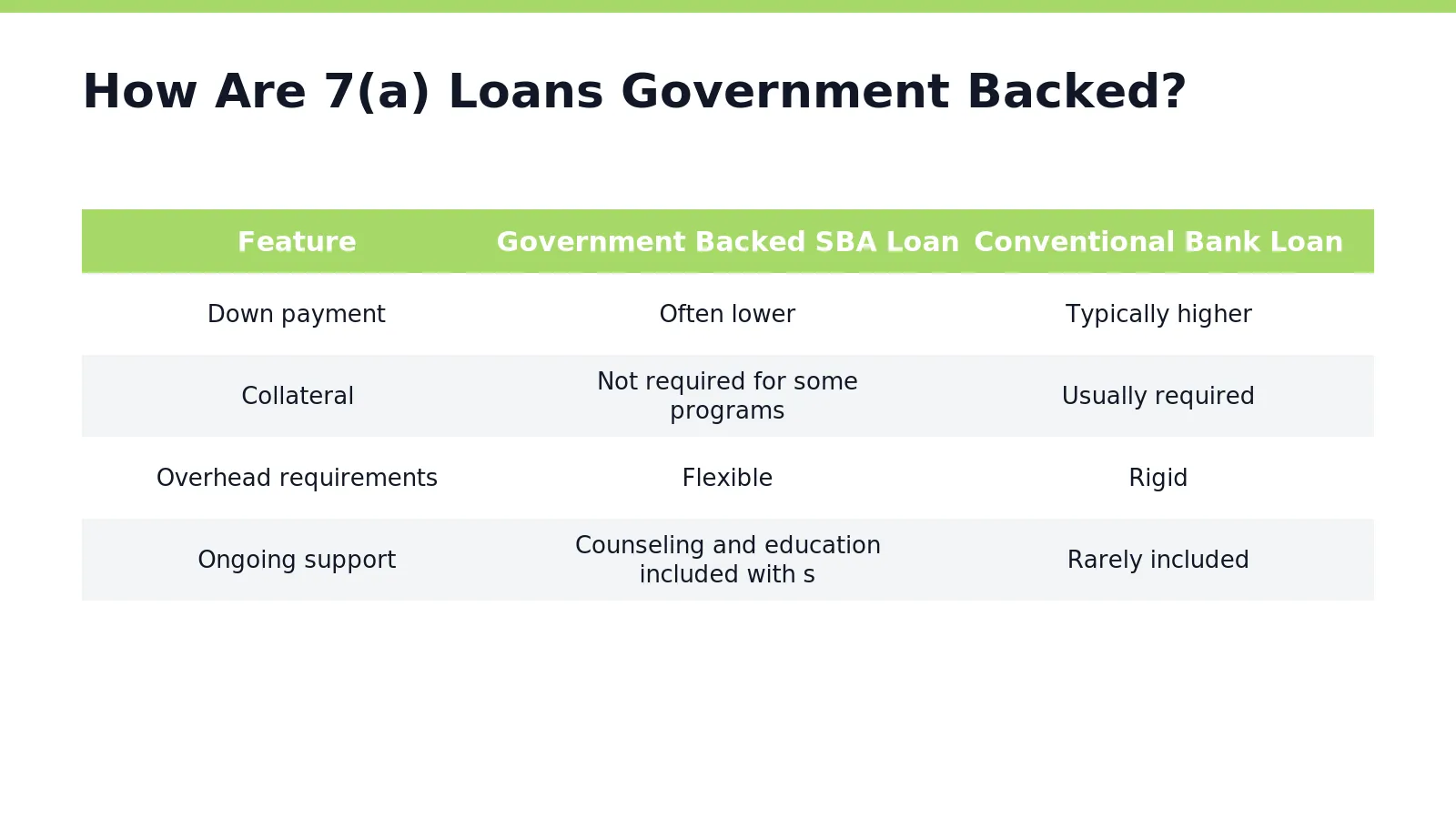
The federal government guarantees a portion of every SBA 7a loan, reducing the risk a lender absorbs if a borrower defaults. That guarantee, not a direct government loan, is what makes this financing structure different from a standard bank product. Business owners pursuing Small Business Growth benefit because lenders can extend capital to companies that might otherwise get turned away.
Despite that federal backing, pricing stays competitive. SBA-guaranteed loans typically have competitive rates and fees, making them an attractive option for borrowers. This structure keeps sba commercial financing accessible without inflating the cost of capital.
What makes a government backed small business loan different from a regular bank loan?
A government backed small business loan typically offers lower down payments, flexible overhead requirements, and may not require collateral in certain cases. Regular bank loans rarely offer that flexibility because the lender carries the full risk alone. The federal guarantee shifts part of that risk away from the lender, opening the door for growing companies with thinner asset bases.
Does SBA backing include more than money?
Yes. Some SBA loans include continued counseling and education support, helping owners start and run their businesses well beyond the closing date. The Small Business Administration also directs owners toward loans, investments, surety bonds, and grants as complementary paths to fund growth. For companies focused on Small Business Growth, that combination of guaranteed capital and ongoing guidance builds a stronger financial foundation than a loan alone.

What Can You Use 7(a) Funds For?
Real estate purchases, working capital, equipment upgrades, and business acquisitions all qualify for SBA 7a loan proceeds. Growing companies lose momentum when cash gets tied up in a single expense category instead of spread across the priorities that actually move the business forward. A single loan product covering multiple needs prevents that bottleneck.
SBA commercial financing through the 7(a) program funds several distinct categories of business growth:
- Acquiring, refinancing, or improving real estate and buildings
- Covering short- and long-term working capital needs
- Purchasing and installing machinery and equipment, including AI-related expenses
- Financing a complete or partial change of ownership
That range matters because growth rarely follows one path. A company scaling operations might need new machinery one year and a facility expansion the next. This structure flexes to meet the business wherever it stands.
Can 7(a) funds cover a business acquisition?
Yes. Ownership changes, whether complete or partial, fall squarely within approved uses. An owner planning to acquire another company, buy out a partner, or take on a controlling stake can structure that transaction through this government backed small business loan program rather than assembling multiple financing sources.
What if the business needs both equipment and working capital?
Both needs can be met under the same loan. The program supports machinery purchases and installation alongside short- and long-term working capital. A business does not need separate approvals for each category. This single-source flexibility is precisely what makes the 7(a) program well suited to expanding facilities, upgrading equipment, or acquiring another company under one financing plan, turning a growth vision into an executable strategy without juggling multiple lenders or mismatched repayment terms.

How Much Can Small Businesses Borrow?

Borrowing limits depend on the loan program, and the sba 7a loan caps the amount available to qualifying businesses. That ceiling gives small business growth plans meaningful room to expand operations, purchase equipment, or acquire another company without hunting for multiple funding sources. Growth-focused businesses lose momentum when they underestimate available capital. Settle for smaller, patchwork loans that create more paperwork and higher blended costs.
Sba commercial financing through the 7(a) program supports more than one goal at a time. Multiple purpose loans let a business combine several eligible uses into a single financing package, rather than applying separately for each need. A company scaling its footprint might roll real estate improvements, working capital, and equipment purchases into one approved loan.
What determines how much a business can actually qualify for?
Qualification hinges on how the business earns its income, not just its size or industry label. Eligibility factors are tied directly to the business's revenue-generating activity, which shapes both the loan structure and the amount a lender approves. Two companies of similar size can receive very different offers based on this factor alone.
Do all lenders offer the same borrowing limits?
No. Lenders and loan programs each set their own eligibility requirements. Those rules shape how much a business can access under a government backed small business loan. One lender's underwriting standards may unlock a larger amount than another's, even for the same applicant.
Because eligibility varies this much, growth-minded owners benefit from comparing terms across multiple lenders before committing to one offer.
Who Qualifies for SBA Commercial Financing?

Qualification hinges on three factors: how a business earns its income, who owns and controls it, and where it operates. These three elements form the foundation lenders use to evaluate any application for sba commercial financing, whether the business sells products, offers services, or supports a Small Business Growth expansion plan.
Beyond those basics, lenders look for specific markers of business health. A company applying for a government backed small business loan generally needs to meet SBA size standards, prove it can repay the debt, and show a clear, sound purpose for the funds. Skipping any of these three checkpoints often stalls an application before it reaches underwriting.
Credit history matters, but it rarely disqualifies an applicant outright. Business owners carrying past credit challenges can still access startup funding through SBA-backed programs. These programs weigh repayment ability and business viability alongside credit scores. This flexibility opens doors for entrepreneurs pursuing Small Business Growth who might not qualify for conventional bank financing.
Does Every Lender Use the Same Requirements?
No, each lender sets its own specific eligibility checklist for the loan program in question. Before applying, the lender provides a full list of requirements tailored to that particular SBA 7a loan or financing option. Reviewing this list early saves time and helps applicants gather the right documentation upfront.
What Documents Should Business Owners Prepare?
Applicants should expect to demonstrate their income source, ownership structure, and operating location clearly. Common preparation steps include:
- Confirming the business meets SBA size standards for its industry
- Organizing financial records that show repayment capacity
- Outlining a specific, sound purpose for the requested capital
- Requesting the lender's full eligibility checklist before submitting an application
Working through these steps builds a stronger, more complete application from the start.
Can 7(a) Loans Solve Cash Flow Gaps?

Cash flow gaps rank among the most common pressures facing growing small businesses. Even companies with strong sales pipelines encounter timing mismatches between receivables and expenses. An SBA 7a loan addresses this problem directly by supplying working capital that keeps daily operations running while revenue catches up.
Growth creates its own strain on cash. Payroll, inventory, and vendor payments often come due before customer payments arrive. Established businesses face this squeeze just as often as startups. Unexpected gaps in cash flow can put pressure on even the most established small businesses, regardless of years in operation or revenue size.
This form of SBA commercial financing bridges that timing gap. Loan proceeds cover operating expenses, payroll, and day-to-day costs without forcing owners to tap personal savings or high-interest credit cards. Because the loan is a government backed small business loan, lenders extend financing with structure and terms not typically found in conventional business loans.
What Can a 7(a) Loan Cover During a Cash Flow Gap?
Proceeds typically cover operating expenses, payroll obligations, and short-term working capital needs. Funds also help owners maintain inventory levels or keep vendor payments current during slower revenue periods.
Does a 7(a) Loan Preserve Capital for Other Priorities?
Yes. The financing structure lets owners manage essential operations while preserving capital for other priorities, such as expansion, equipment upgrades, or acquisition opportunities.
Common working capital uses include:
- Bridging gaps between invoicing and payment collection
- Covering payroll through seasonal slowdowns
- Maintaining vendor relationships through consistent, on-time payments
- Funding day-to-day operating costs without stalling growth plans
Business owners facing recurring cash flow strain gain more than short-term relief. They gain breathing room to plan, invest, and grow without draining reserves meant for long-term priorities.
How Does VIP Business Credit Help You Qualify?

Qualification starts with matching, not guessing. VIP Business Credit reviews a company's financial profile, growth stage, and risk factors, then connects the business to lenders suited to that exact situation. Skipping this step costs growing companies time and credibility. A mismatched application often results in a hard-pulled decline that lingers on a credit file for months.
SBA commercial financing works best when paired with the right lender from the start. VIP Business Credit draws from a network of over 1,000 national and local lenders, giving business owners access to options ranging from traditional bank products to alternative and specialized financing programs. That breadth matters because a startup chasing rapid expansion needs different terms than an established firm consolidating debt or acquiring new equipment.
How Does the Scoring Tool Improve Approval Odds?
VIP Business Credit's proprietary scoring tool shows owners how underwriters actually view their credit position before a single application goes out. Instead of applying blind, business owners see their gaps in advance — missing trade lines, thin credit history, or inconsistent business data — and can correct them first. This preview reduces the risk of a rejected application dragging down future approval chances.
Beyond scoring, credit-building work protects the owner's personal finances while strengthening the company's standing:
- Establishing credit under the business's EIN rather than the owner's Social Security number
- Supporting eligibility for a government backed small business loan, including options structured through SBA programs
- Reporting consistent business identity data that lenders and vendors use to judge risk
VIP Business Credit guides entrepreneurs across Northern Virginia. The Greater Washington, DC region through this exact process, building fundable credit files that hold up under underwriter scrutiny. Based in Sterling, VA, the firm works with lenders nationwide, extending that same qualification support to growth-focused business owners wherever they operate. The goal stays constant: turn a shaky application into a lender-ready one before it ever gets submitted.
What Should You Do Next to Grow?

Growth starts with a clear financing plan matched to a business's stage and goals. Skipping this step costs owners time, money, and missed opportunities as they scramble for capital under pressure instead of preparing ahead. A structured approach turns growth ambitions into funded, executable plans.
Business owners pursuing growth capital benefit from pairing expert guidance with the right funding tools. A government backed small business loan, including options through the SBA 7a loan program, gives growing companies access to competitive terms that standard commercial lending sometimes cannot match. Local Small Business Administration Resource Partners and counseling programs support this process directly, helping owners map out financing strategy alongside experienced advisors before they ever submit an application.
How does an advisory team make the loan process easier?
A small, focused team changes how quickly and clearly a business owner moves through financing decisions. VIP Business Credit operates with three employees who deliver concierge-level advisory support, working closely with owners as they prepare loan applications and strengthen their credit profiles. That size keeps guidance personal instead of routed through a call center.
Does location limit which lenders a growing business can access?
Geography does not have to limit funding options. VIP Business Credit's Sterling, VA office anchors a firm that works with lenders nationwide, meaning SBA commercial financing and other growth capital stay available regardless of where a business operates.
Owners preparing for the next stage of growth should consider:
- Meeting with local SBA Resource Partners to map financing timelines
- Reviewing eligibility for a government backed small business loan before applying
- Exploring federal contractor status, which opens set-aside contract opportunities for qualifying small businesses
- Working with an advisor to align loan structure with long-term expansion plans
Each step builds toward a stronger, better-funded next phase of business growth.
FAQ
What is an SBA 7(a) loan?
SBA 7(a) loans are government-backed financing where the SBA guarantees a portion of the loan, giving lenders confidence to fund small businesses with thinner credit histories. They cover working capital, real estate, equipment, and debt refinancing.
What can SBA 7(a) loan funds be used for?
Common uses include expanding facilities, purchasing commercial real estate, bridging cash flow gaps, refinancing existing business debt, and acquiring equipment, inventory, or another company.
How does VIP Business Credit help with SBA 7(a) financing?
VIP Business Credit connects entrepreneurs in Northern Virginia. The Greater Washington, DC region to over 1,000 national and local lenders, matching each business's growth stage to the right SBA loan structure and terms.
Conclusion
In closing, SBA 7(a) loans represent a proven pathway for small business owners seeking flexible, affordable capital to fuel growth and expansion. By understanding the application process, eligibility requirements, and strategic use of these funds, you position your business to compete effectively and build long-term stability. The key lies in approaching the opportunity with clear financial documentation. A realistic growth plan—two elements that strengthen your credibility with lenders and increase your approval odds.
To explore advisory support and application guidance, consult our SBA loan consulting pricing.
Contact
- 📞 Phone: +1 (571) 248-3863
- ✉️ Email: [email protected]
- 📅 Book a Consultation: Schedule online
- 🌐 Website: vipbizfunds.com
VIP Business Credit is based in Sterling, VA, and serves business owners throughout Northern Virginia and the Greater Washington, DC area.


