Restaurant Loans: Funding Your Food Service Business
Restaurant Loans: Funding Your Food Service Business
Restaurant business loans give food service owners capital for kitchen equipment, inventory, and expansion without draining cash reserves. VIP Business Credit's Business Fundability Scan matches restaurants and caterers to pre-qualified funding options within 2–5 minutes, drawing from 1,000+ lenders nationwide, building EIN-based credit instead of relying on personal liability. This streamlines access to essential restaurant loans and food service financing that support sustainable business growth.
Key Takeaways About Restaurant Loans and Food Service Financing
- Restaurant financing covers equipment purchases, inventory, staffing, and location costs for food service businesses.
- VIP Business Credit connects entrepreneurs to over 1,000 national and local lenders for restaurant business loans and hospitality funding.
- VIP Business Credit's Sterling, VA team builds EIN-based business credit for food service entrepreneurs, enhancing fundability and reducing personal liability.
Why Are Restaurant Loans So Hard to Get?
Lenders see restaurants as high-risk borrowers because the operating model itself is volatile. Thin profit margins leave little cushion when sales dip. Traffic often depends on factors no owner controls, like weather keeping guests home on a Friday night. Equipment failures compound the pressure. A walk-in cooler or fryer can break without warning, forcing owners to choose between an emergency repair bill and payroll.
Staffing adds another layer of instability. Restaurant owners frequently juggle heavy spending on inventory and kitchen equipment while managing staff turnover that never fully stops. Training new hires costs time and money, and that cycle repeats often in this industry. Underwriters notice this pattern, and it shapes how they price risk into restaurant loans.
Seasonal swings make the picture more complicated. Revenue can climb during vacation months and drop sharply in slower seasons, straining cash flow for weeks at a stretch. Food costs fluctuate too, tied to supply chains and ingredient pricing that owners rarely control. Managing employees, seasonal revenue, and food costs simultaneously creates a financial picture that looks inconsistent on paper, even for well-run operations.
What Makes Underwriters Nervous About Food Service Businesses and Hospitality Funding?
Underwriters weigh cash flow consistency heavily, and restaurants rarely show it. Thin margins mean a single slow month can shift a business from profitable to break-even. Add unpredictable equipment failures and turnover-driven labor costs. The risk profile looks shakier than a typical retail or service business.
Does That Mean Hospitality Funding and Restaurant Business Loans Aren't Available?
Not at all. Lenders who understand food service financing structure products around these realities instead of penalizing them. Matching the right lender to a restaurant's specific cash flow pattern is often the difference between a denial and approved hospitality funding. Working with an advisor who knows the lending landscape helps owners present their numbers in a way underwriters trust.
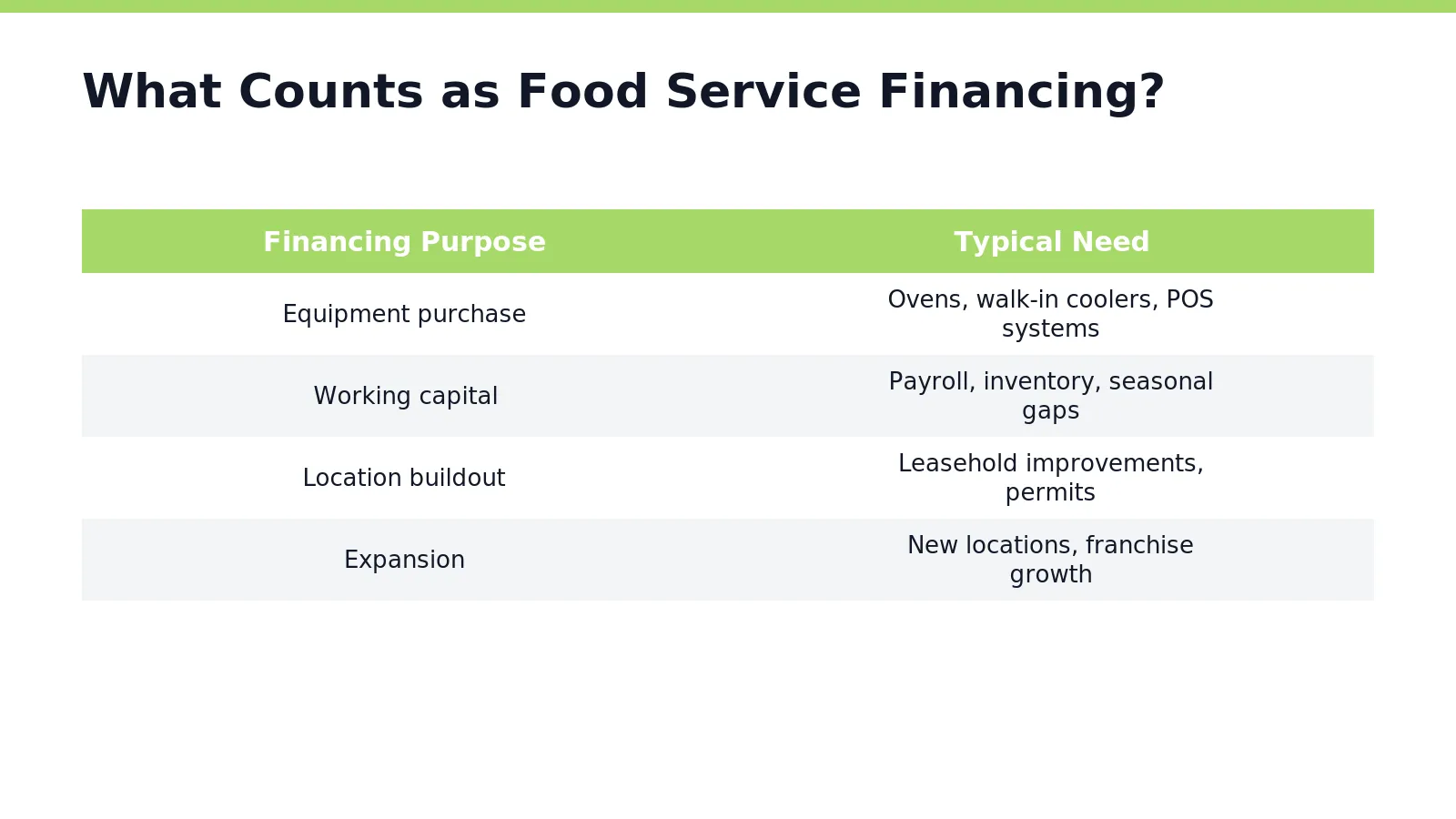
What Counts as Food Service Financing?
Food service financing covers any funding product built around the way restaurants, cafes, and food and beverage businesses actually operate. This category exists because a bakery's cash flow looks nothing like a retail shop's, and a food truck's equipment needs differ sharply from a full-service dining room's. Restaurant loans and financing are structured around those specific goals, not generic business borrowing.
The scope is broad by design. Restaurant business loans can cover short-term needs like restocking inventory before a busy weekend and long-term goals like financing a second location. That flexibility matters because expenses in this industry rarely arrive one at a time.
What Expenses Does Restaurant Financing Typically Cover?
New restaurateurs face a cluster of costs that hit all at once. Location buildout, kitchen equipment, initial inventory, and staffing combine to create expenses that most new owners need outside help covering. Financing products exist specifically to bridge that gap between opening day and steady revenue.
Is Hospitality Funding Different From a Standard Business Loan?
Hospitality funding isn't a single product; it's a category that includes several loan types matched to different needs. The table below breaks down common uses.
Because needs vary so much by concept and stage, a caterer scaling up equipment differs from a franchisee opening a third unit. Matching the right structure to the actual expense keeps repayment realistic and protects margins that are already thin in this industry.

Types of Restaurant Loans and Food Service Financing Options
Understanding the different kinds of restaurant loans and financing options available helps restaurant owners tailor funding solutions to their unique needs. The main types include:
- Term Loans: Fixed-amount loans with set repayment schedules, ideal for long-term investments like remodels, equipment purchase, or expansion.
- Equipment Financing: Loans or leases specifically for purchasing kitchen gear, POS systems, or other capital assets, often collateralized by the equipment itself.
- Lines of Credit: Flexible, revolving credit allowing owners to borrow up to a set limit, best suited for managing cash flow, inventory, or seasonal fluctuations.
- Revenue-Based Financing: Financing repaid as a percentage of daily or weekly sales, aligning payments with revenue patterns and reducing strain during slower periods.
- Merchant Cash Advances: Quick access to cash based on future sales, but often with higher costs and less favorable terms.
By selecting the type of loan or financing product that aligns with the specific capital need and cash flow profile, restaurant owners improve approval chances and maintain healthier margins.
Restaurant Business Loans Eligibility Criteria
Before applying for restaurant loans, understanding eligibility criteria helps prepare documentation and improve fundability. Common requirements include:
- Business Credit Profile: A solid EIN-based credit history demonstrating consistent payments and financial responsibility.
- Financial Documentation: Profit and loss statements, balance sheets, cash flow statements, and bank statements showcasing revenue trends and operational health.
- Business Plan: Especially for new restaurants or expansions, detailing concept, market analysis, revenue projections, and growth strategies.
- Time in Business: Many lenders prefer at least 1-2 years of operational history, though some specialized lenders offer products for startups.
- Personal Credit Score: Often evaluated alongside business credit, especially for new ventures or sole proprietorships.
- Collateral: May be required for larger loans, such as real estate or expensive equipment.
- Licenses and Permits: Proper registration and compliance with local regulations.
Meeting these criteria early and working with advisors to strengthen weaknesses can streamline approval and improve loan terms.
Hospitality Funding Repayment Structures
Repayment structures differ across hospitality funding products to accommodate the restaurant industry's cash flow characteristics. Common structures include:
- Fixed Payments: Most term loans and equipment financing require fixed monthly payments, beneficial for predictable budgeting but may challenge seasonal cash flow.
- Revolving Credit: Lines of credit allow flexible borrowing and repayment, adapting to fluctuating capital needs.
- Revenue-Based Payments: Payments automatically adjust based on a percentage of sales, ideal for matching slower periods and avoiding default.
- Interest-Only Periods: Some loans offer initial interest-only payments to ease cash flow during ramp-up phases.
Choosing a repayment plan aligned with seasonal patterns and sales volatility helps maintain financial stability and avoid default risks.
Seasonal Cash Flow Management for Dining Establishments
Managing fluctuating revenue streams is critical for restaurants, where peak and slow periods dramatically affect cash flow. Effective strategies include:
- Detailed Revenue Forecasting: Analyze historical data to predict monthly and seasonal sales patterns, preparing for leaner times.
- Aligning Expenses to Revenue: Schedule large purchases or staffing increases during peak seasons while minimizing variable costs in slower months.
- Flexible Financing Tools: Use lines of credit or revenue-based financing to bridge cash flow gaps without incurring high fixed payments.
- Cash Reserves: Maintain emergency funds to cover unforeseen expenses like equipment repairs.
- Vendor Negotiations: Structure payment terms to lag behind income cycles when possible.
- Regular Financial Reviews: Monitor cash flow closely to adjust plans proactively.
Integrating cash flow management with tailored restaurant loans and food service financing options ensures the business can weather seasonal variability while investing in growth.
Comparison of Common Restaurant Loan Types
Frequently Asked Questions About Restaurant Financing
1. How quickly can I get approved for a restaurant loan?
Approval time varies by lender and loan type. Alternative lenders and lines of credit often offer faster approvals (within days), while SBA loans and traditional bank loans may take several weeks to months due to stricter underwriting processes.
2. Can startups qualify for restaurant business loans?
Yes, but options are more limited. Startups typically need strong business plans, personal credit scores, and may rely on alternative lenders that consider potential over historical performance. Building business credit early improves eligibility over time.
3. What is EIN-based business credit and why is it important?
EIN-based credit is a business credit profile tied to the Employer Identification Number rather than the owner's personal credit. Building this helps separate personal liability from business debt, often yielding better financing terms and protecting personal assets.
4. How can I improve my chances of securing hospitality funding?
Maintain accurate and transparent financial records, build strong EIN-based business credit, work with knowledgeable advisors to present your business case effectively, and choose loan products aligned with your cash flow and growth needs.
Why Are Restaurant Loans So Hard to Get?
Lenders see restaurants as high-risk borrowers because the operating model itself is volatile. Thin profit margins leave little cushion when sales dip. Traffic often depends on factors no owner controls, like weather keeping guests home on a Friday night. Equipment failures compound the pressure. A walk-in cooler or fryer can break without warning, forcing owners to choose between an emergency repair bill and payroll.
Staffing adds another layer of instability. Restaurant owners frequently juggle heavy spending on inventory and kitchen equipment while managing staff turnover that never fully stops. Training new hires costs time and money, and that cycle repeats often in this industry. Underwriters notice this pattern, and it shapes how they price risk into restaurant loans.
Seasonal swings make the picture more complicated. Revenue can climb during vacation months and drop sharply in slower seasons, straining cash flow for weeks at a stretch. Food costs fluctuate too, tied to supply chains and ingredient pricing that owners rarely control. Managing employees, seasonal revenue, and food costs simultaneously creates a financial picture that looks inconsistent on paper, even for well-run operations.
What Makes Underwriters Nervous About Food Service Businesses and Hospitality Funding?
Underwriters weigh cash flow consistency heavily, and restaurants rarely show it. Thin margins mean a single slow month can shift a business from profitable to break-even. Add unpredictable equipment failures and turnover-driven labor costs. The risk profile looks shakier than a typical retail or service business.
Does That Mean Hospitality Funding and Restaurant Business Loans Aren't Available?
Not at all. Lenders who understand food service financing structure products around these realities instead of penalizing them. Matching the right lender to a restaurant's specific cash flow pattern is often the difference between a denial and approved hospitality funding. Working with an advisor who knows the lending landscape helps owners present their numbers in a way underwriters trust.
What Counts as Food Service Financing?
Food service financing covers any funding product built around the way restaurants, cafes, and food and beverage businesses actually operate. This category exists because a bakery's cash flow looks nothing like a retail shop's, and a food truck's equipment needs differ sharply from a full-service dining room's. Restaurant loans and financing are structured around those specific goals, not generic business borrowing.
The scope is broad by design. Restaurant business loans can cover short-term needs like restocking inventory before a busy weekend and long-term goals like financing a second location. That flexibility matters because expenses in this industry rarely arrive one at a time.
What Expenses Does Restaurant Financing Typically Cover?
New restaurateurs face a cluster of costs that hit all at once. Location buildout, kitchen equipment, initial inventory, and staffing combine to create expenses that most new owners need outside help covering. Financing products exist specifically to bridge that gap between opening day and steady revenue.
Is Hospitality Funding Different From a Standard Business Loan?
Hospitality funding isn't a single product; it's a category that includes several loan types matched to different needs. The table below breaks down common uses.
Because needs vary so much by concept and stage, a caterer scaling up equipment differs from a franchisee opening a third unit. Matching the right structure to the actual expense keeps repayment realistic and protects margins that are already thin in this industry.
Which Restaurant Loan Fits Your Situation for Food Service Financing?
No single loan works for every kitchen emergency or growth plan. The right choice depends entirely on what triggered the need for capital in the first place. A restaurant facing a seasonal cash gap needs something very different from one replacing a walk-in cooler or buying the building next door.
Matching the product to the problem prevents two costly mistakes: borrowing too slowly for an urgent repair, or locking into rigid terms for a need that fluctuates month to month. Restaurant owners exploring restaurant loans should start by naming the specific gap before comparing rates or lenders.
What's the Best Loan Option for Slow Seasons or Unpredictable Cash Flow?
A revolving line of credit tends to fit seasonal swings best. Owners draw funds only when needed, then repay as revenue comes back in, which eases pressure during slower months. This structure makes it a practical form of food service financing for restaurants with predictable busy and slow periods. It flexes with the business rather than forcing fixed payments year-round.
Is an SBA Loan the Right Choice for a Broken Kitchen Appliance?
Usually not, if speed matters. SBA and bank loans offer some of the lowest rates available, but funding often takes 30 to 90-plus days. A failed walk-in cooler or broken oven can't wait that long. These loans work better for planned projects than emergencies.
The table below breaks down how loan type aligns with common restaurant needs:
Choosing the right structure protects margins and keeps hospitality funding decisions strategic rather than reactive.

How Do SBA Loans Work for Restaurants?
SBA loans give restaurant owners a government-backed financing path with repayment terms built around the food service industry's cash flow patterns. Seasonal revenue swings, slow winter months, and unpredictable foot traffic make rigid repayment schedules risky. Restaurant loans structured through the SBA account for those realities instead of forcing a one-size-fits-all repayment plan onto a business that doesn't earn evenly month to month.
Two SBA programs matter most for restaurant financing: the 7(a) loan and the 504 loan. Owners buying an established restaurant franchise, complete with proven systems and brand support, can pursue either program. Owners purchasing or launching an independent restaurant have the same options available to them.
What's the Difference Between an SBA 7(a) and 504 Loan for a Restaurant?
An SBA 7(a) loan works as general-purpose food service financing, covering working capital, equipment, inventory, or the purchase of an existing restaurant. An SBA 504 loan focuses more narrowly on fixed assets like real estate or large equipment purchases. Restaurant owners choosing between the two should match the loan structure to the specific expense driving the need for capital.
Why Does the SBA Loan Process Take Capital Planning Seriously?
Food service is a dynamic, rewarding industry, but it demands substantial capital to open, operate, and grow. Kitchen buildouts, licensing, staffing, and inventory all compete for the same limited cash. SBA loans address that capital demand directly, giving owners a structured path rather than a patchwork of short-term fixes.
Before applying, restaurant owners benefit from understanding how lenders evaluate their business:
- Franchise buyers: need documentation on the franchise agreement, territory, and proven revenue model
- Independent restaurant buyers: need a solid business plan, projected cash flow, and industry experience
- Both paths: require strong personal and business credit positioning to qualify
This groundwork applies broadly to hospitality funding decisions, not just SBA products. Lenders across the board want to see a business built to withstand the industry's cash flow rhythm.
Can Equipment and Fleet Credit Lines Help with Food Service Financing?
Yes — equipment credit lines and fleet credit lines solve two of the most persistent funding gaps in food service: broken kitchen machinery and delivery vehicles that need replacing. Both tools let restaurant owners access what the business needs immediately, rather than waiting months while cash reserves rebuild.
An equipment credit line covers ovens, walk-in coolers, mixers, and other kitchen essentials that fail without warning. Owners get the equipment now, start using it right away, and build business credit with every on-time payment. Payments on that equipment typically qualify as deductible business expenses, which softens the tax hit while the restaurant keeps operating at full capacity.
Fleet credit lines work the same way but apply to delivery and catering vehicles. Restaurant groups running multiple trucks, vans, or cars for off-site catering and third-party delivery can finance the whole fleet under one credit structure. Payments build business credit history and lock in tax deductions tied to vehicle use, giving owners a financial advantage beyond just having the vehicles on the road.
What Does Fleet Financing Actually Cover?
Fleet financing structures deals for the specific vehicles a food service business runs day to day. Trucks for catering setups, vans for bulk delivery routes, and cars for smaller local orders. Specialists design each deal around how the vehicles get used, not a generic loan template.
Who Provides This Kind of Food Service Financing?
VIP Business Credit connects restaurant owners to a network of more than 1,000 national and local lenders offering these credit lines. That network spans:
- Traditional banks with established equipment and vehicle financing programs
- Alternative finance providers built for faster approvals
- Specialized programs matched to a restaurant's growth stage, sector, and risk profile
Matching the right lender to the right need keeps kitchen and fleet upgrades from draining working capital reserved for payroll, inventory, and rent.
How Does a Credit Readiness Scan Work for Restaurant Business Loans?
A credit readiness scan reviews a restaurant's financial profile and shows exactly where it stands with lenders before an application ever gets submitted. Restaurant owners see their credit gaps clearly, along with a roadmap for fixing them and positioning the business to qualify for restaurant loans. That clarity matters in a business where a broken walk-in cooler or a slow month can't wait on guesswork.
The scan doesn't just flag problems — it maps a path forward. Restaurant owners walk away knowing which financing programs they can pursue immediately and which ones require more groundwork first. VIP Business Credit uses a pre-qualification process for exactly this purpose, sorting available food service financing options by readiness level rather than leaving owners to apply blind and collect rejections.
What Does the Scan Actually Measure?
The scan evaluates how a restaurant's credit profile appears to underwriters, the same lens lenders use when deciding on approvals. VIP Business Credit backs this process with a proprietary scoring tool that tracks that lender view over time. A restaurant owner can watch progress instead of guessing at it. Rather than a one-time snapshot, the score becomes an ongoing gauge of fundability as the business grows.
Why Does This Matter for Restaurant Financing Specifically?
Restaurants face thin margins and seasonal swings, so timing an application matters as much as qualifying for one. A scan run months ahead of a kitchen remodel or a second location gives an owner time to close credit gaps before applying.
For entrepreneurs across Northern Virginia and the greater Washington, D.C. region, this groundwork supports a broader goal: separating personal liability from business debt by building credit under the company's own EIN. That separation protects personal assets while opening the door to stronger hospitality funding terms down the road.
How Do You Manage Cash Flow Between Restaurant Loans?
Working capital stays available through deliberate cash flow strategies, not through waiting for a shortfall to force action. Restaurant owners who plan ahead avoid the scramble that hits when payroll, rent, and supplier invoices all land in the same week. A kitchen fire or a slow month shouldn't determine whether the business survives.
Hospitality funding works best as part of a broader cash management approach, not a one-time fix. Seasonal swings hit restaurants harder than most industries — a slow winter for an outdoor patio or a summer lull for a campus cafe can drain reserves fast. Controlling cash on hand gives an operator room to absorb those swings while still investing in growth.
What Does Cash Flow Management Actually Involve?
Cash flow management means matching the timing of money coming in with the timing of money going out. For a restaurant, that includes:
- Forecasting revenue against known seasonal patterns
- Timing loan draws to cover gaps before they become emergencies
- Keeping a reserve for equipment failures or supply cost spikes
- Reviewing vendor terms to align payment dates with cash inflows
Who Helps Restaurant Owners Make These Calls?
Local Business Credit Advisors guide restaurant owners through financing decisions with personalized, concierge-level support. Rather than handing over a generic plan, an advisor works through the specific pressures of a given kitchen or dining concept. That guidance turns cash flow management from guesswork into a repeatable system tied to real restaurant loans and financing tools.
What's the Next Step to Fund Your Restaurant Business?
The next step is a conversation with an advisor who understands restaurant loans, food service financing, and the cash flow realities of running a kitchen. VIP Business Credit, based in Sterling, Virginia, works directly with restaurant owners, franchisees, and caterers who need a clear financing path rather than a maze of generic loan ads. Skipping that conversation often means guessing at loan products that don't fit a restaurant's seasonal revenue swings or equipment needs.
Northern Virginia restaurant owners gain a local advantage here because the firm operates from Sterling, VA. Owners in the region have a hospitality funding partner who understands the local business landscape, not a call center in another state.
Can Restaurant Owners Meet with an Advisor in Person?
Owners who prefer face-to-face guidance can visit VIP Business Credit's office at its Sterling, VA location. In-person meetings help clarify complex topics like corporate credit building or food service financing structure. Many owners find it easier to ask detailed questions about equipment loans or working capital lines when sitting across from a real advisor.
What Makes the Advisory Relationship Different from a Typical Broker?
VIP Business Credit keeps its team small on purpose. A three-person staff means restaurant clients work with familiar faces, not a rotating call queue. That structure supports consistency: the advisor who reviews a client's credit profile today is the same one following up next quarter.
This approach reflects a broader philosophy. VIP Business Credit positions itself as a long-term partner in a restaurant's financial growth, not a one-time broker chasing a single transaction. For an owner weighing options, the practical next step looks like this:
- Reach out to discuss current funding needs and credit position.
- Schedule an in-person or virtual meeting with an advisor.
- Build a financing roadmap suited to the restaurant's stage and goals.
FAQ
What Can Restaurant Business Loans Cover?
Restaurant loans fund kitchen equipment, inventory, staffing, and location costs, covering both short-term needs like restocking before a busy weekend and long-term goals like financing a second location.
Why Do Restaurants Struggle to Qualify for Financing?
Lenders view restaurants as high-risk because thin profit margins, unpredictable equipment failures, constant staff turnover, and seasonal revenue swings create cash flow patterns that look inconsistent on paper.
How Does VIP Business Credit Help Restaurant Owners Find Funding?
VIP Business Credit's Business Fundability Scan matches restaurants and caterers to pre-qualified options from over 1,000 national and local lenders within 2–5 minutes, building EIN-based business credit instead of personal liability.
What Are the Benefits of Building EIN-Based Business Credit?
Building EIN-based credit separates your personal finances from your business, reducing personal liability, improving loan approval chances, and unlocking better financing terms tailored to your restaurant's operational realities.
Conclusion
In closing, securing the right restaurant loan requires understanding your business's financial profile and matching it with lenders who specialize in food service. By building a strong EIN-based business credit foundation and clarifying your funding needs—whether for equipment, working capital, or expansion—you position your restaurant for approval and sustainable growth. The path forward combines honest financial assessment with strategic access to the lending options that fit your operation's stage and goals.
### About The AuthorLee Johnson is a seasoned Real Estate Investor, Business Growth Strategist, and Master Certified Professional Coach. His mission is to help individuals achieve financial freedom and live a life filled with abundance and happiness. With over 25 years of experience in business finance and credit strategy, he has guided numerous entrepreneurs in building fundable credit profiles separate from their personal finances. Lee has also established a significant real estate portfolio valued at $254 million, providing him with unique insights into capital access strategies for business owners.### Contact VIP Business Credit
- 📞 Phone: (571) 248-3863
- ✉️ Email: [email protected]
- 📅 Consultation: Schedule A Business Financial Health Strategy Call
- 🌐 Website: https://vipbizfunds.com
- 🎯 FREE Business Success Scan: FREE Business Success Scan
Service Area: Sterling, VA and surrounding areas.


