Restaurant Loans: Funding Your Food Service Business
Restaurant Loans: Funding Your Food Service Business

By VIP Business Credit Editorial Team · Updated 2026-08-26
Restaurant business loans give food service entrepreneurs capital for equipment, buildout, inventory, or working capital needs. VIP Business Credit connects restaurant owners to a network of 1,000+ lending options nationwide, using its Capital-Ready Score and Funding Explorer tools to match each business with financing suited to its specific stage and risk profile.
Key Takeaways
- Restaurant business loans address short- and long-term funding needs for food service industry growth and operations.
- VIP Business Credit connects entrepreneurs to over 1,000 national and local lenders for restaurant financing.
- US restaurant industry continues expanding with billions in gross turnover despite recent economic challenges.
- Restaurant financing supports equipment purchases, customer loyalty programs, and opening new food and beverage establishments.
Why Do Restaurants Struggle to Get Funded?
Lenders hesitate on restaurant applications far more than on other small-business sectors. Seasonal revenue swings, unpredictable food costs, and thin margins make underwriters nervous. A pizza shop that thrives in summer might barely break even in February. A bank sees that volatility as risk rather than rhythm.
Daily operations add another layer of strain. Owners often pour cash into inventory and equipment while simultaneously hiring and training staff who may not stay long. That combination drains reserves fast, leaving little cushion when a lender asks for proof of stability.
What makes restaurant applications riskier to lenders?
Restaurants operate on unusually tight margins compared to other small businesses. Food costs shift week to week based on supply and market pricing. Staff turnover compounds the problem, since retraining costs eat into the same budget a restaurant needs for restaurant loans repayment. Underwriters see these combined pressures as a pattern of instability, even when a business is fundamentally sound.
How can a restaurant owner fix a weak funding profile before applying?
A credit scan built for restaurants can expose the exact gaps holding an application back. Instead of guessing why an offer got denied, an owner gets a clear roadmap showing which factors to fix first — trade lines, cash flow documentation, or business credit history. That kind of diagnostic step turns a vague rejection into a concrete plan for the next round of food service financing.
VIP Business Credit works directly with entrepreneurs across Northern Virginia and the Greater Washington, DC region, helping restaurants build credit tied to the business itself rather than the owner's personal score. That shift matters most when a growing kitchen needs hospitality funding without risking personal assets.
What Restaurant Loans Are Actually Available?
Restaurant owners can choose from several distinct funding paths, each built around the realities of running a food business. Restaurant loans exist specifically to meet the goals of restaurants, cafes, and other food and beverage operations, rather than acting as generic small-business credit. That distinction matters because a loan built for retail or professional services rarely accounts for perishable inventory, seasonal traffic swings, or equipment breakdowns during a dinner rush.
Food service financing products cover a wide range of needs, from short-term cash gaps to long-term capital projects. A short-term option might bridge a slow month between vacation seasons. A long-term product might fund a full location buildout over several years.
What can restaurant financing actually pay for?
Most restaurant loan products fund a specific set of real-world needs. Common uses include:
- Buying an existing restaurant location
- Building a new restaurant from the ground up
- Refurbishing or updating a current space
- Expanding into a second location or additional seating
How many lenders should a restaurant owner realistically compare?
Comparing only one or two banks limits options and often means missing better terms elsewhere. Working with a network of more than 1,000 national and local lenders, VIP Business Credit widens that pool considerably. More lenders in the mix means more chances to match a restaurant's stage, credit profile, and cash flow pattern to the right product.
Hospitality funding decisions shouldn't rest on whichever bank happens to be closest. Comparing terms across a broad lender network, rather than settling for the first offer, protects owners from overpaying on rates or accepting limits that don't match actual growth plans.
How Does Food Service Financing Cover Equipment?
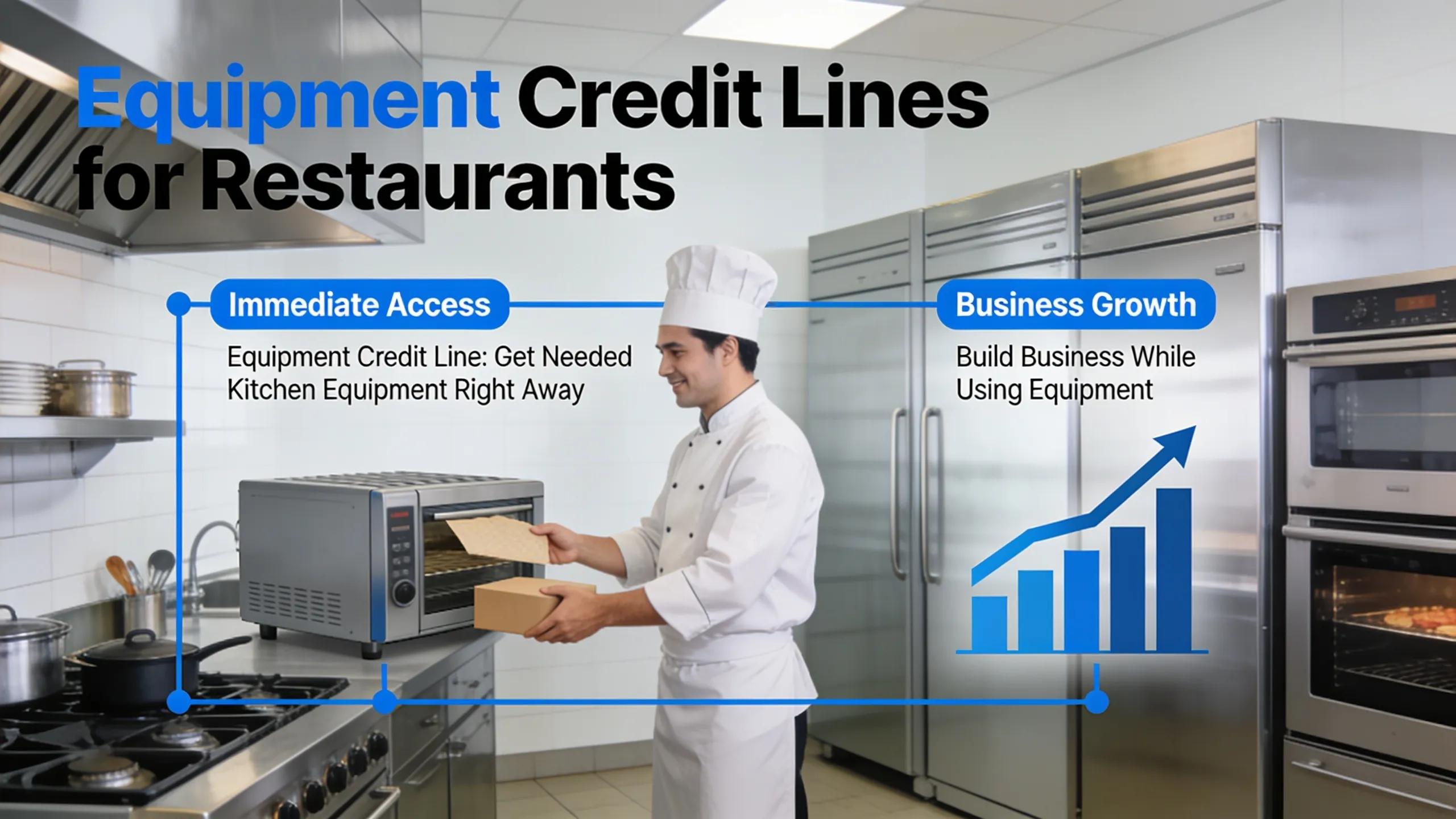
Equipment credit lines put ovens, walk-in coolers, and prep stations into a kitchen immediately, without draining cash reserves. Restaurant owners get the equipment their business needs right away, and regular payments build business credit over time. Those same payments often qualify as deductible business expenses, turning a necessary purchase into a tax advantage rather than just a cost.
Restaurant loans stretch further than a single mixer or fryer, though. Restaurant startup loans are structured to cover a wider list of launch costs, including:
- Kitchen and dining equipment
- Leasehold improvements to the physical space
- Initial inventory and supplies
- Marketing to attract early customers
- Working capital for day-to-day operations
That breadth matters because a new restaurant rarely has one funding need. Equipment competes with buildout costs and opening-week marketing. Startup financing is designed to address all of it under one plan.
Can food trucks and caterers finance more than one vehicle?
Yes. Hospitality funding extends to fleet credit lines, which let food truck operators and caterers finance multiple vehicles at once instead of saving up for each one individually. Every payment made on that fleet also builds business credit. Owners lock in available tax deductions tied to vehicle financing.
Who structures financing for trucks and vans specifically?
Fleet specialists focus on deals built around trucks, vans, and cars, which fits catering and mobile food operations far better than generic equipment loans. A caterer expanding from one van to three, or a food truck operator adding a second unit, needs financing shaped around vehicles first. Working with specialists who understand that structure keeps terms realistic and payments predictable as the fleet grows.
Which Options Fit Startup Restaurant Costs?
New restaurant costs fall into three buckets: buildout, equipment, and working capital, and different restaurant loans match each one better than a single blanket product. Opening a restaurant is exciting. The dream only becomes real when careful planning pairs with enough funding lined up before the doors open. Owners who wait until construction bills arrive often scramble for capital at the worst possible moment.
A restaurant startup loan exists specifically for this launch phase. This financing category was built to help entrepreneurs cover the expenses that come before a single customer walks in — leasehold improvements, kitchen equipment, initial inventory, and marketing to announce opening day. Matching the loan type to the cost category keeps repayment terms realistic instead of forcing short-term debt onto long-term assets.
What costs should a startup loan actually cover?
Startup-stage food service financing works best when it lines up with how the expense behaves over time.
| Cost Type | Better-Suited Financing |
|---|---|
| Kitchen equipment | Equipment-backed term loans |
| Buildout/leasehold improvements | Longer-term startup loans |
| Opening inventory | Short-term or revolving credit |
| Marketing/launch costs | Working capital lines |
Is now a good time to seek hospitality funding?
Timing favors owners moving forward now. The US restaurant trade is expected to keep expanding and generate billions in gross turnover, which strengthens the case for lenders backing new concepts. That growth trajectory doesn't guarantee approval, though — it means the market itself supports the decision to open.
Strong hospitality funding applications pair that favorable timing with a clear cost breakdown. Owners who separate buildout, equipment, and inventory needs before applying present a sharper, more fundable picture to lenders reviewing the request.
How Can Hospitality Funding Support Expansion?
Expansion requires capital that matches the pace of a growing restaurant, and hospitality funding gives owners that flexibility. Restaurant entrepreneurs today face far more financing choices than in years past. Options exist to buy, build, expand, or refurbish a location, and separate tools exist to cover everyday costs. That range matters because growth rarely happens through a single expense; it happens through many smaller ones stacked together.
New equipment, a second location, or a dining room renovation each demand different funding structures. Restaurant loans designed for expansion typically pair with working capital tools built for daily operations, creating a two-part strategy: one product funds the big project, another keeps the lights on while that project gets built out.
What Role Does Working Capital Play in Growth?
Working capital financing secures funds specifically for day-to-day expenses like payroll, inventory, and utility bills. Expansion projects often strain cash reserves before new revenue arrives. A dedicated cash cushion prevents operational gaps during the transition.
Why Does Cash Flow Timing Matter So Much?
Cash flow strategies exist to ensure working capital is available exactly when a restaurant needs it, not after a shortfall has already caused damage. Restaurants that control their cash position consistently find it easier to fund growth. Expansion decisions depend on predictable, available capital rather than reactive borrowing.
Food service financing built around this timing principle typically includes:
- Working capital lines for daily operational expenses
- Equipment financing tied to specific growth projects
- Cash flow monitoring to flag gaps before they become emergencies
- Expansion capital sized to match renovation or location costs
Owners who pair the right financing type with disciplined cash flow management position their restaurants to grow on schedule, not on hope.
Why Build Business Credit Under Your EIN?
An Employer Identification Number, or EIN, lets a restaurant establish a credit history that stands apart from the owner's personal Social Security number. Without that separation, a single missed vendor payment or an unexpected slow season can drag down a personal credit score for years. VIP Business Credit's core focus centers on helping restaurant, cafe, and food truck owners qualify for high-limit restaurant loans and revolving credit lines tied directly to the business's own EIN.
That structure changes who carries the risk. When financing lives under the company's identity, a downturn in sales or a delayed catering payment does not automatically follow the owner home. Building credit this way protects personal assets — homes, savings, personal credit scores — while giving the restaurant room to grow through food service financing and other capital tools.
Does an EIN protect a restaurant owner's personal credit?
Yes. Lenders and vendors that report to business credit bureaus track payment activity against the EIN, not the owner's Social Security number. That separation keeps business debt off a personal credit report, which matters when applying for a mortgage or an auto loan later.
Why does VIP Business Credit's size matter for hospitality clients?
A three-person team means restaurant owners work directly with advisors who know their file, not a rotating call center. That hands-on structure suits hospitality funding decisions, which often hinge on seasonal cash flow patterns unique to food service.
VIP Business Credit operates from Sterling, Virginia, placing the team close to the restaurants, food trucks, and catering companies shaping the regional dining scene. Familiarity with local permitting timelines, seasonal foot traffic, and regional supplier relationships shapes how advisors match restaurant clients to lenders. That local grounding, paired with EIN-based credit building, gives owners a foundation built for sustainable growth rather than short-term borrowing.
How Does a Credit Score Tool Help?
A credit score tool shows restaurant owners exactly how a lender views their business before an application ever gets submitted. Guesswork disappears. Instead of applying blind and risking a denial that dings the credit file, owners see gaps in advance and fix them first.
VIP Business Credit's platform gives food service entrepreneurs four connected tools: a Capital-Ready Score, a Funding Explorer, a Funding Manager, and Bureau Insights. Together these tools reveal how underwriters actually evaluate a restaurant, café, food truck, or catering business — not just how the owner assumes they're being evaluated. That gap between perception and reality is often where restaurant loans get denied.
This structure isn't a one-time snapshot. It supports a step-by-step improvement process. A restaurant can move from marginal approval odds to qualifying for better terms, higher limits, and lower rates as its profile strengthens over time. A pre-qualification workflow sorts financing programs into two clear buckets:
- Programs the business may already qualify for right now
- Programs that require additional preparation before applying
That distinction saves owners from wasting time chasing food service financing they aren't ready for yet, while pointing them toward what's actually within reach today.
What if a restaurant doesn't qualify for financing yet?
Falling short of eligibility isn't a dead end — it's a checklist. The pre-qualification workflow identifies precisely which factors are holding a profile back. An owner knows what to correct before reapplying.
Does a person guide the process, or is it fully automated?
Local Business Credit Advisors work alongside the platform, offering personalized, concierge-level support rather than a single transactional interaction. For an operator juggling inventory, staffing, and seasonal cash swings, that guidance turns raw data into a usable hospitality funding strategy built around the restaurant's actual timeline, not a generic template.
What Should Restaurant Owners Do Next?
Restaurant owners move forward by choosing a financing partner built for the long haul, not a broker chasing a single deal. VIP Business Credit structures its pricing to be transparent and free of hidden surprises. Restaurant clients know the costs upfront before signing anything. That distinction matters in an industry where thin margins already stretch owners thin. A partner focused on repeat guidance, rather than a one-time transaction, changes how financing decisions get made over the life of the business.
How does VIP Business Credit help beyond just securing a loan?
Financing is only part of the picture. VIP Business Credit also strengthens the credibility signals lenders check before extending restaurant loans or approving a line of credit. That means keeping business identity data consistent across registrations and directories, along with building trade credit reporting that shows a track record of on-time payment. Lenders and vendors read these signals as proof of lower risk, which opens the door to better terms down the line.
Is this approach only for brand-new restaurants?
No. The framework serves two very different stages of ownership at once:
- New ventures — food truck operators, first-time café owners, or caterers seeking their first approvals for food service financing.
- Established operators — restaurant groups looking to scale locations, consolidate existing debt, or secure better-priced hospitality funding for expansion.
Both paths run through the same foundation: consistent credibility signals, transparent pricing, and steady guidance.
Restaurant owners in the Northern Virginia area can take the next step in person. VIP Business Credit's office sits at 21000 Southbank St Ste 106-380, Sterling, VA 20165, giving local operators a direct place to start the conversation. Whether the goal is opening a first location or expanding a growing group of restaurants, the process begins with an honest look at where the business stands today, and a clear plan for where it needs to go next.
FAQ
Why do restaurants struggle to get approved for business loans?
Seasonal revenue swings, unpredictable food costs, and thin margins make lenders view restaurants as unstable, even when the business itself performs well. Staff turnover and heavy spending on inventory and equipment further strain cash reserves lenders want to see.
How does VIP Business Credit help restaurant owners get funded?
VIP Business Credit connects restaurant owners to a network of over 1,000 national and local lenders, using its Capital-Ready Score and Funding Explorer tools to match each business with financing suited to its stage and risk profile.
What can a restaurant owner do to fix a weak funding profile?
A credit scan built for restaurants identifies specific gaps, such as trade lines, cash flow documentation, or business credit history, holding an application back. This turns a vague rejection into a concrete plan for the next funding attempt.
Conclusion
In closing, securing the right restaurant loan requires understanding your business's unique funding needs and positioning your operation as a credible borrower to lenders. By building EIN-based business credit, strengthening your financial foundation, and connecting with lenders who understand food service operations, you gain access to capital on terms that support sustainable growth. The path forward demands clarity about your numbers, consistency in your business identity, and partnership with advisors who guide you through the lending landscape with transparency and expertise.
About The Author
Lee Johnson is the Co-Founder and CEO of VIP Business Credit, a seasoned Real Estate Investor, Business Growth Strategist, and Master Certified Professional Coach with more than 500 coaching hours. He holds a Bachelor of Science from Fairleigh Dickinson University and a Master of Business Administration from the University of Phoenix. Since 2005, Lee has built a personal real estate investment portfolio exceeding 1,700 units valued at approximately $254 million across multiple U.S. markets.
Lee's mission is to help small business owners — including those in home services, trucking, and real estate — achieve financial freedom by first establishing a strong business credit profile, then accessing the highest loan amounts at the best terms available. He and his team at VIP Business Credit guide restaurant, food truck, and catering entrepreneurs through that same process, helping them build credit tied to the business itself.
Connect with Lee and VIP Business Credit:


