Non-Bank Financing Solutions for Growing Businesses
Non-Bank Financing Solutions for Growing Businesses
Non-bank business financing solutions include revenue-based financing, online term loans, lines of credit, merchant cash advances, invoice factoring, equipment financing, and PO financing, funding in 24 hours to 2 weeks. VIP Business Credit connects owners to 1,000+ lenders through its pre-qualification tool, matching pre-qualified options with zero impact on personal credit. These alternative funding solutions provide vital options outside traditional bank lending.
Key Takeaways on Non Bank Financing and Alternative Business Lending
Non-bank financing solutions fund businesses in 24 hours to 2 weeks versus traditional bank timelines.
VIP Business Credit connects entrepreneurs to over 1,000 national and local lenders for flexible financing options, including private funding sources.
Alternative business lending offers revenue-based financing, term loans, lines of credit, and equipment financing without lengthy approval processes.
Why Look Beyond Traditional Bank Loans for Alternative Funding Solutions?
Bank approval odds stack against small business owners more often than most applicants expect. According to the Federal Reserve's Small Business Credit Survey, cited by the publication Alternative Business Loans: 7 Non-Bank Options, about a third of small business loan applicants at large banks get declined outright. Nearly half of the applicants who do get approved receive less money than they actually requested. That gap between what a business needs and what a bank offers can stall payroll, inventory orders, or a lease renewal at exactly the wrong moment.
Credit conditions at conventional banks are not loosening anytime soon, either. Regulators are watching bank portfolios closely for excessive risk, which pushes many banks to restrict lending even to companies with solid financials. A profitable business with clean books can still walk away empty-handed because underwriting standards have tightened industry-wide.
Is bank financing the only path to business capital?
No. Non bank financing and alternative business lending give companies routes to capital that don't depend on a single bank's risk appetite. These alternative funding solutions typically move faster and evaluate businesses on more than just a credit committee's current mood.
How does VIP Business Credit help when banks say no?
VIP Business Credit works with entrepreneurs across Northern Virginia. The Greater Washington, DC region to build credit tied directly to the business's EIN, rather than leaving funding prospects dependent on bank approval alone. This approach opens access to private funding sources beyond conventional lending.
What separates bank-dependent businesses from those with broader options through alternative business lending and non bank financing:
Bank-only borrowers face a one-in-three decline rate and reduced funding amounts
EIN-based credit building creates approval paths independent of a single lender
Diversified funding access reduces exposure when credit conditions tighten
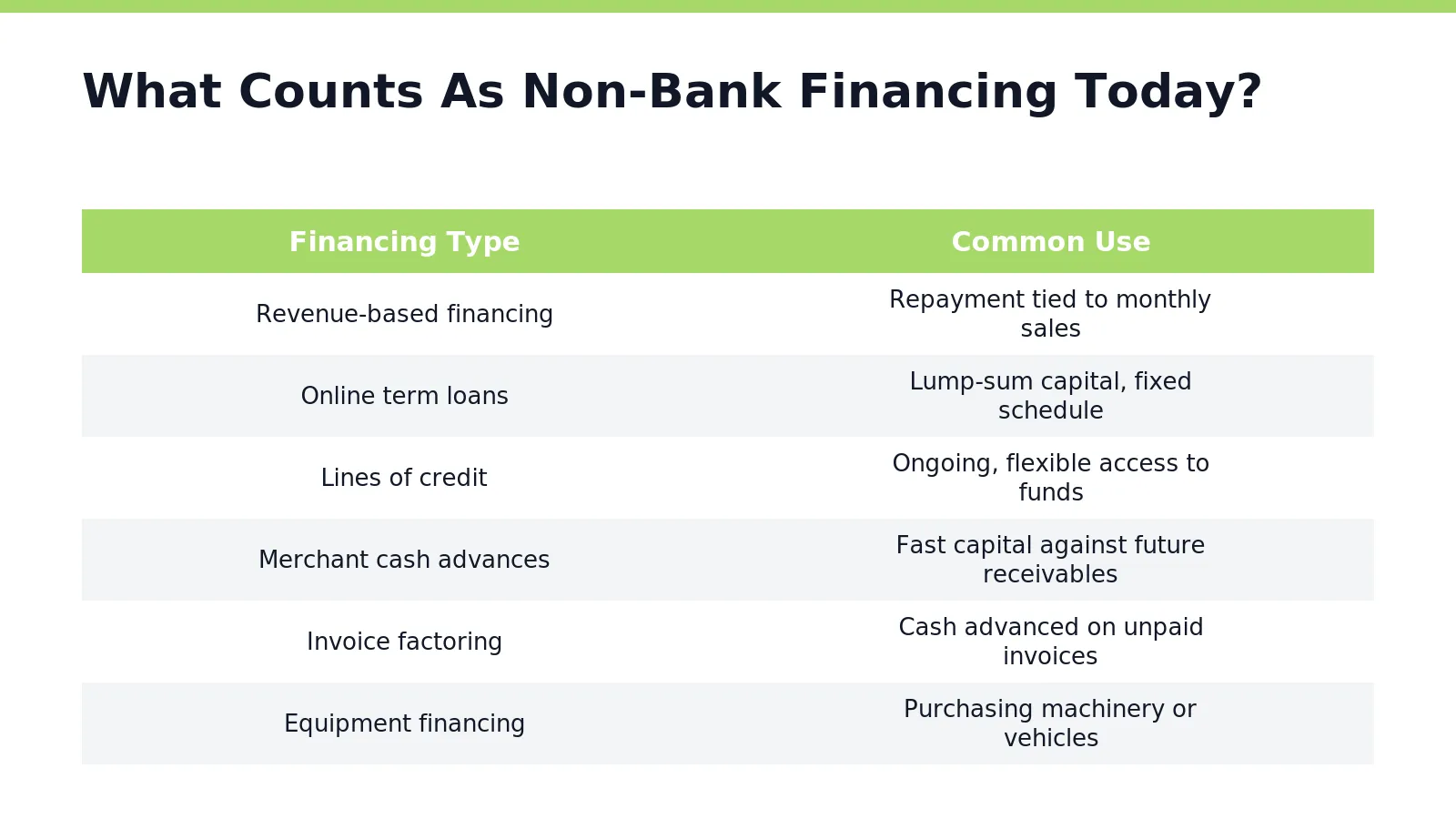
What Counts As Non Bank Financing Today?
Non bank financing covers any funding source outside a traditional commercial bank, structured around business performance rather than a banker's checklist. Seven main categories make up this landscape: revenue-based financing, online term loans, lines of credit, merchant cash advances, invoice factoring, equipment financing, and purchase-order financing, according to Alternative Business Loans: 7 Non-Bank Options (2026). Each type solves a different cash flow problem, from covering payroll gaps to funding a large equipment purchase.
Alternative business lending trades certain conveniences for others. Approval standards tend to be less rigid than a bank's, and funding decisions often move faster. In exchange, borrowers typically face higher interest rates and larger or more frequent payments, according to 10 Nonbank Lenders for Small Business Loans. That trade-off makes sense for a business that needs capital now and can't wait weeks for a bank's underwriting process.
What's the difference between a bank loan and non bank financing?
Bank loans usually come with lower rates but stricter qualification rules and longer approval timelines. Non-bank options prioritize speed and accessibility, often approving businesses that banks would decline. The cost of that flexibility shows up in the pricing structure, not the paperwork.
Businesses researching these categories often find the process easier when matched to the right lender network from the start. VIP Business Credit connects clients to a network of more than 1,000 national. Local lenders spanning these financing categories, pairing each business with options suited to its stage and risk profile. Private funding offerings through this network include business loans, lines of credit, and a full business credit-building program designed to strengthen a company's standing before it applies.

How Does Alternative Business Lending Actually Work?
Speed defines the process. Non bank financing moves money into business accounts in as little as 24 hours to two weeks, a sharp contrast to the 30 to 90 days a typical SBA loan requires. That timeline difference changes what a business can do when an opportunity, or an emergency, shows up without warning.
The tradeoff is cost for convenience. Alternative business lending generally carries higher pricing than a conventional bank loan. In exchange, qualification standards loosen and approval decisions arrive faster. Business owners with thinner credit files or shorter operating histories often qualify for options that a traditional bank would decline outright.
What Determines Whether a Business Qualifies for Non Bank Financing and Alternative Business Lending?
Eligibility hinges on how underwriters read the business, not just the owner's personal credit score. Lenders look at cash flow, time in business, and how the company's credit file appears on the bureaus that score commercial risk.
A structured pre-qualification workflow removes much of the guesswork. Business owners see which programs they can access right away and which ones need more groundwork, like stronger trade payment history or higher revenue documentation, before applying.
How Do Advisory Tools Fit Into the Process for Private Funding?
Technology-driven insight speeds up decision-making. VIP Business Credit offers a proprietary scoring tool that shows how lenders view a business's credit profile.
Together, these tools show business owners how underwriters actually view their company and where eligibility gaps exist before an application ever gets submitted. That visibility matters, because private funding sources, unlike large commercial banks, often weight different data points depending on industry and deal size. Knowing those gaps in advance turns a guessing game into a plan:
Identify which bureau data points need correction or strengthening
Match the business to programs suited to its current stage
Track progress as the credit file matures over time
Working through this sequence, rather than applying blind, cuts wasted applications and protects the business's credit file from unnecessary inquiries.

Where Does Private Funding Fit In The Mix of Alternative Funding Solutions?

Private capital fills the gap when bank credit tightens or falls short. Private funding sources deliver near-immediate relief from the restrictions that traditional lenders often place on borrowers, giving business owners a faster path to working capital when timing matters most.
That speed matters because bank financing does not always match a company's actual cash needs. Businesses unable to satisfy the terms of a bank loan, or facing thin working capital and tight cash flow, increasingly look toward alternative business lending to keep operations moving. This shift is not a sign of poor financial management. It reflects a lending environment where traditional banks impose stricter conditions than many growing companies can meet on a predictable timeline.
Is Private Funding Only For Businesses That Can't Get A Bank Loan?
No. Established companies use private capital strategically, not just as a fallback option. Many businesses combine bank credit with non bank financing to diversify their capital sources and reduce dependence on any single lender's approval cycle.
VIP Business Credit connects clients to a broad network spanning three categories:
Traditional banks for conventional loan structures and rate stability
Alternative finance providers for speed, flexibility, and less rigid underwriting
Specialized programs matched to a business's particular stage, sector, and risk profile
How Does A Business Decide Which Funding Type Fits Best Among Alternative Funding Solutions?
The right mix depends on where a company stands and what it needs next. A newer venture chasing its first approvals typically needs different terms than an established firm looking to scale operations or refinance existing debt at a better price.
VIP Business Credit's advisory approach accounts for that difference directly. Rather than pushing a single product, the firm matches financing strategy to each business's stage and growth goals, whether that means securing an initial credit line or expanding capital access for a company ready to grow.
Are SBA Loans Still Worth Considering?

Yes, SBA loans remain a strong option for many small businesses, particularly because SBA-guaranteed loans generally carry rates and fees comparable to non-guaranteed financing. That competitiveness on cost doesn't disappear just because faster funding paths exist. Owners weighing their options still need to understand what SBA programs require and how they stack up against speedier alternatives.
Eligibility, however, is where many applicants stumble. Qualification depends on three factors: how the business earns its income, the character of its ownership, and where the business physically operates. A company that checks all three boxes may find SBA terms hard to beat. One that doesn't fit neatly into those categories often needs a different path forward.
How does an SBA loan compare to non bank financing and alternative business lending?
Non bank financing generally moves faster and asks fewer questions about ownership structure or operating history. SBA loans trade that speed for lower long-term cost, since their government-backed terms keep rates competitive with conventional bank products.
Should every business apply for SBA funding first?
Not necessarily. Businesses facing urgent cash flow gaps often can't wait out the SBA's review process. Turn to alternative business lending instead.
Local Business Credit Advisors at VIP Business Credit help owners weigh these tradeoffs directly, offering concierge-level guidance on whether SBA programs or faster options fit a given situation. That guidance draws on a broader view of the market:
Access to 1,000+ lending options spanning traditional banks and alternative finance providers
Comparison of SBA terms against private funding sources in real time
Matching based on business stage, industry, and eligibility profile
Rather than defaulting to one loan type, advisors help owners see the full landscape before committing to an application that could take weeks to resolve.
What Should You Weigh: Speed Versus Cost in Alternative Funding Solutions?

Speed and cost move in opposite directions in most funding decisions. Faster approvals generally come from non bank financing sources, but that convenience carries a price. Slower, more traditional paths often cost less over time. The right balance depends on how urgently a business needs capital. How much room its cash flow has for larger payments.
Alternative lenders that approve applications quickly and with fewer requirements typically charge more for that flexibility. Reporting on nonbank lending, CO by the U.S. Chamber of Commerce notes that these lenders tend to have higher interest rates. Larger or more frequent payments, even as they offer looser qualification standards and more flexible terms. Owners trade cost certainty for speed and easier approval.
Is faster funding always the more expensive option?
Not always, but it usually carries some tradeoff. Alternative business lending products move quickly because underwriters accept more risk in exchange for higher rates or shorter repayment windows. A business chasing a narrow opportunity, such as a bulk inventory discount, may find the added cost worthwhile.
VIP Business Credit approaches this tradeoff differently. Instead of steering clients toward a single fast option, the firm builds a full financing strategy around transparent, no-surprise pricing. It positions itself as a long-term partner, not a one-time broker chasing a transaction.
That long-term view shows up in how VIP Business Credit structures access to capital:
Guides clients toward high-limit loans and revolving credit tied to the company's EIN, separating personal liability from business debt
Strengthens foundational credibility signals, including consistent business identity data and trade credit reporting, so lenders and vendors view the business as lower risk
Helps clients compare private funding sources against slower, lower-cost paths before committing
Weighing speed against cost works best with full visibility into both. Owners who understand these tradeoffs upfront avoid surprises at the closing table.
How Does VIP Business Credit Help You Qualify for Non Bank Financing and Alternative Business Lending?

Qualification starts with local expertise and a hands-on advisory model, not a generic application form. VIP Business Credit operates from Sterling, Virginia, giving the firm direct roots in the Northern Virginia business community and a practical understanding of what regional lenders expect. That local grounding shapes every recommendation made to clients.
Behind the scenes, VIP Business Credit runs with a small team of three employees. This size matters more than it might seem. A small team supports a concierge-style, advisory-driven approach rather than a call-center model where clients get passed between departments. Business owners work with people who actually know their file.
Does VIP Business Credit only work with businesses near Virginia?
No. While the firm is rooted in Northern Virginia. Stays active in Loudoun County, its services extend far beyond that footprint. VIP Business Credit serves clients digitally. Connects them with lenders nationwide, including non bank financing sources and alternative business lending programs that traditional banks often overlook. Location does not limit access to the network.
What makes qualification easier with VIP Business Credit than applying alone?
Education is the difference. Rather than submitting an application and hoping for approval, clients receive coaching alongside financing access. VIP Business Credit pairs its lending connections with guidance designed to help owners understand:
How underwriters evaluate business credit profiles
Which factors influence approval odds before an application goes out
How to maintain healthy credit usage after funding closes
Where gaps exist between a business's current standing and lender expectations
This combination of coaching and access matters most when owners explore private funding sources that carry different qualification standards than a conventional bank loan. Understanding those standards in advance, rather than discovering them after a decline, protects both credit profiles and time. Confidence comes from knowing what lenders actually look for.
What's Your Next Step Toward Funding?
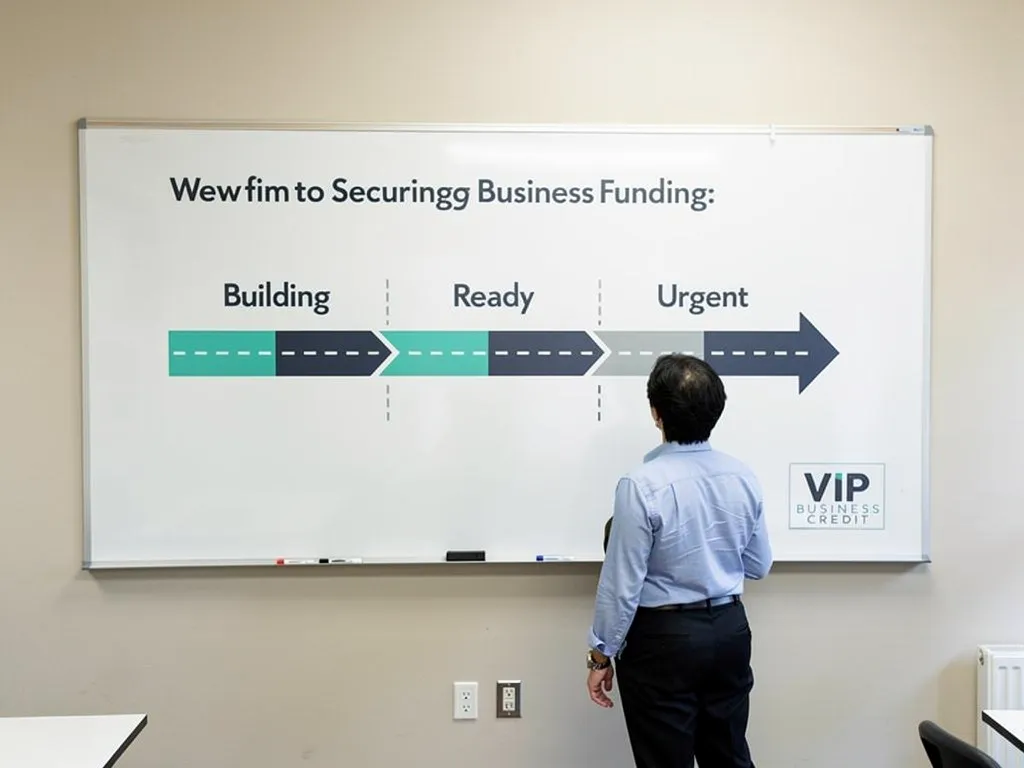
A sequence, not a single application, defines the smartest path toward business funding. Strong credit foundations come first; larger financing follows once that foundation holds. Skipping straight to a big loan request without that groundwork often leads to denials or unfavorable terms that cost more over time.
VIP Business Credit builds its process around this order. The first phase focuses on establishing a strong business credit profile, separate from an owner's personal credit history. That profile becomes the evidence lenders review when deciding how much capital to extend and at what cost.
Why does credit-building come before applying for a loan in alternative funding solutions?
Lenders size their offers around risk, and a thin or inconsistent credit file signals risk they can't easily price. A well-documented profile, by contrast, gives lenders confidence to extend larger amounts on better terms. This is why the credit-building phase isn't a delay tactic; it's what unlocks stronger offers later.
Once that profile is secured, attention shifts to pursuing the highest loan amounts available on the most favorable terms. This second phase is where non bank financing and alternative business lending options often enter the picture. These channels can move faster than conventional bank underwriting.
What if a business needs funding faster than that two-step process allows?
Timing pressure is real. Many owners need capital quickly and don't have weeks or months to spare for a traditional, document-heavy loan process. For these situations, private funding sources built for speed become a practical alternative to waiting on a slower, more rigid application cycle.
The right next step depends on where a business currently stands:
Building phase: strengthen the credit profile before applying for larger amounts.
Ready phase: pursue high-limit financing on the strongest available terms.
Urgent phase: explore faster funding channels suited to immediate cash needs.
FAQ
What types of non bank financing are available to businesses?
Options include revenue-based financing, online term loans, lines of credit, merchant cash advances, invoice factoring, equipment financing, and PO financing. Each addresses different cash flow needs, from payroll gaps to equipment purchases.
How fast does non bank financing fund compared to banks?
Non-bank financing solutions fund businesses in 24 hours to 2 weeks. This timeline beats traditional bank approval processes, which often involve lengthy underwriting and higher decline rates.
How does VIP Business Credit connect businesses to funding?
VIP Business Credit connects entrepreneurs to over 1,000 national and local lenders through its pre-qualification platform. This matches pre-qualified options with zero impact on personal credit.
Conclusion
In closing, non-bank business financing solutions expand your access to capital beyond traditional banking constraints, enabling you to build genuine business credit tied to your EIN while protecting personal assets. By exploring alternative lenders, trade credit programs, and specialized funding products, you position your business to scale with confidence. The key lies in understanding how lenders view your business, matching your needs to the right financing structure, and maintaining consistent credit practices that strengthen your credibility over time. Your path to sustainable growth starts with clarity about available options and a commitment to building a lender-ready business.
About The Author
Lee Johnson is the Founder of VIP Business Credit, a Real Estate Investor, Business Growth Strategist, and Master Certified Professional Coach. With over 25 years of experience in business finance and credit strategy, Lee specializes in helping entrepreneurs build strong, lender-ready business credit profiles tied to their EIN (rather than their personal SSN) to access high-limit funding while safeguarding personal assets.
Contact Us
📞 Phone: (571) 248-3863
✉️ Email: [email protected]
📅 Consultation: Schedule A Business Financial Health Strategy Call
🌐 Website: https://vipbizfunds.com
🎯 FREE Business Funding Pre-Qualification Scan: FREE Business Success Scan
Serving Sterling, VA and surrounding areas. (Do NOT include any physical street address).


