Free Financial Templates for Business Planning In VA
Free Financial Templates for Business Planning In VA
Free Excel and SCORE templates cover budgeting, forecasting, and business planning statements, letting founders map income, expenses, and savings goals using built-in formulas. VIP Business Credit's quick credit-gap scan, the FREE Business Success Scan, complements these templates by revealing underwriting gaps in minutes, giving entrepreneurs a lender-ready roadmap before applying for financing.
Key Takeaways
Free Excel templates support budgeting, forecasting, and financial decision-making for entrepreneurs.
Cash flow statements and budget templates help track business payments and financial health.
Entrepreneurs receiving mentoring report 5× higher likelihood of starting successful businesses.
VIP Business Credit connects entrepreneurs to over 1,000 national and local lenders.
What Will You Accomplish With These Templates?
Completed financial templates turn scattered numbers into a usable business roadmap. Entrepreneurs who fill out budget sheets and cash flow forecasts gain a clear picture of where money comes from and where it goes, long before a lender ever asks. That clarity becomes documentation investors and other stakeholders expect to see before they commit capital, giving a new venture credibility it would otherwise lack.
Before starting, gather recent bank statements, a list of recurring expenses, and any projected revenue figures. With that information in hand, founders can move through the process efficiently:
Select a template that matches the business's current stage, whether that's a startup budget or an established cash flow statement.
Enter historical income and expense data into the pre-formatted fields.
Apply budget tools and built-in formulas to calculate totals and compare projections against actual spending.
Adjust the plan as revenue or costs shift, keeping the forecast current rather than static.
Export or share the finished plan with an advisor or lender for review.
How does working with a local advisor strengthen the results?
A three-person advisory team at VIP Business Credit reviews each client's completed templates and translates the numbers into a usable financing strategy. That small, focused staff allows for concierge-level attention rather than a rushed, one-size-fits-all review.
Does location affect the guidance entrepreneurs receive?
Operating from Sterling, Virginia, gives VIP Business Credit direct insight into the financing patterns shaping small businesses across the region. That regional focus extends to entrepreneurs throughout Northern Virginia and the Greater Washington, DC area. Advisors help business owners build credit under the company's EIN rather than the owner's personal Social Security number. Sound business planning paired with that kind of guidance gives a completed template real financing power, not just organizational value.

Which Financial Templates Do You Need First?
Four categories come first: income and expense tracking, cash flow forecasting, budget planning, and a simple financial projection sheet. Skipping any one of these leaves gaps that lenders notice immediately during underwriting. A business missing clean records on income and expenses often struggles to explain its own numbers, let alone present them to a lender.
Start with documentation, not projections. Organizing records around income and expenses lays the foundation for building business credit tied to the company's EIN rather than the owner's personal credit history. Once income and expenses are logged consistently, a founder has something concrete to build on.
A complete library of financial templates generally covers four areas:
Goal planning sheets, for setting measurable funding and revenue targets
Financial projections, for forecasting growth over coming quarters
Budget planning tools, for controlling monthly spending
Retirement calculations, for long-term owner planning
What Order Should a New Business Owner Fill These Out In?
Income and expense tracking comes first, since every other sheet depends on accurate numbers. Budget planning follows next, turning raw figures into monthly spending limits. Financial projections come third, once real data exists to forecast from. Goal planning and retirement calculations round out the set once the core financial picture is clear.
Who Can Help Choose the Right Starting Templates?
Local guidance matters here. Advisors based out of Sterling, Virginia, work directly with business owners to identify which templates match their current stage and funding goals. That local support, paired with access to more than 1,000 national and local lenders, means a completed budget tool or projection sheet can later connect to financing suited to the business's specific risk profile and growth plan.
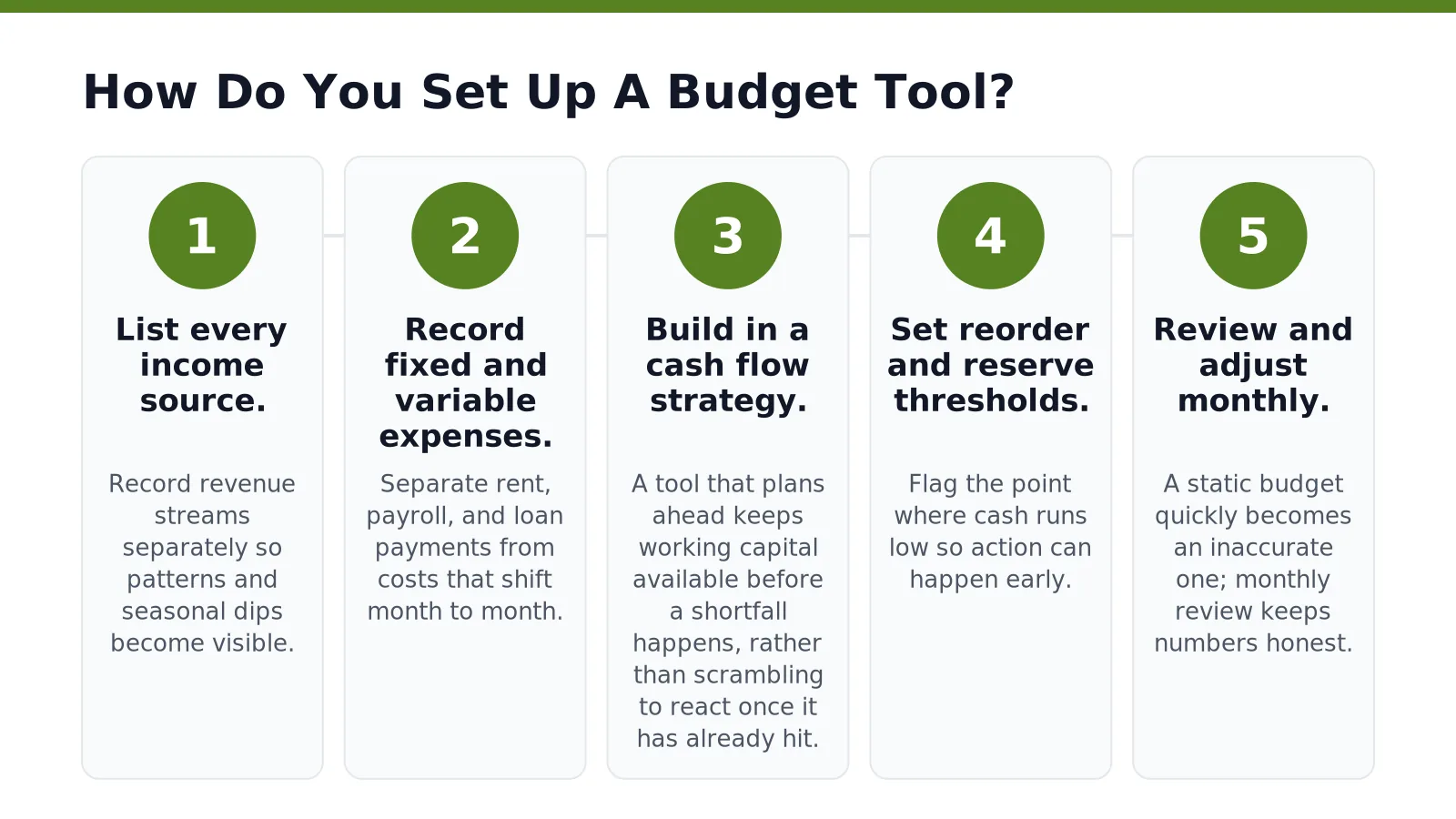
How Do You Set Up A Budget Tool?

Setting up a budget tool starts with one goal: giving a business owner a clear view of money coming in and money going out. A well-built budget tool tracks a company's financial health over time, not just a single snapshot from one busy month. Without that ongoing view, a cash shortage can arrive without warning.
Follow these steps to build a working budget tool:
List every income source. Record revenue streams separately so patterns and seasonal dips become visible.
Record fixed and variable expenses. Separate rent, payroll, and loan payments from costs that shift month to month.
Build in a cash flow strategy. A tool that plans ahead keeps working capital available before a shortfall happens, rather than scrambling to react once it has already hit.
Set reorder and reserve thresholds. Flag the point where cash runs low so action can happen early.
Review and adjust monthly. A static budget quickly becomes an inaccurate one; monthly review keeps numbers honest.
Controlling cash this way does more than prevent emergencies. A disciplined budget tool, used consistently, gives a business steadier footing to grow from. Every expansion decision rests on real numbers instead of guesswork.
Does a business owner need help setting one up?
Many owners build their first budget tool alone, then hit questions about structuring cash reserves or forecasting lean months. A small, focused advisory team can walk through the setup step by step, helping translate raw numbers into a usable financial plan. That kind of guided business planning often catches gaps a spreadsheet alone won't reveal.
What's the biggest mistake with budget tools?
Treating the tool as a one-time project is the most common error. A budget tool only earns its value when revisited regularly. Financial templates lose accuracy the moment income or expenses shift and aren't updated to match.
How Do You Build A Cash Flow Statement?

A cash flow statement lists every dollar moving into and out of a business, organized by category. Owners know when cash arrives and when it leaves. Building one starts with gathering recent bank records, invoices, and payment schedules before entering a single figure. Skipping this groundwork leaves owners guessing about how much working capital actually sits available in a given week.
Before drafting the statement, business owners need three items ready: a list of income sources, a record of fixed and variable expenses, and payment due dates for loans or vendors. With those pieces gathered, the statement comes together in a predictable order.
List every expected source of incoming cash, including sales revenue, loan proceeds, and receivables.
Record all outgoing payments, separating fixed costs like rent from variable costs like inventory.
Subtract total outflows from total inflows to find the net cash position for each period.
Compare the result against prior periods to spot patterns in surplus or shortfall.
Update the statement weekly or monthly as new transactions post.
Good financial templates simplify this process by pre-building the categories above into a spreadsheet. Owners enter numbers instead of designing a layout from scratch. Structured business planning built around this routine reduces the guesswork that often leads to missed payment deadlines.
Why Does Cash Flow Timing Matter for Small Businesses?
Timing decides whether a business covers payroll, rent, or supplier invoices the moment they're due, not just somewhere across the month. A company can show a profit on paper while running short on cash the same week bills arrive. Cash flow strategies exist to close that exact gap, keeping working capital available when it's needed rather than after a shortfall hits.
What Role Does a Cash Flow Statement Play in Securing Financing?
Lenders review cash flow documentation to judge whether a business can repay financing on schedule. Accurate records support credit built under a company's EIN. Underwriters rely on documented cash positions rather than an owner's personal credit history. A Sterling, Virginia-based advisory team brings regional lending insight to local businesses preparing these records, and dependable budget tools make that documentation far easier to produce and defend.
How Do You Create Financial Projections And Forecasts?
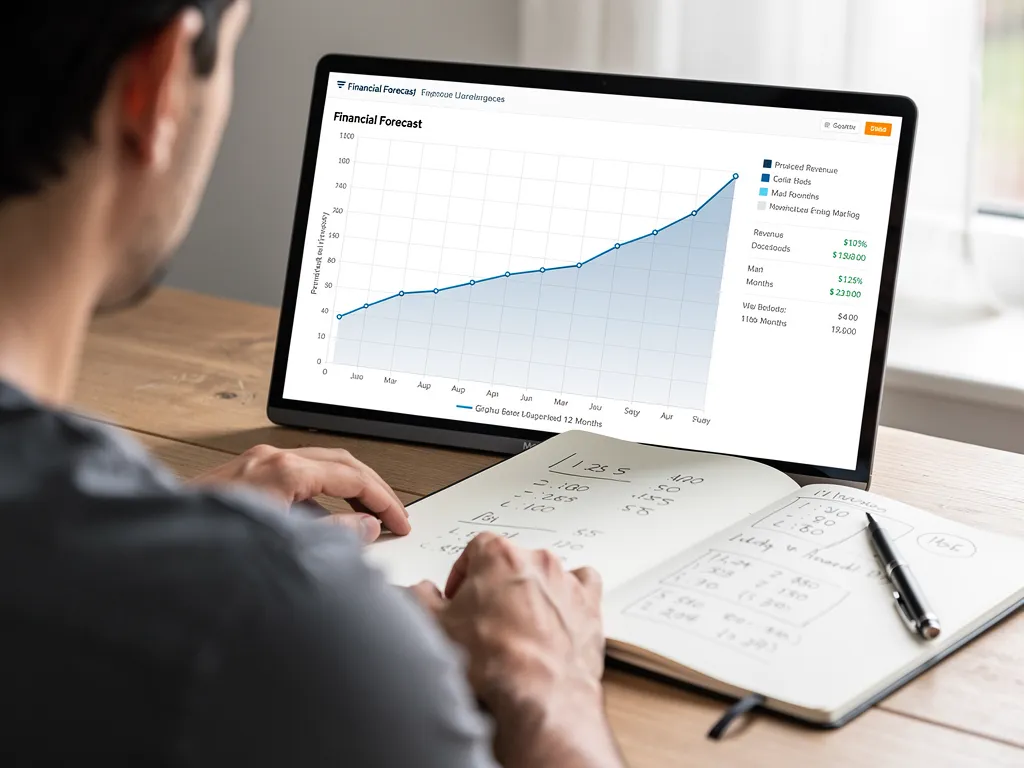
Creating financial projections starts with organized historical data, realistic assumptions, and a template built for forecasting rather than simple record-keeping. Entrepreneurs who skip this step often discover their numbers don't hold up once a lender starts asking questions. Accurate forecasting matters because matching a projection to the right lender out of more than 1,000 national and local funding sources depends on getting the math right first.
A few prerequisites make the process smoother. Business owners should gather at least three to six months of revenue and expense records before opening any financial templates, since forecasts built on thin data tend to drift from reality within a quarter.
Select a template designed for cash flow and revenue forecasting, not just expense tracking.
Enter actual income and expense figures from recent months to establish a baseline.
Build in known upcoming costs, including equipment purchases that let a business use new machinery immediately, build credit through the financing itself, and deduct the payments as business expenses.
Factor in vehicle-related financing if the business plans to grow a fleet, since multiple vehicles financed together can build business credit while locking in tax deductions.
Run the formulas forward 12 months and adjust assumptions as actual numbers come in.
What Role Do Budget Tools Play In Forecasting?
Budget tools connect daily spending decisions to the long-range forecast, keeping both in sync. Without that connection, a forecast becomes a static document instead of a living plan.
Why Combine Templates With Broader Business Planning?
Projections only hold value inside a complete business planning process. Financial templates work best when budgeting, forecasting, and daily financial decisions all live in one connected workspace, giving owners a single source of truth before approaching any lender.
How Do You Customize Templates For Your Business Stage?

Customization depends on what a business needs to prove to a lender right now, not on a fixed formula. A startup tracking its first revenue needs different budget tools than a company adding a fleet of vehicles. Business Credit Advisors based at VIP Business Credit's Sterling, Virginia office work directly with growing companies to adjust financial templates as the company's stage changes. The numbers match what the business actually looks like today.
Staging changes should follow the business, not the calendar. A company that just added equipment, for example, should rework its templates around financing structured to let it use new equipment immediately, while building credit and locking in deductions for those payments. A company adding trucks or vans faces a similar shift: financing multiple vehicles changes cash flow projections and reporting, and it also builds business credit while locking in tax deductions along the way.
What Should Change First When a Business Grows?
Cash flow projections and debt schedules should update first, since lenders weigh these heavily during underwriting. Business planning documents built for a solo founder rarely hold up once a company adds staff, inventory, or vehicles.
Does Working With an Advisor Make a Difference?
Guidance matters more than many founders expect. Entrepreneurs who work with a mentor while refining their plans are far more likely to successfully start a business, according to the Business Planning & Financial Statements Template Gallery.
Three adjustments tend to matter most as a company advances:
Rebuilding budget categories around new fixed costs like equipment or fleet payments
Updating credit-building projections to reflect new financing accounts
Revisiting deduction schedules tied to equipment and vehicle payments
Working through these adjustments with a local advisor keeps the templates aligned with both current operations and future funding goals.
How Do You Use Templates To Prepare For Financing?

Business owners prepare for financing by completing templates in a specific order: income and expense figures first, then forecasts, then lender-ready summaries. Skipping this sequence costs valuable time once a lender starts asking questions the numbers can't yet answer. A completed set of financial templates gives a lender a clear picture of a company's financial habits before a single application goes out.
The sequence matters because lenders and card issuers evaluate a business separately from its owner. Credit built under a company's EIN, rather than an owner's Social Security number, depends on accurate financial records that support that separation. VIP Business Credit helps entrepreneurs in Northern Virginia and the Greater Washington, DC region build this type of EIN-based business credit, and clean templates are the foundation that makes it possible.
What Should A Business Owner Do First?
Gather baseline numbers: monthly income, fixed expenses, and savings goals.
Enter those figures into pre-formatted budget tools so totals calculate automatically.
Build a short-term cash flow forecast to project upcoming payment obligations.
Draft a one-page summary connecting the budget to a growth plan, the core of sound business planning.
Save the finished workbook, export it as a PDF, or share it through a secure link so it reaches lenders and partners without friction.
How Does This Help With Finding The Right Lender?
Finished templates make it easier to match a business to appropriate financing once numbers are in order. Access to more than 1,000 national and local lending options means a completed template can be compared against many different products rather than just one bank's criteria. Advisors can then review the completed paperwork with the owner directly. A focused, three-person advisory team offers that kind of hands-on review before a lender ever sees the file, catching gaps early and building confidence before submission.
What Common Mistakes Should You Avoid?

The biggest misstep business owners make is waiting until cash is already tight before building a financial plan. By the time working capital is needed, it's often too late to arrange it on favorable terms. A solid budget tool only helps when it's used early, not as a last resort during a crisis.
Losing control of cash flow defeats the purpose of planning in the first place. The goal of strong financial templates and tracking habits is growth, not just survival. When cash flow slips out of view, that growth stalls, and the business ends up reacting to problems instead of preparing for them.
Why does location matter when building a financial plan?
Local market conditions shape lending decisions more than many founders realize. A Sterling, Virginia-based advisory team brings regional insight that helps catch mistakes specific to local lending patterns, loan terms, and underwriting expectations that a generic template can't flag on its own.
Is skipping mentorship a mistake too?
Yes. Many founders build their business planning documents alone and never seek outside review. Entrepreneurs who work with a mentor report higher revenues and stronger business growth, according to SCORE's Business Planning & Financial Statements Template Gallery. Free one-on-one mentoring allows founders to review templates, refine strategy, and sharpen a plan before it reaches a lender.
Common mistakes to avoid include:
Treating budget tools as a one-time exercise instead of an ongoing habit
Ignoring cash flow until capital is urgently needed
Skipping local market insight when applying for financing
Building a financial plan without outside mentorship or review
Avoiding these errors keeps a business's financial plan accurate, timely, and ready to support real funding conversations.
FAQ
Which financial templates should entrepreneurs use first?
Entrepreneurs should start with income and expense tracking, cash flow forecasting, budget planning, and a simple financial projection sheet. Lenders notice gaps in these four categories during underwriting.
How does VIP Business Credit support entrepreneurs filling out these templates?
VIP Business Credit's three-person team in Sterling, Virginia reviews completed templates and turns the numbers into a financing strategy. Its quick credit-gap scan reveals underwriting gaps before applying for financing.
Why does building credit under an EIN matter after completing these templates?
Organizing income and expense records lays the foundation for building business credit tied to the company's EIN rather than the owner's personal Social Security number, strengthening financing power.
Conclusion
In closing, free financial planning templates provide a practical foundation for organizing your business's numbers. Templates alone cannot replace the strategic guidance needed to build genuine lender confidence. As you move beyond spreadsheets toward securing capital and establishing true business credit, connecting with advisors who understand your specific situation, your industry, your stage, and your funding goals, transforms planning from a compliance exercise into a pathway toward sustainable growth and stronger financial positioning.
About The Author
Lee Johnson is a seasoned Real Estate Investor, Business Growth Strategist, and Master Certified Professional Coach whose years of hands-on experience guiding entrepreneurs through financing and credit-building shape the strategies shared throughout VIP Business Credit's resources. His mission centers on helping business owners achieve financial freedom through sound planning and sustainable growth.
Lee's professional coaching certification, paired with his background in real estate investing and business strategy, informs the practical, lender-ready approach VIP Business Credit brings to every client relationship, from building an EIN-based credit profile to matching a business with the right financing partner.
Contact
📞 Phone: +1 (571) 248-3863
✉️ Email: [email protected]
📅 Consultation: Schedule a Free Consultation
🌐 Website: vipbizfunds.com
🎯 FREE Business Funding Pre-Qualification Scan: Start Your Free Scan
VIP Business Credit is based in Sterling, VA, serving entrepreneurs throughout Northern Virginia and the Greater Washington, DC area.


