Free Cash Flow Template for Businesses
Free Cash Flow Template for Businesses
A free cash flow projection template forecasts operating cash flow minus capital expenditures over 12 months, typically using Excel. VIP Business Credit, based in Sterling, VA, helps Northern Virginia entrepreneurs build EIN-based credit profiles and leverages its credit scoring tool plus 1,000+ lender connections to strengthen financing eligibility.
Entrepreneurs benefit from a disciplined cash flow projection template to forecast inflows and outflows, spotting shortages before they hit. Our team, based in Sterling, VA, pairs this planning with our credit scoring tool and access to over 1,000 national and local lenders to strengthen EIN-based business credit.
Free cash flow projection templates estimate monthly cash in and cash out, revealing shortfalls before they threaten operations. VIP Business Credit's Cash Flow Management service pairs this forecasting with its business credit scan, giving owners a clear roadmap connecting working capital needs to lender-ready financing options across a
Key Takeaways
- Cash flow projections estimate money moving in and out of your business over specific time periods.
- Accurate forecasting identifies cash shortages early, enabling strategic planning to protect your business's financial health.
- VIP Business Credit connects entrepreneurs to over 1,000 national and local lenders for funding solutions.
What Will a Cash Flow Projection Help You Achieve?
A cash flow projection estimates money moving in. Out of a business over a set period, flagging shortages or surpluses before they occur. This forward-looking view transforms guesswork into a dependable financial forecast that guides spending, hiring, and borrowing decisions. Business owners who build this habit stop reacting to cash crunches and start preventing them.
Cash flow functions as the financial engine of any company, powering payroll, inventory, and day-to-day operations. A business without steady cash on hand risks stalling even when sales look strong on paper. Tracking inflows and outflows with a reliable cash flow template gives owners a concrete picture of what's coming and what's going out, week by week or month by month.
Why does a cash flow projection matter for financing?
Lenders evaluate a business the same way a projection does: by looking at what's expected to come in versus what's already committed to go out. Knowing exactly where a business stands financially before applying for credit mirrors the clarity lenders seek during underwriting. A business that tracks cash positions ahead of time arrives at the lending table prepared, not surprised.
What does strong cash flow planning actually deliver?
Consistent use of a projection tool builds several advantages for growing companies:
- Early warning of upcoming shortfalls, giving owners time to arrange financing before a crisis hits
- Confidence to pursue growth opportunities, knowing working capital will be available when needed rather than after it's too late
- A clearer basis for timing major purchases, hiring, or equipment upgrades
- Stronger conversations with lenders, since projections demonstrate financial discipline
Strategic cash flow management keeps working capital available on schedule, not as an emergency fix after a shortfall has already disrupted operations. Owners who master this process protect their businesses from avoidable financial strain.

What Tools and Data Do You Need First?
Three items matter most: a spreadsheet or dedicated projection tool, at least three months of bank and transaction history, and a clear list of upcoming obligations. Skipping any one of these creates blind spots that surface later as missed payroll, late vendor payments, or a declined credit application. Business owners who gather this information before building a forecast save themselves hours of rework down the line.
Start with the right starting document. A cash flow template gives structure to raw numbers, organizing them into categories like receivables, payables, and recurring expenses. Business owners, entrepreneurs, financial analysts, and accountants rely on these templates regularly, which means the spreadsheet skills required are widely taught and easy to pick up. No advanced finance degree is necessary.
What data goes into the template?
Three categories of data populate most templates: historical bank statements, outstanding invoices, and fixed monthly obligations like rent or loan payments. Pull at least 90 days of transaction history to spot patterns in revenue timing. Add known upcoming costs, including equipment purchases or seasonal payroll spikes. The resulting financial forecast reflects real conditions rather than guesswork.
Gathering these inputs follows a simple sequence:
- Export three months of bank transactions.
- List all outstanding receivables and their expected collection dates.
- Compile fixed and variable monthly expenses.
- Note any one-time costs or windfalls expected in the forecast period.
Once a projection reveals a funding gap, matching that gap to the right lender matters just as much as the math. VIP Business Credit connects clients to more than 1,000 national. Local lenders, a network built to pair projected shortfalls with financing options suited to the business. Headquartered in Sterling, Virginia, the firm operates with a focused, 3-person advisory team supporting entrepreneurs across Northern Virginia and the Greater Washington, DC region as they build EIN-based business credit alongside their cash flow planning.
How Do You Set Up the Template Structure?
A well-built cash flow template starts with three columns: beginning balance, cash inflows, and cash outflows, repeated across each period being tracked. Weekly or monthly columns work best for most small businesses, since shorter windows catch shortfalls before they become emergencies. The goal matches what a properly prepared cash flow projection is meant to deliver: a full view of every dollar expected to move in and out of the business across the chosen period.
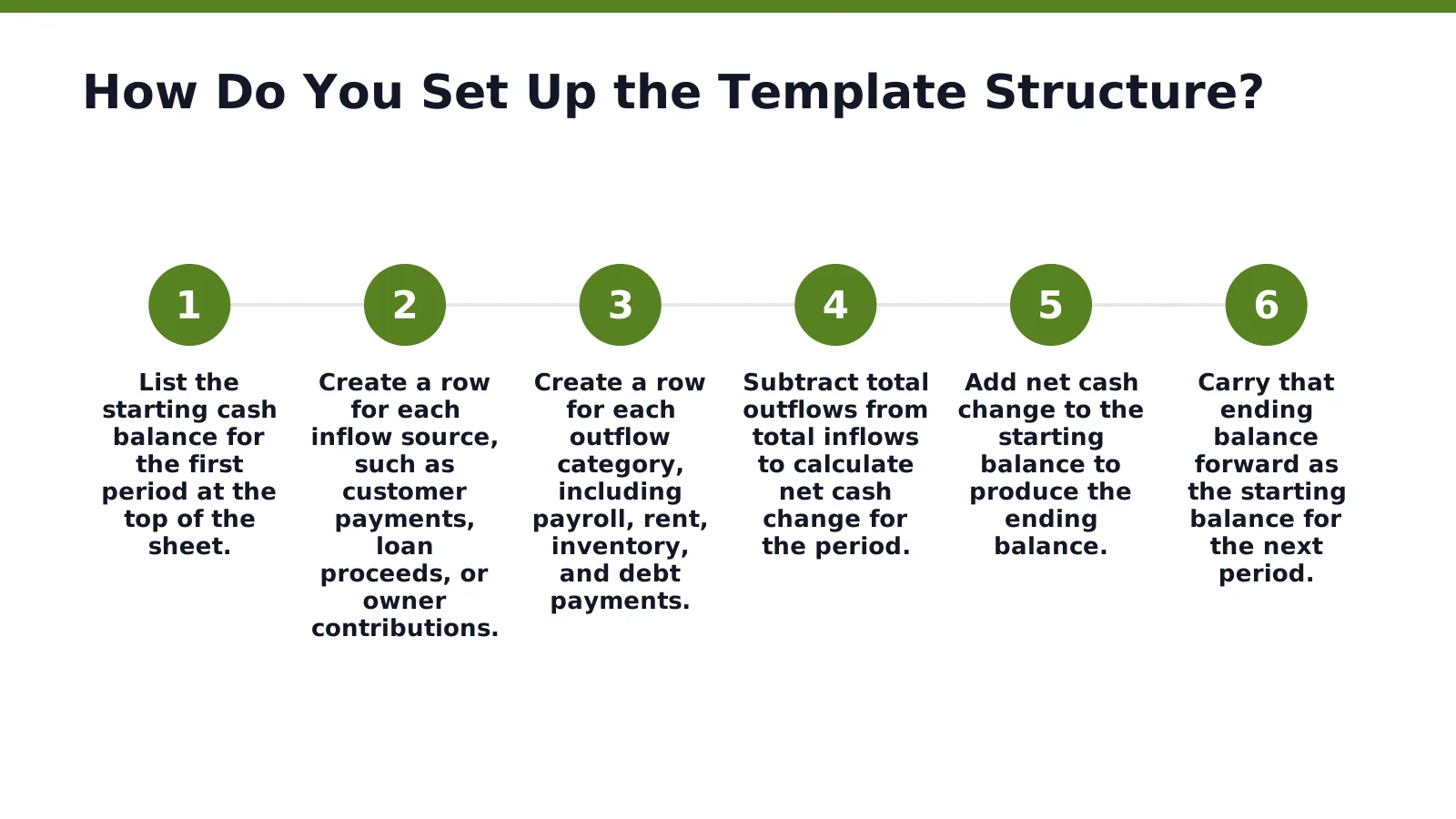
Before building the layout, gather three things: recent bank statements, a list of recurring expenses, and expected receivables by due date. With those in hand, follow these steps:
- List the starting cash balance for the first period at the top of the sheet.
- Create a row for each inflow source, such as customer payments, loan proceeds, or owner contributions.
- Create a row for each outflow category, including payroll, rent, inventory, and debt payments.
- Subtract total outflows from total inflows to calculate net cash change for the period.
- Add net cash change to the starting balance to produce the ending balance.
- Carry that ending balance forward as the starting balance for the next period.
What Should a Financial Forecast Section Include?
A financial forecast section projects revenue and expense trends beyond the current period, usually three to twelve months out. It should flag seasonal dips, planned hires, and large purchases before they hit the bank account. Pairing this forecast with the cash flow rows above turns the sheet into a true decision-making tool rather than a historical record.
Once the structure holds steady, it becomes a reliable projection tool for everyday choices, from timing a hiring decision to scheduling an equipment purchase. VIP Business Credit's scan tool is built to show business owners exactly where their company stands with lenders before they request financing, which pairs naturally with this kind of cash planning. Advisors at VIP Business Credit's Sterling, Virginia office, located at 21000 Southbank St Ste 106-380, coordinate financing strategy alongside this cash flow work.
How Do You Forecast Monthly Cash Inflows?
Forecasting monthly cash inflows starts with listing every source of incoming money and the date each payment is expected. A cash flow template lays out that expected cash clearly, showing a business how much money it will have on hand at any given point. Without that structure, timing gaps go unnoticed until they become shortages.
Many business owners never build this habit. Many don't have a firm handle on where their cash flow stands month to month. That blind spot is exactly what a structured forecast closes.
A dependable forecast follows a repeatable sequence:
- Gather every expected deposit: client payments, recurring revenue, and any financing draws.
- Assign each deposit a realistic date, not just the month it's invoiced.
- Separate guaranteed income from probable income so the projection doesn't overstate cash on hand.
- Total the inflows weekly or monthly, depending on how tight the business's margins run.
- Compare the total against upcoming obligations to spot gaps before they hit.
What Counts as a Cash Inflow Besides Sales Revenue?
Inflows extend beyond customer payments. Loan proceeds, lines of credit draws, and vendor financing all count as cash entering the business. A complete financial forecast has to include them. A business working with a wider lender network has more inflow categories to plan around. VIP Business Credit's connections to more than 1,000 national. Local lenders give business owners additional, realistic sources to factor into monthly projections, rather than relying on sales alone.
How Often Should Inflow Forecasts Be Updated?
Monthly is the minimum; weekly works better for businesses with tight margins. A projection tool built for ongoing updates, rather than a one-time spreadsheet, catches shifts in payment timing early. VIP Business Credit's cash flow approach centers on keeping working capital available before shortfalls appear, not after, which keeps the forecast useful instead of reactive.
How Do You Project Outflows and Expenses?
Projecting outflows means listing every dollar scheduled to leave the business before it leaves, then matching that total against expected income. Owners who track this movement plan and act strategically, rather than scrambling when a shortfall hits. Cash flow functions as the lifeblood of any company. Many businesses face a constant threat of shortages that can push them toward failure. A disciplined outflow projection catches that threat early, while there's still time to adjust.
Building an accurate outflow projection follows a repeatable sequence:
- List fixed monthly obligations, including rent, payroll, insurance, and loan payments.
- Add variable costs tied to production or sales volume, such as materials and shipping.
- Include equipment financing payments. Businesses using equipment credit lines acquire the equipment they need immediately, build business credit through consistent use, and deduct the payments as business expenses, making this a recurring line item worth tracking monthly.
- Factor in fleet-related costs. Companies financing trucks, vans, or cars through fleet credit lines carry ongoing payments that also build credit history and lock in tax deductions, so these belong in the same recurring category.
- Set aside a buffer for irregular expenses like repairs, tax deadlines, or seasonal dips in revenue.
What Expenses Get Missed Most Often?
Equipment and vehicle financing payments slip through the cracks more than any other category. Owners often track rent and payroll closely but forget that financed equipment. Fleet vehicles carry monthly obligations tied to credit terms. Missing these payments in a financial forecast distorts the entire cash position. Hides risk until it's too late to fix.
Should Outflow Projections Be Reviewed Monthly?
Yes. Expenses shift as equipment leases renew, fleet needs grow, and seasonal costs fluctuate. A cash flow template reviewed monthly, paired with a reliable projection tool, keeps outflow estimates aligned with what the business actually spends.
How Do You Calculate Your Net Cash Position?
Net cash position equals total cash inflows minus total cash outflows over a set period. Business owners calculate this figure to predict future cash positions, flagging a shortage before it turns into a crisis or spotting a surplus worth putting to work. A disciplined cash flow template turns this calculation into a repeatable habit rather than a once-a-year guess.
The process breaks down into clear steps:
- List every expected source of incoming cash: customer payments, financing proceeds, asset sales.
- List every expected outflow: payroll, rent, loan payments, inventory purchases, taxes.
- Subtract total outflows from total inflows for the period.
- Compare the result against the business's minimum operating cushion.
- Flag any projected gap early enough to arrange financing before it becomes urgent.
A properly built financial forecast carries this calculation forward month by month. A business owner sees trouble or opportunity coming rather than reacting to it after the fact.
What Counts as a Cash Shortage Versus a Surplus?
A shortage appears when outflows exceed inflows for a given period, leaving insufficient cash to cover obligations. A surplus is the opposite: more cash coming in than going out, often cash that can earn returns rather than sit idle. Mastering this projection process helps a business gain control over its finances and steer clear of avoidable financial crises.
Should a Projected Shortfall Always Be Covered With Financing?
Not automatically, but it deserves a close look. VIP Business Credit's proprietary Capital-Ready Score gives business owners an immediate read on how their financial position looks to lenders, which helps determine whether a projected gap calls for a credit line, a term loan, or simply tighter expense management.
Pairing that insight with disciplined cash flow strategies keeps working capital available exactly when a business needs it, not after a shortfall has already done damage.
How Do You Turn Projections Into Funding Readiness?
Funding readiness starts when a business owner's numbers meet the right lender match. A completed financial forecast shows lenders exactly how a company plans to use capital. Repay it, turning a hopeful application into a credible one. Without that bridge, even accurate projections sit unused on a spreadsheet.
VIP Business Credit's advisors pair cash flow figures with lending programs most likely to approve them, so working capital arrives when a business needs it rather than after a shortfall hits. cite-2 That matching process relies on reach: VIP Business Credit connects clients to more than 1,000 national and local lenders, giving a projected cash gap a real shot at landing with a product built for that exact scenario.
Turning a projection into an approved line of credit generally follows this sequence:
- Build or update a cash flow template that reflects current receivables, payables, and seasonal swings.
- Share projected shortfalls or surpluses with an advisor to identify timing gaps.
- Match the gap to a lender type, bank, alternative finance provider, or specialized program, suited to the business's stage and risk profile.
- Submit financing requests backed by consistent business data and credit tied to the company's EIN.
Does Business Credit Affect How Lenders Read a Forecast?
Yes. Lenders weigh a forecast more heavily when it comes from a business with its own credit identity. VIP Business Credit helps entrepreneurs across Northern Virginia and the Greater Washington, DC region build EIN-based business credit, so financing decisions don't rest on personal credit scores alone.
Why Does a Small Advisory Team Matter for This Process?
A compact team means closer attention to each file. Operating from Sterling, Virginia with three dedicated staff members, VIP Business Credit gives each client's projection tool output and funding plan direct, hands-on review rather than a generic checklist.
What Mistakes Should You Watch For?
Three errors sink most projections before they ever get used: skipping equipment payments, abandoning the process out of frustration, and ignoring credit gaps until a lender finds them. Each mistake carries a real cost, measured in missed financing, mismanaged cash, or declined applications.
Business owners often leave financed equipment payments out of the outflow line entirely. This happens even though those payments can be deducted as business expenses once the financing is structured correctly. Skipping this line item makes a cash flow template look healthier than reality, which sets up a false sense of security heading into a slow month.
Why do business owners abandon their cash flow projections?
Cash flow management feels overwhelming, and that difficulty is a major reason projections get built once and never updated again. Business owners end up uncertain about their financial stability precisely because the habit never sticks. Treating a financial forecast as a living document, reviewed monthly rather than filed away, prevents this drop-off.
How can business owners catch credit gaps before they become loan denials?
A proactive projection tool paired with credit monitoring closes this gap. VIP Business Credit's Capital-Ready Score tool shows business owners exactly where they stand with lenders. It flags credit gaps early, so a projected shortfall never turns into a surprise decline on a loan application.
Common missteps to avoid:
- Omitting financed equipment payments from monthly outflows
- Building a forecast once and never revisiting it
- Applying for financing without checking lender-facing credit standing first
- Treating projections and credit profiles as separate, unrelated tasks
Advisors at VIP Business Credit's office at 21000 Southbank St Ste 106-380, Sterling VA 20165 work directly with clients to correct these missteps before they affect funding outcomes.
FAQ
What does a cash flow projection template help a business do?
It estimates monthly cash in and cash out, revealing shortfalls before they threaten operations and guiding spending, hiring, and borrowing decisions with clear data instead of guesswork.
What do I need before building a cash flow projection?
Gather a spreadsheet or dedicated projection tool,
Conclusion
In closing, mastering free cash flow projection transforms how you manage your business finances and positions you to make confident decisions about growth and capital needs. By building accurate projections into your planning process, you establish the financial clarity lenders expect when evaluating your creditworthiness. Strong cash flow visibility, paired with solid business credit fundamentals, strengthens your overall funding readiness and opens doors to the capital your business deserves.


