Credit Building FAQs: FAQs about building and improving business
Credit Building FAQs: FAQs about building and improving business
Entrepreneurs build EIN-based business credit by separating personal and business finances, then connecting with lenders who report payments. VIP Business Credit links clients to over 1,000 national and local lenders and provides proprietary scoring tools to track progress for Northern Virginia and Greater Washington, DC businesses.
Business credit questions typically cover separating personal and business liability, building credit under an EIN, and understanding Paydex scores. VIP Business Credit's business credit scan answers these by identifying credit gaps in minutes, matching businesses to pre-qualified funding options, and mapping a clear path toward stronger, lender-ready credit profiles.
Key Takeaways
Business credit reflects your company's financial reputation and directly impacts financing options and loan terms.
Separating personal and business finances establishes the foundation for building strong EIN-based business credit.
VIP Business Credit connects entrepreneurs to over 1,000 national and local lenders for financing opportunities.
Monitoring credit bureaus and vendor relationships strengthens your business credit score and unlocks favorable terms.
What Is Business Credit, and Why Does It Matter?
Business credit is a financial reputation attached to a company rather than to any individual. Lenders, suppliers, and credit bureaus use this reputation to judge how reliably a company meets its financial obligations. A weak profile closes doors quietly; applications get denied or quoted at steep rates, often without a clear explanation why.
Much like personal credit tells a lender how an individual handles debt, business credit tells a lender how a company manages debt and other financial commitments. The comparison matters because the stakes differ. Personal credit mistakes follow an individual for years. Business credit, when separated properly, keeps that risk off an owner's personal file entirely.
Why does a strong business credit score matter for funding?
A strong score opens access to better financing options, lower interest rates, and more favorable supplier terms. Weak credit does the opposite: higher borrowing costs, shorter repayment windows, and vendors demanding upfront payment instead of invoicing terms. The gap between a strong profile and a weak one often shows up as thousands of dollars in avoidable interest over the life of a loan.
Where does credit building help fit into this picture?
Many founders hit a wall once startup capital runs out and growth stalls. Business credit help addresses that wall directly, guiding owners through the steps that build a lender-ready profile instead of leaving it to trial and error. VIP Business Credit works with entrepreneurs and small to midsize companies on exactly this task, helping them build credit histories strong enough to stand up to underwriting review. Owners who answer credit building FAQs and score questions early avoid costly surprises when it's time to apply for real capital.
How Do I Start Building Business Credit From Scratch?
Starting from scratch means forming a legal business entity first. An LLC or corporation creates a structure separate from the owner. That separation is the foundation every lender checks before extending capital. Skipping this step leaves personal assets exposed and makes future funding harder to secure.
Once the entity exists, the next priority is tying credit activity to the business itself rather than to an individual. Establishing credit under the company's [EIN](https://www.irs.gov/businesses/small-businesses-self-employed/get-an-employer-identification-number) (Employer Identification Number) instead of the owner's Social Security number keeps personal and business liability separate. This distinction protects personal credit scores from business debt and builds a financial identity lenders can evaluate on its own merits.
Timing matters more than most new owners expect.
Why does starting early matter so much?
Business credit profiles grow stronger with age and consistent activity, not overnight. Because the process takes time to mature, owners who delay lose months or years of track record they can never recover. Starting early, even with a small vendor account or a modest credit line, gives the profile room to season before a larger funding need arises.
What if a business owner doesn't know which lenders to approach?
This is where guided business credit help makes a measurable difference. Access to over 1,000 lending options across traditional banks, alternative finance providers, and specialized programs means a business isn't limited to whichever bank happens to be nearby.
A practical starting sequence looks like this:
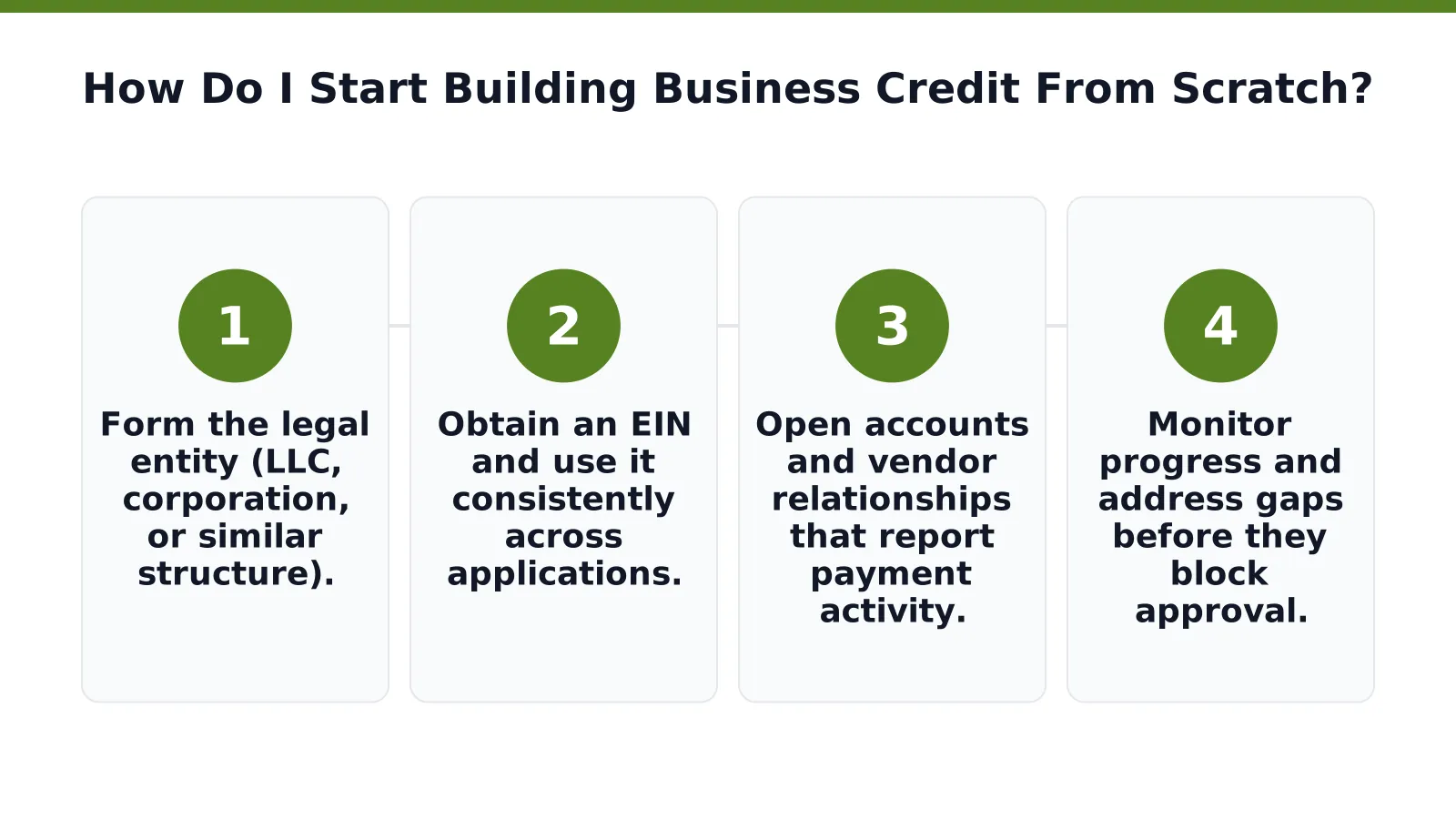
Form the legal entity (LLC, corporation, or similar structure).
Obtain an EIN and use it consistently across applications.
Open accounts and vendor relationships that report payment activity.
Monitor progress and address gaps before they block approval.
Owners with score questions at any stage of this sequence benefit from reviewing common credit building FAQs before applying. Early mistakes often take longer to correct than to prevent.

Does Business Credit Affect My Personal Credit Score?
Properly structured business credit stays separate from an owner's personal credit score. The two systems track different data, and a corporate profile built on the company's EIN exists apart from any individual's Social Security number. That separation matters for founders who want to borrow, lease, or open new accounts without putting personal assets on the line.
The key word is "properly." Business credit only stays separate when owners take deliberate steps to keep business and personal finances apart from day one. Mixing the two, paying business bills from a personal account, or using a personal card for company purchases, blurs the line lenders rely on to judge risk. Separating finances early is what allows a business credit profile to exist in the first place, independent of the owner's personal history.
Can building business credit protect my personal assets?
Yes. Establishing credit under the company's own identity is one of the clearest ways owners shield personal assets while the business grows. When a company qualifies for funding on its own merits, the owner's home, savings, and personal credit history stay out of the equation. This protection grows stronger as the business builds a longer, cleaner credit history of its own.
How do I know which accounts I already qualify for?
A pre-qualification review answers this directly. It shows owners which financing programs they can access right now, which ones require more groundwork, and what specific actions close that gap. This kind of business credit help gives owners a clear starting point instead of guesswork.
For entrepreneurs working through credit building FAQs for the first time, the answer to common score questions usually comes back to the same principle: separation first, qualification second. Get those two steps right. Personal credit stays protected while the business credit profile does the heavy lifting for growth.

What Shapes My Business Credit Score?

Four forces determine a business credit score: payment history with vendors, consistency of business identity data, account mix, and how lenders perceive overall risk. Underwriters weigh each factor differently, which is why two companies with similar revenue can receive very different funding offers. Missing any one piece weakens the whole profile and limits access to higher-limit capital.
Lenders rely on specialized tools to judge a company before extending credit. A technology platform built for this purpose can reveal how underwriters actually view a business, flag gaps in eligibility, and monitor the data major bureaus use to score a company. These insights matter because owners often discover blind spots in their credit file only after a denial. Catching those gaps early protects access to better terms down the line.
What steps actually build a stronger score?
Reporting relationships do most of the heavy lifting. Working with vendors that report payment activity, maintaining a Data Universal Numbering System listing, opening dedicated business credit accounts, and paying obligations on time all contribute to a stronger profile.
Vendor reporting: payments made to suppliers that report to credit bureaus build a payment history separate from personal credit.
Identity consistency: matching business name, address, and entity details across every account prevents fragmented or inaccurate files.
Account diversity: a mix of trade lines and credit types signals stability to underwriters.
Why does identity consistency matter so much?
Lenders, card issuers, and vendors read inconsistent business information as a red flag. Consistent identity data paired with reliable trade credit reporting helps these parties classify a business as lower risk. That lower-risk classification translates directly into better pricing and higher approval odds. A structured, step-by-step approach to closing these gaps helps owners qualify for improved terms, larger limits, and lower rates over time.
How Many Lenders Should I Compare?

Business owners gain the strongest negotiating position when they draw from a wide pool of lenders rather than settling for one or two offers. A narrow search limits options and often leads to mismatched terms, higher rates, or outright denials that could have been avoided. The right comparison set depends less on a fixed number and more on matching the lender pool to the business itself.
VIP Business Credit gives entrepreneurs access to more than 1,000 lending options, a range built specifically so that a financing strategy can be matched to a company's stage, sector, and risk profile. A newer venture in a high-risk industry needs a different set of lenders than an established firm looking to consolidate debt or expand operations. Casting a wide net increases the odds of finding a product built for the business's actual situation, not a generic fit.
Why does comparing multiple lenders matter for business credit help?
Different lenders weigh risk differently, and relying on a single source hides better offers elsewhere. Owners who compare across traditional banks, alternative finance providers, and specialized programs see a fuller picture of what their business qualifies for. This comparison process sits at the center of most credit building FAQs owners raise early in their funding search.
Who guides the comparison process?
Local Business Credit Advisors deliver personalized, concierge-level guidance to owners sorting through lender options. Rather than leaving entrepreneurs to sort through hundreds of products alone, these advisors narrow the field to choices that fit the business's goals.
VIP Business Credit remains rooted in Northern Virginia, actively supporting businesses across Loudoun County, while serving clients digitally and working with lenders nationwide. That structure keeps score questions and comparison decisions grounded in advisor support, no matter where a business operates.
Can Equipment or Fleet Financing Build Credit?

Equipment and fleet financing build business credit by combining a practical purchase with structured, reported payments. [Equipment credit lines](https://vipbizfunds.com/locations/reston-herndon-va/equipment-financing) let a company acquire machinery, tools, or technology immediately, then build a credit history by making regular payments on that equipment. Those payments often qualify as deductible business expenses, which adds a tax benefit on top of the credit-building advantage.
Fleet financing works on the same principle but applies to vehicles. [Fleet credit lines](https://vipbizfunds.com/services/fleet-credit-lines) allow a business to finance multiple trucks, vans, or cars at once rather than paying cash for each one. Specialists structure these deals so payments get reported properly, which strengthens the credit file while locking in tax deductions tied to vehicle costs.
Why does financed equipment help a credit profile more than a cash purchase?
Paying cash skips the credit-reporting step entirely. Financing creates a recorded payment history tied to the business's EIN, which is exactly what lenders review when deciding future approvals. A business that finances equipment or fleet vehicles builds that track record automatically with each on-time payment.
Does financing equipment or vehicles affect day-to-day cash flow?
It can, if payments aren't planned around revenue cycles. This is where cash flow strategy matters: ensuring working capital stays available before it's needed, not scrambling for it after a shortfall. A business that pairs financing with disciplined cash flow management avoids missed payments, which protects the very credit history it's trying to build.
For founders weighing these options, three practical benefits stand out:
Equipment credit lines: immediate access to needed tools plus deductible payments
Fleet credit lines: financing for multiple vehicles with payments structured by specialists
Cash flow planning: working capital available on schedule, reducing missed-payment risk
These answers address common score questions and double as straightforward business credit help for owners building a lender-ready profile from the ground up.
How Long Until I See Credit Results?

Timelines vary by lender, industry, and how quickly a business starts reporting activity to the commercial bureaus. No fixed calendar applies to every company, but delaying the process carries its own cost. Poor business credit makes growth harder down the road, which is exactly why owners benefit from starting early rather than waiting until funding becomes urgent.
Results build in stages, not overnight. Early accounts need time to report, and underwriters want to see a pattern, not a single payment. A structured approach shortens that waiting period considerably.
A thorough business credit help program addresses this by pairing financing access with education and coaching. Owners learn underwriting criteria early, which helps them use credit responsibly from the first account onward. That foundation tends to produce steadier, faster-building results than scattered efforts to open accounts without a plan.
Does monitoring speed up results?
Monitoring itself doesn't accelerate reporting timelines, but it prevents setbacks that delay progress. Regular credit monitoring paired with proactive financial management helps a business maintain a strong profile and catch problems before they spread. Many score questions that owners raise later, like unexplained drops or reporting errors, trace back to gaps that monitoring would have caught months earlier.
What slows down progress the most?
Inconsistent business information across vendors and bureaus is a common drag on timelines. So is relying on accounts that don't report payment activity at all. Among the most frequent credit building FAQs advisors field: why a score hasn't moved despite months of on-time payments. The answer usually involves reporting gaps rather than payment behavior, which is why pairing financing moves with ongoing coaching and monitoring produces more predictable, visible progress than guesswork alone.
Where Can I Get Hands-On Credit Help?

Local advisors at VIP Business Credit's Sterling, Virginia office deliver one-on-one guidance for owners navigating credit decisions. Business owners who skip personal consultation often miss gaps in their credit profile that only surface after a lender denial. Working with a dedicated advisor catches those gaps early, before they cost an approval.
Business credit help works best when it combines software insight with human judgment. A platform can flag a weak payment history or a missing trade line, but an advisor explains what that gap means for a specific industry or funding goal. That pairing of technology and guided execution helps owners move through a complex lending marketplace with far more clarity, speed, and confidence than a self-guided search allows.
Pricing transparency matters just as much as access to advisors. VIP Business Credit structures its advisory relationship around clear, no-surprise pricing, standing as a long-term partner rather than a one-time broker chasing a single transaction. Owners get consistent support as their credit profile and funding needs evolve, not just a single pitch tied to one loan.
What should a business owner ask during a credit consultation?
Strong score questions focus on specifics: which bureau data the lender will pull, what the current eligibility gaps look like, and which products fit the business's revenue stage. Owners should also ask how long credit building typically takes for a company in their industry. A good advisor answers directly, without vague timelines or generic reassurances.
Are credit building FAQs enough, or does a business need an advisor?
General credit building FAQs answer common questions, but they rarely address a company's exact bureau history or lender mix. An advisor reviews actual data and recommends next steps tailored to that business. FAQs build background knowledge; advisors apply it to a real funding decision.
FAQ
How do entrepreneurs build EIN-based business credit?
Entrepreneurs separate personal and business finances, then connect with lenders who report payments. VIP Business Credit links clients to over 1,000 national and local lenders and tracks progress with proprietary scoring tools.
Why does a strong business credit score matter?
A strong score opens access to better financing options, lower interest rates, and favorable supplier terms. Weak credit results in higher borrowing costs, shorter repayment windows, and upfront payment demands from vendors.
How does VIP Business Credit identify credit gaps?
VIP Business Credit's business credit scan identifies credit gaps in minutes, matches businesses to pre-qualified funding options, and maps a clear path toward stronger, lender-ready credit profiles.
Conclusion
In closing, building business credit is a deliberate, measurable process that separates your personal finances from your company's financial identity. By establishing consistent business records, managing trade credit responsibly, and monitoring your progress through the right tools and guidance, you create a stronger foundation for securing capital when you need it. The effort you invest today in these fundamentals directly shapes the lending options and terms available to your business tomorrow, making this work essential to sustainable growth and long-term financial independence.
About The Author
Lee Johnson is a seasoned Real Estate Investor, Business Growth Strategist, and Master Certified Professional Coach with years of hands-on experience helping entrepreneurs build strong, lender-ready business credit profiles. His mission is to help business owners achieve financial freedom by guiding them through the practical steps of separating personal and business finances, securing funding, and building sustainable, long-term credit strategies.
Through his work with VIP Business Credit, Lee combines his real estate investing background and professional coaching certification to deliver guidance that is both strategic and approachable, helping clients move from uncertainty to confidence in their business credit journey.
Contact
📞 Phone: +1 (571) 248-3863
✉️ Email: [email protected]
📅 Consultation: Schedule a Free Consultation
🌐 Website: vipbizfunds.com
🎯 FREE Business Funding Pre-Qualification Scan: Start Your Free Scan
Serving Sterling, VA and the surrounding Northern Virginia and Greater Washington, DC area.


