Business Financing Glossary: Essential Terms Explained
Business Financing Glossary: Essential Terms Explained
Business financing terminology includes terms like EIN-based credit, fundability, and lender networks. VIP Business Credit, based in Sterling, VA, defines these concepts for entrepreneurs through its proprietary Fundability Score tool, connecting clients to over 1,000 national and local lenders across Northern Virginia and the DC region.
Key financing terms, like EIN-based business credit, Fundability Score, and lender networks, help entrepreneurs understand funding options. VIP Business Credit, based in Sterling, VA, connects Northern Virginia. DC-area business owners to over 1,000 national and local lenders while clarifying these concepts for stronger credit decisions.
Business financing terminology covers terms like accrual basis accounting, adjusted net worth, and affiliate status, each defining how lenders evaluate a company's financial health. VIP Business Credit's Business Fundability Scan translates these concepts into practical insight, revealing credit gaps and matching entrepreneurs to funding options tied to the business's EIN rather than personal credit.
Key Takeaways
- Understanding accrual basis accounting helps entrepreneurs recognize revenues when earned, not when cash arrives.
- VIP Business Credit connects clients to over 1,000 national and local lenders for financing opportunities.
- Adjusted net worth calculations determine tangible asset values minus liabilities for accurate business valuation.
- Financial fluency empowers Northern Virginia and Greater Washington, DC entrepreneurs to make confident funding decisions.

What Is a Financing Glossary and Why It Matters?
A financing glossary collects the definitions business owners need to understand loan terms, credit structures, and lender requirements in one place. Without this knowledge, small business owners risk signing agreements they don't fully understand or missing financing options that fit their company's stage and risk profile. A clear glossary turns confusing industry terms into plain language that supports faster, more confident decisions.
Financial fluency does more than build vocabulary. According to Harvard Business School's publication Financial Terminology: 20 Financial Terms to Know, developing financial skills helps professionals excel and make a greater impact on their organizations. For entrepreneurs, that fluency translates directly into stronger conversations with lenders and underwriters.
Why Does Terminology Affect Real Business Decisions?
Financing vocabulary isn't academic. The same Harvard Business School resource notes that finance determines the number of employees a company can hire and shapes its annual budget. A founder who misunderstands terms like "revolving credit" or "underwriting" may misjudge how much capital the business can safely carry, leading to hiring decisions or budget plans that don't match actual cash flow.
Who Helps Entrepreneurs Learn This Language?
Finance enablement firms exist specifically to translate complex credit terminology for business owners. VIP Business Credit, based in Sterling, Virginia, works with entrepreneurs to build lender-ready business credit profiles using exactly this kind of plain-language education. The firm's core focus centers on guiding clients toward high-limit business loans and revolving credit lines. That guidance starts with making sure clients understand the terms before they apply.
A working glossary typically covers:
- Credit structure terms (revolving credit, term loans, lines of credit)
- Underwriting language (risk profile, eligibility criteria)
- Reporting terms (business credit bureaus, trade credit)
Mastering these categories gives founders a sturdier foundation for every funding conversation that follows.
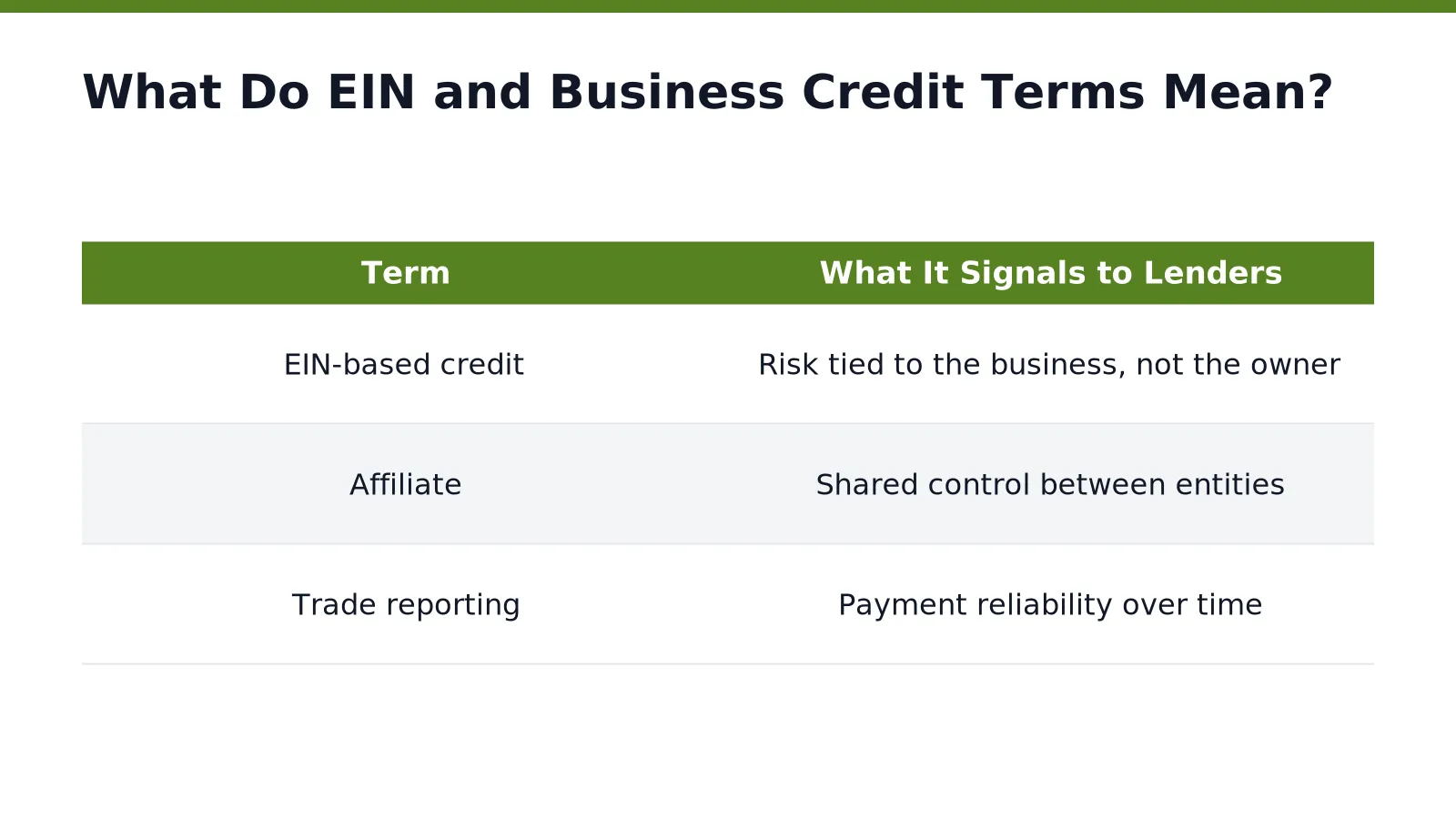
What Do EIN and Business Credit Terms Mean?
An EIN, or Employer Identification Number, ties a company's borrowing history to its federal tax identification number instead of the owner's Social Security number. This single distinction separates personal liability from business liability. Skipping this step leaves an owner's personal credit exposed to every business debt, late payment, and default the company racks up.
A working financing glossary gives entrepreneurs the vocabulary to decode lender decisions before a denial letter arrives. Without it, a founder reads loan terms the way a tourist reads a foreign menu: guessing, hoping, and often ordering wrong. Clear definitions turn confusing underwriting language into something a business owner can act on.
What does "affiliate" mean in a loan application?
An affiliate describes a relationship between two business entities. One entity controls, or has the power to control, the other, or a third party controls both at once. Lenders use this classification to decide whose revenue, debt, and ownership count toward loan eligibility. Misreading it can shrink or inflate a company's qualifying numbers.
Why do industry terms matter more for new businesses?
New businesses have thin credit files, so every data point lenders can verify carries extra weight. Industry terms around identity consistency and trade reporting signal whether a company looks stable or scattered.
Key credibility signals lenders check include:
- Consistent business name, address, and phone number across registrations
- Trade credit reporting from vendors and suppliers
- Verified tax identification and entity structure
Advisory teams working this closely with clients tend to stay small by design. A compact, hands-on advisory model built around three employees reflects that same philosophy: teaching these definitions directly, one business owner at a time, rather than through mass-produced content.
What Are Common Loan and Credit Line Terms?
Common loan and credit line terms describe the products, structures, and conditions a small business owner encounters when applying for capital. A typical financing glossary covers business loans, lines of credit, and structured credit-building programs, each carrying its own underwriting criteria and repayment expectations. Understanding these definitions before sitting down with a lender saves time and reduces the risk of a mismatched application.
Lenders rarely speak the same language twice. One bank's "line of credit" may carry revolving terms. Another's version functions more like an installment loan with a draw period attached. That inconsistency is exactly why a shared set of industry terms matters: it gives a founder a stable reference point no matter which lender is reviewing the file.
A broad lender network widens the range of definitions a business owner may run into. VIP Business Credit connects clients to over 1,000 national and local lenders, spanning traditional banks, alternative finance providers, and specialized programs. Each type of lender uses slightly different language for similar products. A strategy gets matched to a business's stage, sector, and risk profile rather than forced into a one-size-fits-all label.
What does "abandonment option" mean in a loan or credit agreement?
An abandonment option refers to the right to terminate an investment earlier than originally planned. In lending conversations, this term surfaces when comparing credit agreements that allow early exit versus those that lock in a fixed term. Recognizing this distinction helps a business owner weigh flexibility against potentially lower rates.
Why do loan terms vary so much between lenders?
Underwriting criteria differ because each lender weighs risk factors differently, from time in business to industry type. A term that sounds standard at one institution may carry stricter conditions elsewhere. Comparing definitions side by side, rather than assuming uniformity, protects a founder from surprises at closing.
What Do Underwriting and Risk Terms Mean?
Underwriting and risk terms describe how lenders judge whether a business qualifies for capital. How much danger that loan poses to the lender. These terms appear across loan applications, credit agreements, and bankruptcy filings. Misreading them costs business owners approvals, favorable rates, or clear visibility into what a contract actually requires.
One term worth knowing well is absolute priority. In bankruptcy proceedings, this rule requires senior creditors to be paid in full before junior creditors receive any payment at all. For a business owner, this concept matters because it shows how lenders rank risk among different types of debt. A senior lender sits higher on the repayment ladder. A junior lender takes on more risk and often charges more for it.
Why do underwriting terms feel so confusing?
Underwriting language borrows heavily from legal and accounting fields, so plain-English equivalents rarely exist. VIP Business Credit combines proprietary technology with hands-on advisory support specifically to translate this terminology into terms business owners can act on.
How can business owners protect themselves from hidden risk language?
Pricing clauses often hide fees inside dense underwriting language. Transparent, no-surprise pricing policies help owners spot and avoid charges buried deep in contract text before signing anything.
Local Business Credit Advisors deliver personalized, concierge-level guidance so owners interpret underwriting language correctly before applying. This advisory support typically covers:
- Risk-tier classifications that determine interest rates and repayment terms
- Priority structures affecting repayment order during default or bankruptcy
- Fee disclosures hidden within standard financing agreements
- Covenant language that triggers penalties or accelerated repayment
Learning this vocabulary early builds confidence. Owners who understand risk terminology negotiate better terms and avoid costly misunderstandings down the road.
What Are Key Accounting Terms Borrowers Should Know?
Four accounting terms shape how lenders read a company's financial story: accrual accounting, amortization, accelerated depreciation, and adjusted net worth. Each one changes a number on a financial statement, and underwriters pay close attention to those numbers before approving capital. A borrower who understands these definitions walks into a lending conversation with far more confidence.
Accrual basis accounting records revenue the moment it's earned, not when cash lands in the bank. Expenses get matched to the revenue they helped generate, or logged when they actually occur. Most lenders expect this method on financial statements because it paints a fuller picture of business performance across a given period, rather than a snapshot of cash movement alone.
What does amortization mean on a loan application?
Amortization refers to a non-cash expense that gradually reduces the recorded value of intangible assets, such as patents, trademarks, or goodwill. The reduction happens in a systematic, predictable pattern over time. Because amortization lowers net income without affecting actual cash flow, lenders reviewing a borrower's books often separate this figure out to judge true operating performance.
Accelerated depreciation works differently. This tax-related method front-loads larger deductions into the early years of an asset's life rather than spreading them evenly. That timing shift can make a company appear less profitable early on, which matters during underwriting review.
Why does adjusted net worth matter for disaster-related loans?
Adjusted net worth applies in specific lending situations, particularly certain SBA disaster-loan programs. It reflects the post-disaster fair market value of tangible assets minus liabilities, within defined restrictions. Borrowers pursuing these specialized programs should expect this term to surface during application review.
Mastering this small set of industry terms and building fluency in a broader financing glossary helps borrowers speak the same language as the lenders evaluating their applications.
What Do Equipment and Fleet Financing Terms Mean?
Equipment and fleet financing terms describe credit tools built for businesses that need physical assets, machinery, trucks, or vehicles, rather than cash alone. These terms belong in any serious financing glossary because they cover some of the most commonly misunderstood industry terms small business owners encounter when applying for capital. Clear definitions matter here because the wrong assumption can cost a business thousands in missed tax benefits or slower credit building.
Equipment credit lines allow a business to acquire necessary machinery or tools immediately, without waiting to save up cash reserves. Regular use of the equipment, paired with on-time payments, builds a business credit history over time. Many of these payments also qualify as deductible business expenses, which lowers taxable income while the equipment stays productive.
Fleet credit lines work on a similar principle but apply to vehicles instead of machinery. A business can finance multiple trucks, vans, or cars under one credit structure. Doing so builds business credit history and locks in tax deductions tied to vehicle ownership and use.
What makes fleet financing different from general equipment financing?
Fleet financing involves specialists who structure deals specifically for trucks, vans, and cars. This niche focus matters most to trucking operators and home services businesses. Multiple vehicles carry the weight of daily operations. General equipment financing, by contrast, covers a broader range of machinery and tools outside of transportation.
Both financing types fit newer ventures seeking first approvals and established firms ready to scale with better-priced capital.
What Cash Flow Terms Should Entrepreneurs Know?
Cash flow terminology describes how money moves into and out of a business, and mastering these terms helps owners avoid a gap between bills due and cash on hand. Working capital, the funds available to cover day-to-day operations, sits at the center of this vocabulary. Business owners who understand this financing glossary can plan for slow months before those months create a crisis, rather than scrambling once a shortfall already hits.
Strong cash flow strategy exists to make sure working capital is available when it's needed, not after a shortage has already strained payroll or supplier payments. That distinction matters: reactive cash management fixes problems after the damage is done. Proactive planning prevents the damage in the first place.
What does "account group" mean on a business balance sheet?
Account group, a bookkeeping term found across standard industry terms, classifies the source or purpose of funds within a company's financial records. Grouping accounts this way lets an owner, or a lender reviewing the business, see at a glance where money originates and where it's intended to go. This classification becomes especially useful when separating operating cash from reserves earmarked for debt service or growth projects.
Why does knowing lender standing matter for cash flow planning?
Clear definitions only help in practice once a business owner knows exactly where that business stands with lenders. A credit review that reveals gaps also delivers a roadmap for closing them, turning glossary knowledge into an actionable funding plan. Without that baseline, even a well-defined term like working capital stays theoretical rather than something an owner can act on.
Local guidance strengthens this process. VIP Business Credit's office in Sterling, Virginia, supports cash flow and credit-building education for business owners navigating these terms firsthand.
How Do You Apply These Definitions When Seeking Funding?
Applying a financing glossary starts with matching each term to the stage of the funding process it governs. Entrepreneurs who understand definitions before meeting with a lender avoid confusion when a term sheet or application arrives full of unfamiliar language. Preparation at this level separates owners who negotiate confidently from those who sign without fully grasping the terms.
A pre-qualification workflow puts this knowledge to immediate use. Business owners can see which financing programs they already qualify for. Which require more groundwork, such as stronger trade references or cleaner financial statements. That distinction matters because chasing the wrong program wastes time and can trigger unnecessary credit inquiries.
What does "acceptance of offer" mean in a funding context?
"Acceptance of offer" describes a buyer's agreement to the terms a seller submits, a foundational contract concept that shows up throughout financing agreements. In lending, the "buyer" is the business accepting a lender's proposed rate, term, or collateral requirement. Recognizing this moment matters because acceptance usually locks in the deal, with limited room to renegotiate afterward.
Does location affect which financing terms apply?
Geography rarely changes the vocabulary of financing. Guidance rooted in Northern Virginia still serves clients digitally and works with lenders nationwide. industry terms like acceptance of offer or pre-qualification apply the same way whether a business operates in Loudoun County or another state entirely.
Owners get the most value from a glossary when they treat it as a working reference, not a one-time read. Consider this simple approach:
- Look up unfamiliar terms before signing any document, not after.
- Cross-check lender language against standard definitions to catch inconsistent terminology.
- Revisit terms periodically, since usage shifts slightly across lender types.
Combining broad access to lenders, purpose-built technology, and guided execution helps owners move through a complex funding marketplace with far more clarity and confidence than vocabulary alone provides.
FAQ
What is accrual basis accounting?
Accrual basis accounting recognizes revenues when earned, not when cash arrives. This distinction matters because lenders use it to evaluate a company's true financial health during underwriting.
How does VIP Business Credit help entrepreneurs understand financing terms?
VIP Business Credit's Business Fundability Scan translates financing concepts into practical insight, revealing credit gaps. The Sterling, VA-based firm matches entrepreneurs to funding options tied to the business's EIN rather than personal credit.
Why does understanding financing terminology matter for business owners?
Misunderstanding terms like "revolving credit" or "underwriting" leads founders to misjudge how much capital their business can safely carry. This affects hiring decisions and budget plans that may not match actual cash flow.
Conclusion
In closing, mastering these financing terms transforms how you navigate the lending landscape and communicate with underwriters. When you understand the language lenders use, from Paydex scores to revolving credit lines to covenant requirements, you move from confusion to confidence. This knowledge becomes your foundation for building sustainable business credit, accessing capital that fuels growth, and making informed decisions that protect your company's financial future. The terminology may seem dense at first. Each term represents a concrete tool you can leverage to strengthen your fundability and unlock the resources your business deserves.


