Cash Flow Management Strategies for Small Business
Cash Flow Management Strategies for Small Business
Small business cash flow management strategies center on forecasting income and expenses accurately, maintaining working capital reserves, and separating business credit from personal liability through EIN-based financing. VIP Business Credit's Cash Flow Management service pairs these tactics with its Business Fundability Scan, identifying credit gaps and building a roadmap. Capital arrives before shortfalls occur, not after.
Key Takeaways
- Small business owners stabilize operations by prioritizing cash management as an essential organizational function.
- Effective cash flow strategies unlock capital tied up in day-to-day operations for business expansion.
- VIP Business Credit connects entrepreneurs to over 1,000 national and local lenders for funding.
- Smart fiscal planning and timely cash movement lower capital costs and improve financial stability.
Why Does Poor Cash Flow Sink Small Businesses?
Poor cash flow management, not lack of customers or a weak product, closes most small businesses. Small Business Cash Flow Management Strategies reports that 82% of small business failures trace back to poor cash flow management or a poor understanding of cash flow. That single statistic explains why so many owners with loyal customers and steady sales still end up shutting down.
The U.S. Chamber of Commerce backs this up, naming cash flow problems as the leading cause of small business failure. Sales numbers can look strong on a report while the bank account tells a different story. A business can even generate healthy revenue and still run out of usable cash, making effective cash flow management and solid business liquidity essential.
Why do profitable businesses still run out of cash?
Profit and cash are not the same thing. A company can book a sale today but not collect payment for 30, 60, or even 90 days. Rent, payroll, and supplier invoices come due immediately. That timing gap between money earned and money in hand creates the shortfall, even when incoming revenue looks sufficient on paper.
This gap is exactly where business liquidity breaks down for otherwise healthy companies. Common warning signs include:
- Paying vendors late despite strong monthly sales
- Relying on credit cards to cover payroll
- Watching cash reserves shrink even during profitable months
VIP Business Credit builds cash flow management plans and cash flow strategies designed to put working capital in place before a shortfall hits, rather than after. That timing difference, having funding available in advance instead of scrambling once bills come due, is often what separates a business that survives a rough quarter from one that doesn’t.
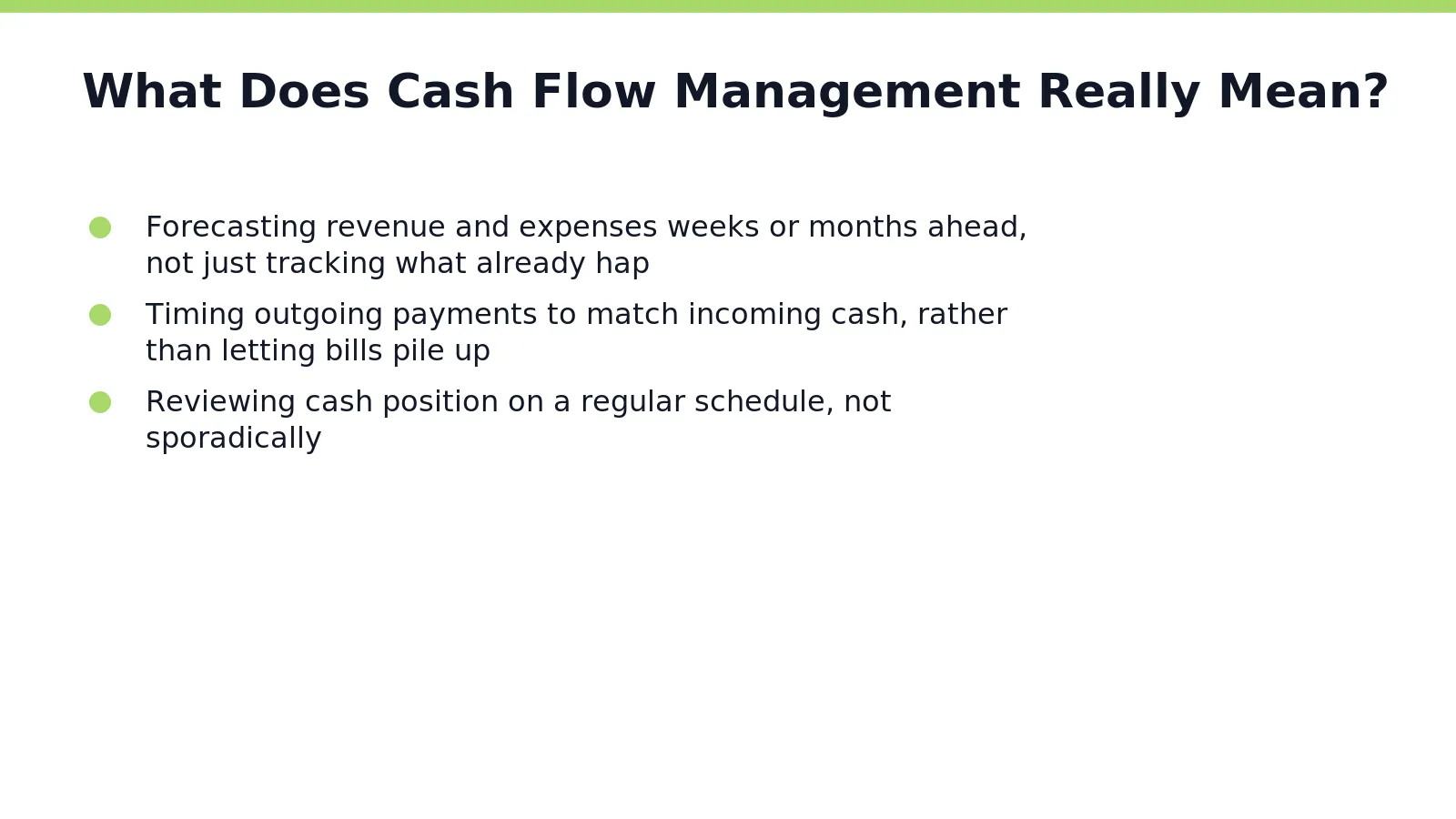
What Does Cash Flow Management Really Mean?
Tracking cash flow means knowing exactly what money moves in and out of a business, then forecasting sales and expenses before they happen. This is not a once-a-year exercise. Small business owners who skip regular tracking often discover shortfalls only after the damage is done, when payroll is due and the account balance says no.
Cash flow management starts with two simple questions: what came in this week, and what went out? Owners who answer those questions consistently build a clear picture of business liquidity, the cash actually available to cover bills, payroll, and unexpected costs. Without that picture, decisions become guesswork.
VIP Business Credit helps entrepreneurs in Northern Virginia and the Greater Washington, DC region build EIN-based business credit. That mission starts with the basics: helping owners see their cash position clearly before recommending any funding path, improving cash flow management and maintaining strong business liquidity.
Why does cash flow management matter for a small business?
Poor cash flow visibility leads to missed payments, strained vendor relationships, and rushed borrowing decisions made under pressure. Strong management flips that script. Smart fiscal planning and timely movement of cash lower the overall cost of capital, meaning less money spent on interest and fees over time, strengthening both cash flow strategies and overall business liquidity.
How does cash flow management connect to growth?
Controlling cash is the foundation for expansion, not a separate task from it. VIP Business Credit frames this directly: control the cash, and the business grows on schedule instead of scrambling for funding at the last minute.
Effective cash flow strategies share a few common traits:
- Forecasting revenue and expenses weeks or months ahead, not just tracking what already happened
- Timing outgoing payments to match incoming cash, rather than letting bills pile up
- Reviewing cash position on a regular schedule, not sporadically
Owners who treat cash tracking as routine, rather than reactive, gain the confidence to plan growth on their own timeline while maintaining optimal business liquidity.

When Will Your Business Hit Break-Even?
Break-even arrives the moment revenue fully covers costs, with no profit yet earned but no loss either. That single milestone confirms a business is recovering every dollar spent before any profit goal becomes realistic. Skipping this calculation leaves owners guessing whether sales are actually sustaining the business or merely masking a slow drain on reserves, which negatively impacts business liquidity.
Knowing the break-even point changes how cash flow management decisions get made day to day. Instead of reacting to a shrinking bank balance, owners can plan around a concrete number and measure progress against it.
How does break-even connect to business liquidity?
Break-even and business liquidity are related but distinct measures. Break-even shows when costs are covered. Liquidity shows whether cash is available right now to pay bills while waiting to get there. A business can be approaching break-even on paper while still facing a liquidity gap if cash arrives slower than expenses go out.
What role do cash flow strategies play in reaching break-even faster?
Strong cash flow strategies shorten the runway needed to hit break-even by keeping working capital available exactly when it’s required, not after a shortfall has already started. VIP Business Credit builds its cash flow strategies around that timing principle rather than reactive fixes. A pre-qualification review adds another layer of clarity, showing owners:
- Which funding programs they already qualify for today
- Which programs require additional preparation before approval
- Where gaps in credit history might be slowing progress toward break-even
That combination, a clear break-even target paired with proactive capital planning, gives owners a realistic timeline instead of a guess while reinforcing solid business liquidity.

What Causes Most Small Business Cash Crunches?
Two forces drive most cash crunches: weak cash flow management habits and thin starting capital. Small Business Cash Flow Management Strategies identifies poor cash flow management skills and a poor understanding of cash flow among the leading reasons small businesses fail. That gap in knowledge, more than a lack of sales, often decides which companies survive their first hard stretch, directly impacting business liquidity.
Undercapitalization compounds the problem. Many founders launch with barely enough money to cover startup costs, let alone absorb the normal swings in when cash actually arrives versus when bills come due. A single slow-paying client or a seasonal dip can drain reserves fast when there’s no cushion behind day-to-day business liquidity.
Why does a profitable business still run out of cash?
Profit on paper and cash in the bank are two different things. A company can book a sale in March and not collect payment until May, while payroll and rent still come due monthly. Without a clear view of timing gaps, even a growing business can find itself short on the cash needed to operate, underscoring the importance of cash flow management.
What early warning signs point to a coming crunch?
Late vendor payments, maxed-out credit lines, and reliance on personal funds to cover business expenses all signal trouble ahead. These patterns often show up months before a business actually misses a payroll or a lease payment.
Closing these gaps starts with visibility. VIP Business Credit’s tools are built to show owners how underwriters actually view their business, surfacing the specific eligibility gaps that quietly drain working capital. Paired with its business credit-building program, which combines education and coaching, owners learn underwriting criteria and practical cash flow strategies before a shortfall turns into a crisis, safeguarding business liquidity.
Which Cash Flow Strategies Protect Your Liquidity?
Strong cash flow strategies lower the amount of cash a business must keep sitting idle while boosting returns on the capital already at work. Smart fiscal planning, timely movement of cash, and integration of day-to-day operations with financial systems all work together to reduce risk. Businesses that connect operational and financial systems, rather than tracking them separately, gain more control over short-term needs and long-term growth funding, enhancing business liquidity.
Separate spreadsheets and disconnected accounting tools create blind spots. A business owner who cannot see cash position in real time makes decisions based on outdated numbers. Integration closes that gap and turns cash flow tracking into a strategic tool instead of a monthly scramble.
Business liquidity protection also depends on matching the right financing to the right situation. A generic loan product rarely fits a seasonal retailer the same way it fits a growing service firm. That’s where credit-readiness tools add value: they identify gaps in a business’s eligibility before a lender does, then surface funding products suited to that business’s actual financial picture.
What role does technology play in managing cash flow?
Technology gives owners visibility they cannot get from manual tracking alone. VIP Business Credit pairs proprietary tools with hands-on advisory support, rather than handing clients a single generic product. That combination helps surface eligibility gaps early and matches businesses to funding options suited to their specific stage and risk profile, strengthening cash flow management.
How does integration improve cash flow control?
Linking operational systems to financial systems removes the lag between what happens in the business and what shows up in the books. Cash movement becomes timely instead of delayed. Fiscal planning improves because decisions rest on current data, not last month’s snapshot.
Three practices consistently support stronger liquidity positions:
- Integrating systems: connect daily operations with financial tracking for real-time visibility
- Reducing idle cash: keep only the liquidity needed, freeing capital for growth or debt reduction
- Matching financing to need: use credit-readiness insights to find funding products fit for the business’s stage
How Can Broader Lender Access Boost Liquidity?
More lender options mean more paths to working capital when a business needs cash fast. VIP Business Credit connects clients to a network of more than 1,000 national and local lenders, giving business owners far more chances to find funding that fits their situation. A narrow lender list often means fewer approvals and slower access to capital, exactly when business liquidity matters most.
That broad network changes how a cash flow management plan gets built. Instead of chasing a single bank’s rigid requirements, owners can compare offers across traditional banks, alternative finance providers, and specialized programs. This widens the door for businesses that don’t fit a conventional lending box, including newer companies or those in less common industries. Owners exploring more traditional government-backed options can also review SBA loan programs alongside private lender offers.
Financing strategies aren’t one-size-fits-all, either. Each plan gets matched to a business’s specific stage, sector, and risk profile, rather than forced into a generic template. A retail company six months old faces different funding needs than a ten-year-old logistics firm, and matching the strategy to those realities improves the odds of approval. Some owners also explore crowdfunding platforms as a supplemental funding source alongside traditional lending.
How does a business find out which lenders fit its profile?
A short credit-readiness scan speeds up that discovery process considerably. In just a few minutes, it matches a business to pre-qualified funding options without touching the owner’s personal credit score. That fast, no-risk snapshot helps owners see real options before they commit time to a full application.
The result is a more resilient set of cash flow strategies, built on real market options rather than guesswork. Owners gain:
- Access to a wide, diversified pool of potential lenders
- A funding match based on business stage, sector, and risk
- A quick, low-risk way to check pre-qualified options before applying
Wider access doesn’t guarantee approval, but it substantially improves the odds of finding a workable fit.
Why Separate Business Credit From Personal Credit?
Personal and business finances follow different rules, and mixing them puts an owner’s house, savings, and credit score on the line every time the company borrows money. Separation matters because it shields personal assets from business risk while giving the company its own financial identity. Building credit under the business’s EIN (Employer Identification Number), instead of the owner’s Social Security number keeps that risk where it belongs: inside the business, securing better business liquidity.
VIP Business Credit helps entrepreneurs across Northern Virginia and the Greater Washington, DC region build this kind of EIN-based business credit. The approach centers on establishing a credit profile tied directly to the company rather than to the founder’s personal history. That structure protects business liquidity because a downturn in the company doesn’t automatically drag down the owner’s personal borrowing power or credit score.
Does business credit affect personal credit?
When credit is properly separated, activity on business accounts does not appear on the owner’s personal credit report. This distinction matters most during cash flow management, when a company may need to draw on credit lines to cover payroll or inventory without exposing the founder’s personal finances to added risk.
How does an advisor help with this separation?
Local Business Credit Advisors work directly with owners to build the credibility signals lenders and vendors rely on. Guidance is delivered one-on-one, not through a generic checklist. Advisors help clients establish consistent business identity records and reporting habits that support long-term cash flow strategies, not just a single loan approval.
The payoff compounds over time. A business with its own credit profile can pursue larger credit lines and better terms without the owner’s personal SSN determining the outcome. Skipping this step leaves personal assets exposed and limits how far the company can eventually grow.
What’s Your Next Step To Protect Cash Flow?
Protecting liquidity starts with a clear-eyed look at where a business stands today, not after a shortfall hits. Strong cash flow management depends on knowing credit gaps before a lender points them out. Waiting until cash runs tight limits options and raises costs. Acting early keeps more paths open.
VIP Business Credit approaches this work as an ongoing partnership, not a one-time transaction. Pricing stays transparent from the first conversation, with no hidden fees surfacing later in the process. That structure matters for owners weighing business liquidity decisions. Surprise costs can undo careful planning just as easily as a slow-paying customer.
Is this approach only for new businesses?
A startup chasing its first approval needs a different roadmap than a ten-year-old company refinancing equipment debt. Both benefit from cash flow strategies built around the business’s actual stage, not a one-size-fits-all pitch. Owners in Loudoun County specifically can review local business loan options suited to the region’s lending landscape.
Does location limit who can get help?
Geography doesn’t restrict access to support. VIP Business Credit is based in Sterling, Virginia, but serves clients digitally and works with lenders nationwide.
A business owner in another state gets the same guidance as one down the road from the Sterling office. That national lender reach means financing decisions aren’t boxed in by local bank relationships alone.
The next step is simple: assess the business’s current credit position before a cash gap forces a rushed decision. Planning ahead, with a transparent partner and a stage-appropriate strategy, keeps working capital available when growth demands it.
FAQ
What causes most small business failures?
Poor cash flow management, not weak sales or product quality, closes most small businesses. 82% of small business failures trace back to poor cash flow management or a poor understanding of cash flow.
Why does a profitable business run out of cash?
Sales book today, but payment often arrives in 30, 60, or 90 days. Rent, payroll, and supplier invoices come due immediately, creating a timing gap.
How does VIP Business Credit help with cash flow?
VIP Business Credit pairs cash flow strategies with its Business Fundability Scan, connecting entrepreneurs to over 1,000 national and local lenders and building EIN-based business credit before shortfalls occur.
Conclusion
In closing, effective cash flow management transforms how small business owners navigate growth and uncertainty. By implementing these strategies, tracking inflows and outflows, maintaining reserves, and optimizing payment cycles, you build the financial stability that lenders recognize and reward. Strong cash flow discipline strengthens your business’s credibility, making it easier to secure the capital you need when opportunity strikes. Start with one strategy this week, measure the results, and build from there. Your business’s financial health depends on the decisions you make today.
About The Author
Lee Johnson is a seasoned Real Estate Investor, Business Growth Strategist, and Master Certified Professional Coach. His mission is to help business owners achieve financial freedom through fundable, lender-ready credit profiles established under an EIN (separated from personal liability). He coaches entrepreneurs across various industries (home services, trucking, real estate investing) in accessing capital and navigating commercial lending underwriting standards.
Contact Us
- 📞 Phone: (571) 248-3863
- ✉️ Email: [email protected]
- 📅 Consultation: Schedule A Business Financial Health Strategy Call
- 🌐 Website: https://vipbizfunds.com
- 🎯 FREE Business Success Scan: FREE Business Success Scan
- 📍 Service Area: Sterling, VA and surrounding areas


