Business Plan Template for Funding
Business Plan Template for Funding
A funding-ready business plan outline includes executive summary, company description, market analysis, organization structure, product/service details, marketing strategy, and financial projections. VIP Business Credit, based in Sterling, VA, uses a proprietary business credit scoring tool to connect entrepreneurs with over 1,000 lenders nationwide for funding success.
A downloadable outline from SCORE.org covers company description, market analysis, organization structure, product lines, and financial projections, core sections lenders expect before approving commercial loans. Pairing that outline with VIP Business Credit's pre-qualification scan gives founders a clear roadmap, identifying credit gaps lenders flag before funding gets approved.
Key Takeaways
- A solid business plan guides entrepreneurs through each stage of starting and managing their business successfully.
- Your business plan serves as a roadmap for structuring, running, and growing your new company effectively.
- Thorough planning helps you think through every step and better prepare to handle business challenges ahead.
- VIP Business Credit connects you to over 1,000 national and local lenders to fund your vision.
What Will a Lender-Ready Plan Accomplish?
A business plan template gives a company its roadmap for every stage of starting, running, and growing an operation that needs outside capital. Lenders read this roadmap before they read a loan application. Without it, a strong business idea can still stall at the underwriting desk. Reviewers have no structured way to judge direction or risk.
This document works best when it answers the lender's core question: can this business repay what it borrows? A clear funding outline inside the plan lays out how much capital the business needs, what it will fund, and how revenue will cover repayment. Skipping this step forces lenders to guess, and guesswork rarely ends in approval.
Why does location matter for business credit building?
Firms that help entrepreneurs build credit tied to the company's own EIN, rather than the owner's personal Social Security number, often operate within a defined service region. One example: advisors supporting business owners across Northern Virginia and the Greater Washington, DC area, guide local founders through this EIN-based credit-building process in person.
Does a funding-ready plan only help local businesses?
No. Advisory relationships increasingly happen online, and lender networks extend across the country. A business plan built for funding readiness travels with the company. It works whether the business sits in a single county or serves customers nationwide. The underlying strategic document reflects standards lenders everywhere recognize: clear structure, credible numbers, and a repayment story that holds up to scrutiny.

What Do You Need Before You Start Writing?
Two things come before the first draft: a clear picture of current lender standing and a realistic sense of what financing is actually available. A proprietary scoring tool from VIP Business Credit shows a business owner exactly where their company stands with lenders before a single page gets written. Skipping this step leaves founders guessing at numbers that underwriters will check anyway.
How does a pre-qualification scan help with planning?
A scan takes minutes to complete and carries zero impact on personal credit. It surfaces qualifying loans, lines of credit, and vendor terms, giving an owner real planning data instead of assumptions. That data belongs in the financial section of any business plan template. Projected funding needs should match what lenders will realistically approve.
Why does the writing process itself matter?
Working through a plan forces an owner to think through every step of the company, from operations to sales to staffing, so problems surface before they become expensive. SCORE.org notes that this exercise helps founders prepare for and handle challenges that would otherwise catch them off guard. A well-built strategic document isn't paperwork for a drawer; it's a working map tested against real conditions.
Before drafting, gather these inputs:
- Current credit standing, measured through a proprietary business credit scoring tool
- Pre-qualification results showing available loan and credit line options
- A sense of lender scale: VIP Business Credit connects to over 1,000 national and local lenders, which shapes realistic funding targets
- Basic financials and a rough sense of how much capital the business actually needs
Treat this information as the backbone of the funding outline that follows. Without it, even a well-written plan will undersell what the business can realistically secure, or worse, overpromise to lenders who check the numbers first.
How Do You Write a Strong Executive Summary?
A strong executive summary states the business goal, the funding need, and the reason a lender should say yes, all within the first page. Skip this clarity, and a loan officer loses interest before reaching the financial projections. The summary sits at the front of a business plan template for a reason: it carries the weight of a first impression.
Most business plans follow one of two common formats, traditional or lean startup, and both still open with this same summary section. The format changes further into the document, but the opening page always works the same way. It introduces the company, states the ask, and sets the tone for everything that follows.
The summary's core job is persuasion. Every paragraph should build toward convincing a reader that working with, or lending to, the business makes sound financial sense. Vague mission statements fail here. Specific, confident language works better.
What Should the Funding Request Include?
The funding section of the summary needs plain, direct language about the goal. State whether the business is pursuing a high-limit loan, a revolving credit line, or another form of capital. Avoid burying this detail in later chapters; lenders look for it early.
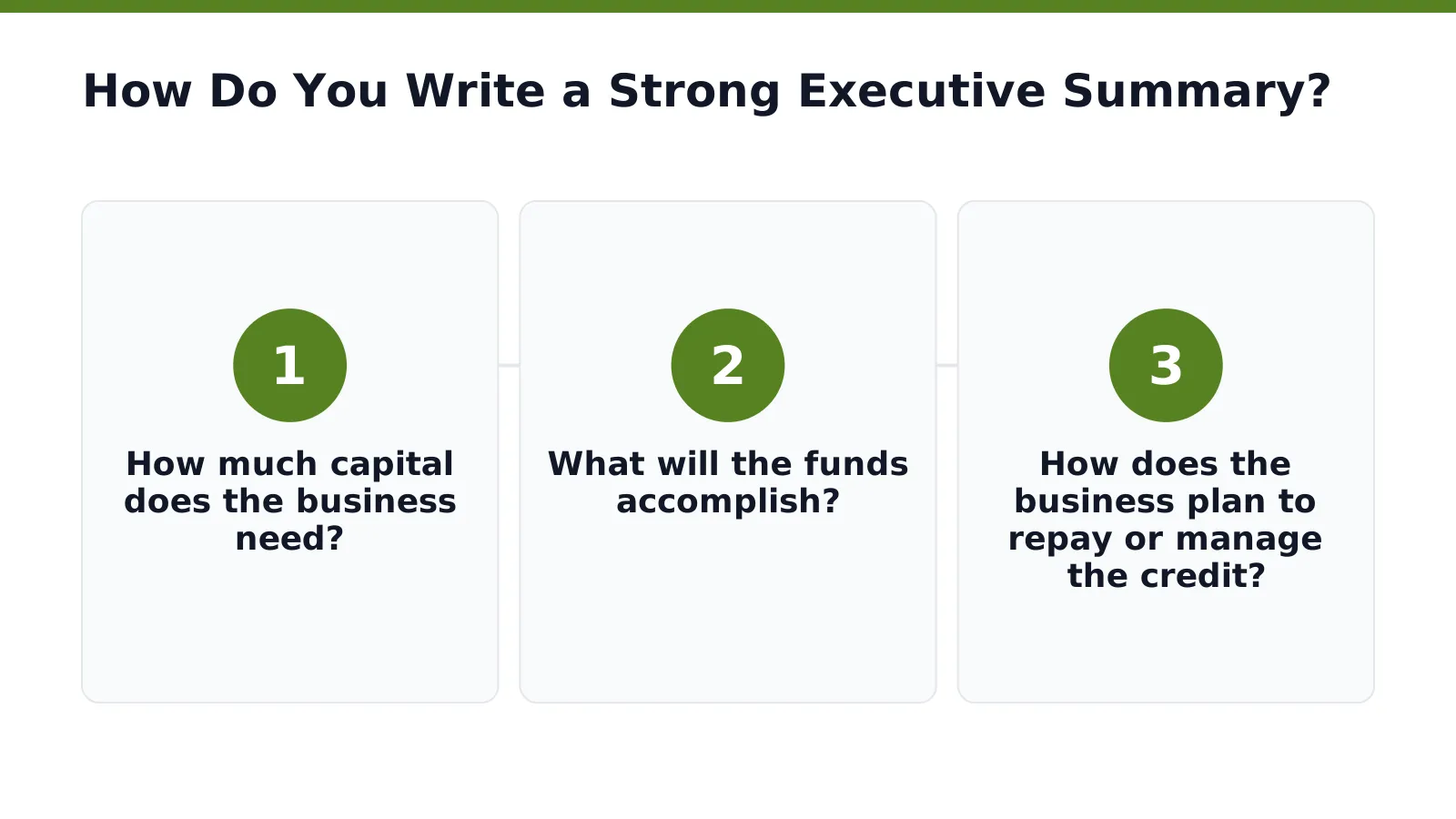
A clear funding outline inside the summary should answer:
- How much capital does the business need?
- What will the funds accomplish?
- How does the business plan to repay or manage the credit?
Does the Summary Replace the Full Plan?
No. The summary previews the full strategic document but never substitutes for it. Readers expect the detail to show up in later sections, supported by data and structure.
How Do You Outline Company Description and Goals?
Company description and goals form the section where an owner thinks through the core identity of the business: its structure, vision, and mission. A business plan template usually places this section near the front, right after the executive summary. Lenders read it to understand what the company actually does. Skipping this step leaves gaps that surface later during underwriting, when a lender asks questions the owner cannot answer clearly.
Structure comes first. Every company description should state whether the business operates as an LLC, S-corp, partnership, or sole proprietorship. This choice affects liability and tax treatment. The description should also note that business credit ties to the company's EIN rather than the owner's Social Security number. That distinction separates personal and business liability, which matters enormously once the company starts borrowing.
Why does the EIN versus SSN distinction matter for goals?
Credit built under an EIN protects personal assets from business debt. Goals written into this section should reflect that priority, not just revenue targets. A growth goal that ignores liability separation leaves the owner personally exposed even as the company scales.
The goals portion of this section works best as a short, forward-looking narrative paired with a simple list:
- Short-term goal: Establish an EIN-based credit profile distinct from personal credit.
- Mid-term goal: Qualify for larger lines of credit as revenue grows.
- Long-term goal: Expand operations while keeping personal assets shielded from business liability.
This strategic document should connect expansion plans directly to asset protection. Growth without that connection creates risk; growth paired with it creates a company lenders can evaluate with confidence. Owners who write this section with structure, identity, and liability separation in mind set up every later section, including the funding outline, to make a stronger case to lenders.
How Do You Complete the Market Analysis Section?
Completing a market analysis requires three steps: identify the company's industry classification, study the competitive landscape, and connect those findings to a funding ask. Skipping this section weakens a business plan template before a lender even reaches the financials. A thin or generic analysis signals unpreparedness, and underwriters notice.
Start with classification. Identifying the company's NAICS code, according to the Small Business Administration, supports the market analysis section along with insurance and tax planning. This six-digit code places a business inside a specific industry category. Lenders use it to benchmark risk against similar companies. Skipping this step leaves the rest of the analysis without a frame of reference.
What Should the Market Analysis Actually Prove?
The section should analyze the market and competition to strengthen the overall case for a new venture, per SCORE.org. That means answering concrete questions:
- Identify the target customer and estimate the size of the market.
- List direct and indirect competitors, with their strengths and gaps.
- Explain what makes the business different enough to win market share.
- Tie demand evidence back to the funding request.
How Does This Section Affect Loan Approval?
A well-built market analysis becomes part of the broader funding outline a lender reviews before approving capital. Findings from the analysis help match a financing strategy to a business's particular stage, sector, and risk profile. Lenders fund differently based on where a company sits in its growth cycle.
Treat the market analysis as more than a formality. It functions as a strategic document that proves the business understands its own competitive position, not just its product. Entrepreneurs who build this section carefully give lenders fewer reasons to hesitate and a clearer picture of long-term viability.
How Do You Build the Funding Outline and Financials?
A strong funding outline names the lender types a business intends to pursue. Pairs that list with realistic financial projections. Skipping this step leaves owners guessing which lenders fit their situation and wasting months chasing the wrong applications. Building the outline correctly takes a few structured steps, not a vague wish list.
- List every lender category under consideration. A complete funding outline names traditional banks, alternative finance providers, and specialized programs, since each evaluates risk differently.
- Specify the exact products needed. State whether the business is seeking term loans, revolving lines of credit, or a structured credit-building program rather than writing "funding" in general terms.
- Match products to business stage. A newer venture chasing initial approvals needs different terms than an established firm looking to consolidate costs or expand.
- Build financial projections around realistic ranges. Because approval terms vary across more than 1,000 lending sources, projections should reflect a range of possible rates and repayment structures, not a single best-case number.
- Review the outline against lender criteria before submission. Catching mismatches early saves time and protects the business's credit profile from unnecessary inquiries.
What belongs in the financial projections section?
Financial projections should include realistic revenue estimates, expense forecasts, and cash flow timelines that match the funding amount requested. Overstated numbers raise red flags with underwriters, while understated ones limit how much capital a business can secure. Projections grounded in actual sales history and documented expenses carry more weight than optimistic guesses.
Why does lender variety matter in the outline?
Lender variety matters because approval odds and pricing shift dramatically depending on the source. A bank might decline an application that a specialized program approves within days, and vice versa. This is also where a complete strategic document earns its value: it keeps owners moving in one direction.
Owners who pair a written outline with guided execution and broad lender access gain real advantages, moving through the marketplace with more clarity, speed, and confidence than those applying blind.
How Do You Turn a Draft Into a Strategic Document?
A draft becomes a strategic document through expert review, not extra pages. Local Business Credit Advisors examine the financial assumptions, market positioning, and funding requests inside a plan, then reshape weak sections so lenders read them with confidence. Skipping that review leaves gaps a loan officer will spot immediately, often resulting in a declined application or a buried request for more documentation.
Advisors do not simply proofread. They test whether the numbers support the ask. Whether the funding outline matches what a specific lender wants to see. This kind of review turns a generic write-up into a document built for underwriting, not just description.
What should a business owner expect from an advisory session?
Expect a conversation focused on gaps, not grammar. An advisor will ask about revenue projections, collateral, and how the requested capital will be used, then flag anything that could raise questions during underwriting. Owners walk away with specific edits to make, not vague encouragement.
Is in-person support available during this process?
Yes. Owners who prefer face-to-face guidance can work with advisors at the Sterling, Virginia office. Local, hands-on support helps clarify complicated sections of a plan without relying solely on email or phone calls.
Trust matters as much as expertise in this relationship. A dependable advisory partnership runs on transparent, no-surprise pricing, so owners always know what a service costs before committing. That transparency signals a long-term partnership rather than a single transaction, which matters because a business plan template is rarely finished after one draft.
Turning a draft into something lenders trust usually involves:
- Reviewing financial projections for realistic, defensible assumptions
- Aligning the funding request with the specific lender or program being targeted
- Tightening the narrative around market opportunity and risk
- Confirming the plan reflects current business structure and credit profile
Each revision moves the document closer to something an underwriter can approve quickly.
What Mistakes Should You Avoid Before Submitting?
Three errors sink most submissions: a mismatched format, unexamined weaknesses, and inconsistent business records. None of these require fancy fixes, just careful review before a lender ever sees the document.
No single format works for every company. The Small Business Administration notes that there's no right or wrong way to write a business plan. The real failure point is choosing a business plan template that doesn't match the business's stage, industry, or funding goal. A retail startup seeking a line of credit needs different emphasis than a contractor applying for equipment financing. Before submitting anything, confirm the structure actually fits the request being made.
Why do lenders reject otherwise solid plans?
Lenders catch unaddressed weaknesses fast, often within the first few pages. SCORE.org points out that a well-built plan helps founders discover weaknesses in the business idea. They can fix them before opening for business, not after a lender flags them. Skipping this self-review is one of the most common mistakes founders make.
What else undermines a funding request besides the plan itself?
Business identity records matter just as much as the narrative inside the funding outline. Mismatched addresses, inconsistent business names, or conflicting filings across directories signal higher risk to lenders, card issuers, and vendors, even when the underlying business is sound.
Before submission, review the full package as a strategic document:
- Match the format to the specific lender or funding type.
- List known weaknesses and show how they're addressed.
- Verify business name, address, and EIN match across every listing and filing.
FAQ
What sections does the downloadable business plan outline cover?
The SCORE.org outline covers company description, market analysis, organization structure, product lines, and financial projections, the core sections lenders expect before approving commercial loans.
How does VIP Business Credit strengthen a downloadable business plan outline?
Pairing the outline with VIP Business Credit's pre-qualification scan identifies credit gaps lenders flag before funding gets approved, giving founders a clear roadmap alongside the template.
What should founders check before writing their business plan?
Founders should check their business credit standing first, using a proprietary scoring tool that shows exactly where a company stands with lenders before a single page gets written.
Conclusion
In closing, a well-structured business plan outline serves as your roadmap to funding success, transforming scattered ideas into a compelling narrative that lenders understand and trust. By organizing your financial projections, market analysis, and operational strategy into clear sections, you demonstrate the discipline and foresight that underwriters seek. Combined with a strong business credit foundation, this preparation positions your company as a lower-risk investment and opens doors to the capital your growth demands.


