Business Loan Terms Glossary
Business Loan Terms Glossary
Key terms include EIN (Employer Identification Number), used instead of SSN for business credit applications. Fundability Score, VIP Business Credit's proprietary metric assessing loan readiness. And lender network, referring to VIP Business Credit's access to over 1,000 national and local lenders in Sterling, VA.
Business credit terminology includes essential concepts like Character, Capacity to Pay, and Capital, the Financial Six C's lenders use to evaluate applications. VIP Business Credit's Business Fundability Scan clarifies these terms for owners, revealing credit gaps within minutes and mapping a clear path toward loan approval, strong Paydex scores, and lender-ready corporate credit profiles.
Key Takeaways
- Lenders evaluate borrower character through credit history and payment patterns to assess repayment obligation.
- Capacity to pay requires lenders to analyze financial statements and borrower information comprehensively.
- VIP Business Credit connects entrepreneurs to over 1,000 national and local lenders nationwide.
- Understanding loan terminology empowers Northern Virginia and Greater Washington, DC business owners during applications.

What Do Loan Application Terms Actually Mean?
Loan terms describe the conditions attached to borrowed money: repayment schedules, interest structures, collateral requirements, and the obligations a business accepts when signing a financing agreement. Confusion around this language causes real friction. Small Business Loan Terminology: Your Lending Glossary notes that loan applications often feel tedious because the surrounding terms are highly confusing, leaving many owners unsure what they are actually agreeing to.
That confusion has a name: application jargon. This phrase covers the shorthand lenders use on forms. Disclosures, things like "debt service coverage," "UCC filing," or "personal guaranty." Jargon isn't static. The Loan terminology glossary explains that the exact meaning of a term depends on where it appears, since signed agreements, customer disclosures, and internal policy manuals all shape how a word gets applied in practice. A phrase defined loosely in a marketing brochure may carry stricter meaning once it appears in a signed contract.
Financing vocabulary rounds out the picture, covering broader concepts like revolving credit, trade lines, and underwriting criteria that owners encounter across different lenders and products.
Why do loan terms vary between lenders?
Lenders write their own documents, so definitions shift based on internal policy and local practice. A term that means one thing at a national bank may carry a different nuance at a regional institution.
Does location affect how lending language gets explained?
Yes, proximity to lenders shapes the relationships that explain these terms clearly. VIP Business Credit, based in Sterling, Virginia, supports entrepreneurs across Northern Virginia and the Greater Washington, DC region as they work to build EIN-based business credit and interpret this vocabulary with confidence.
What Are the Six C's Lenders Evaluate?
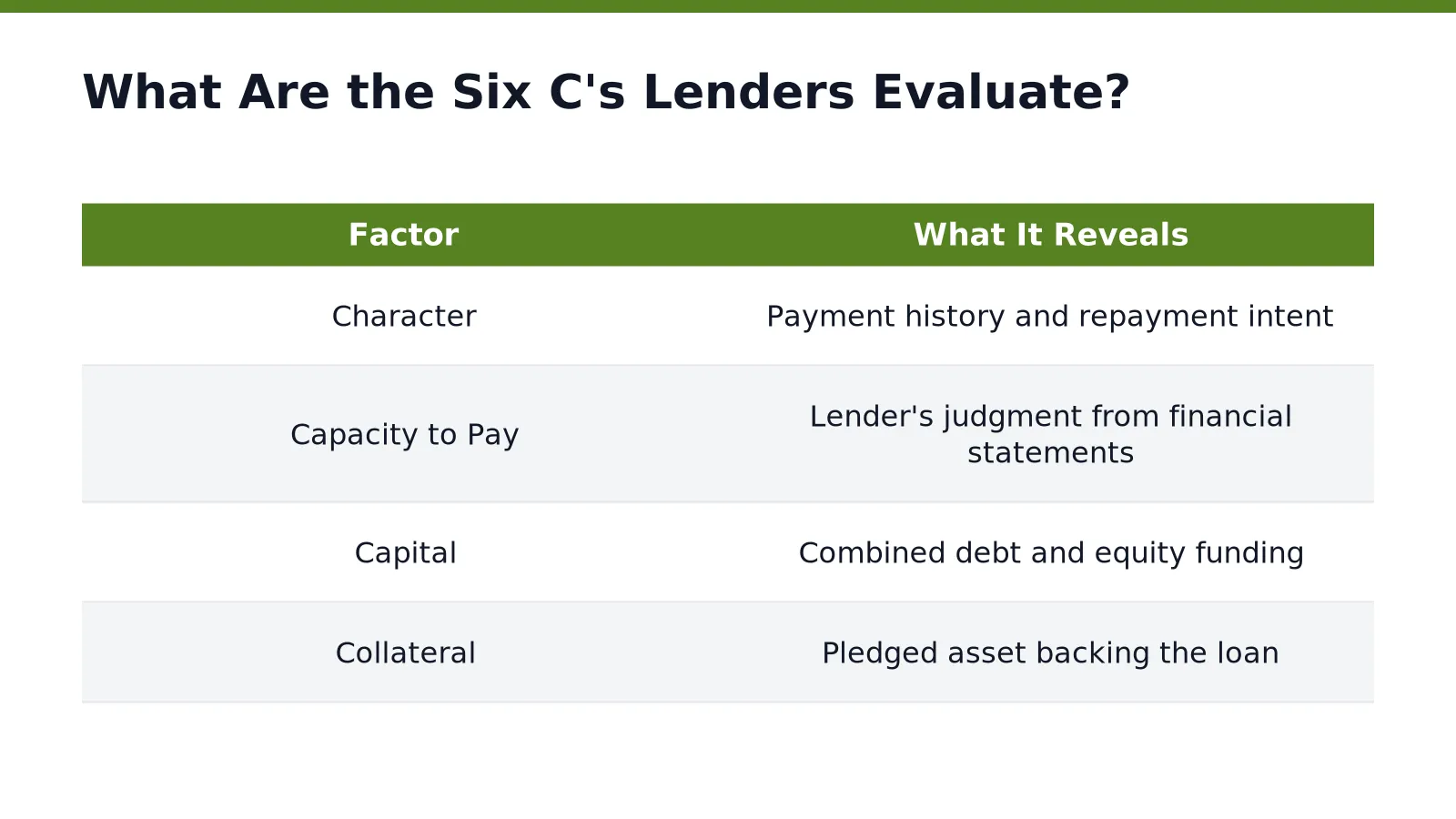
Four core factors shape how a lender judges a loan application: character, capacity to pay, capital, and collateral. These factors belong to the broader financing vocabulary every borrower encounters while comparing loan terms across institutions. Understanding each factor turns confusing application jargon into a readable checklist.
Character measures how strongly a borrower feels obligated to repay debt. Lenders gauge this trait through credit history and past payment behavior. A business that has consistently paid vendors and lenders on time signals lower risk, even before any numbers get reviewed.
Capacity to pay works differently. It is not a fixed formula but a judgment call. A lender reaches this conclusion by studying the borrower's financial statements alongside other supporting documentation. Two businesses with identical revenue can receive different capacity assessments depending on expenses, debt load, and cash flow patterns.
Capital refers to the total funding a business has built from two sources: debt and equity combined. Lenders view this combined total as a cushion. A thin cushion raises concern; a thick one suggests the business can absorb setbacks without defaulting.
Collateral rounds out the list. This asset belongs to the borrower but gets pledged to the lender as a safeguard against non-payment. Common examples include equipment, real estate, or inventory.
Why Do Lenders Use Four Factors Instead of One?
No single factor tells the full story of risk. A business might show strong character through perfect payment history yet lack the capital cushion to survive a slow season. Combining all four factors gives lenders a fuller, more balanced picture before approving loan terms.
How Do Conventional and Alternative Lenders Differ?
Conventional lenders are traditional financial institutions, most commonly banks, that evaluate applicants against standardized underwriting criteria. Alternative lenders cover a broader category, including nonprofit sources such as community development financial institutions and SBA-approved certified development companies. Small Business Loan Terminology: Your Lending Glossary describes alternative lenders as a source offering "a wide variety of funding sources," expanding options well beyond the conventional bank model. That difference in structure shapes nearly every part of the borrowing experience, from required paperwork to repayment timelines.
Understanding this split matters because the loan terms attached to each lender type vary widely. Banks often require longer operating histories and stronger collateral positions. Nonprofit and SBA-backed lenders may offer more flexibility for newer or higher-risk ventures. Business owners sifting through application jargon frequently find that conventional. Alternative paperwork use overlapping terms but apply different standards for approval.
Which Lender Type Fits a Growing Business Best?
No single lender category works for every company. Financing strategies should match a business's particular stage, sector, and risk profile rather than follow a one-size-fits-all approach. A seasonal retail operation and a five-year-old manufacturing firm face different underwriting realities. The right lender depends on the specifics of the business, not just its credit score.
Can a Business Owner Compare Lenders Without Getting Lost in Financing Vocabulary?
Yes, with the right framework. Pairing broad lender access with purpose-built software and guided execution gives owners a clearer path through unfamiliar financing vocabulary and competing offers. This combination helps translate confusing terminology into a side-by-side view of what each lender actually requires and provides, building confidence instead of guesswork.
What Is EIN-Based Business Credit vs SSN?
EIN-based business credit ties a company's borrowing history to its federal Employer Identification Number, separate from the owner's personal finances. SSN-based credit, by contrast, links every approval, balance, and missed payment to the founder's own Social Security number. The distinction shapes how much personal risk a business owner carries when the company borrows money.
Mixing the two creates a real cost. When a business relies on an owner's SSN for financing, a late payment or high utilization rate can drag down the owner's personal credit score, limiting future mortgage or auto loan options. Separating business liability from personal liability through EIN-based credit protects personal assets while the company builds its own borrowing track record.
Why does separating EIN and SSN credit matter for liability?
Separating these two forms of credit shields the owner's personal assets from business debt obligations. A company that defaults on an EIN-based account does not automatically damage the owner's personal credit file, which preserves borrowing power for both the business and the individual.
Who benefits most from EIN-based credit building?
Newer ventures working toward their first approvals and established firms seeking better-priced capital both gain from this approach. Learning the loan terms, application jargon, and financing vocabulary that lenders use helps owners at either stage interpret offers accurately and avoid costly missteps.
Businesses in Loudoun County and across Northern Virginia can pursue EIN-based credit-building support locally. Companies anywhere in the country can access similar guidance digitally, regardless of physical location.
What Do Underwriting and Prequalification Terms Mean?
Underwriting describes the process a lender uses to evaluate risk before approving a loan or credit line. Prequalification refers to an early check that tells a business owner which financing options are realistic before a formal application goes in. Both terms sit at the center of commercial lending vocabulary, and understanding them separates confident applicants from those caught off guard by a denial.
Rejection costs more than time. Every hard inquiry and declined application can leave a mark on a credit file, and repeated denials signal risk to the next lender in line. Owners who skip prequalification often apply to programs they were never eligible for in the first place, wasting weeks on paperwork that was destined to fail.
Specialized scanning tools now exist to close that gap. These tools show business owners how underwriters are likely to view their company, flagging eligibility issues before a single application is submitted. One example is a proprietary scoring tool that gives owners a structured, numeric way to see where they stand with lenders, similar to how a personal credit score summarizes consumer risk.
What happens during a prequalification check?
A prequalification workflow sorts financing options into two groups: programs a business can likely access right now, and programs that require more groundwork first. This distinction matters because it prevents wasted applications and protects the credit file from unnecessary inquiries.
How do these tools support long-term credit building?
They feed into a structured, step-by-step improvement process rather than a one-time check. Businesses that follow this process systematically work toward better terms, higher credit limits, and lower rates over time. The result is a repeatable path from basic eligibility to stronger negotiating position with lenders.
What Common Credit Terms Appear in Documents?
Loan agreements and credit applications use a specific vocabulary that confuses many business owners. Four terms show up often enough that every founder and finance director should recognize them on sight. Missing their meaning can lead to a misread contract or a missed negotiating point.
AAA credit describes a business or individual holding a top credit rating with lenders. A company that reaches this status signals strong repayment history and low risk, which often translates into better pricing on new financing vocabulary like interest rates and fees. Lenders reserve their most favorable loan terms for borrowers at this level.
What does a 1031 exchange have to do with business financing?
A 1031 exchange allows owners of business or investment real estate to sell a property. Purchase another similar property without paying capital gains tax right away. This provision comes from the tax code, not from a specific lender's policy. Finance directors managing commercial property often encounter this term when restructuring a company's real estate holdings alongside its financing strategy.
Abandonment refers to voluntarily giving up an interest, claim, privilege, or possession tied to a loan agreement. This term appears in default language and security agreements, where it clarifies what happens if a borrower walks away from collateral or a contractual right.
Collateral value matters because lenders measure comfort by how closely it tracks the loan amount. Consider two scenarios:
- A loan backed by collateral worth nearly the full loan balance: lenders view this as lower risk.
- A loan backed by collateral worth a fraction of the balance: lenders demand stronger guarantees or higher rates.
Recognizing this application jargon early helps business owners negotiate terms with confidence rather than confusion.
How Many Lenders and Loan Types Exist?
More than 1,000 national and local lenders make up the commercial financing marketplace that business owners can access through a single network. That number matters because no single bank fits every company's stage, industry, or risk profile. A business turned down by one lender may qualify instantly with another, simply because underwriting standards differ so widely across institutions.
This breadth explains why financing vocabulary has grown so dense. Each lender category brings its own products, qualification rules, and paperwork expectations. Sorting through them starts with understanding three broad categories of lending sources.
- Traditional banks: conventional institutions offering term loans and credit lines, typically with stricter documentation requirements.
- Alternative finance providers: online and non-bank lenders that often move faster and accept shorter operating histories.
- Specialized programs: niche financing designed for specific industries, equipment types, or growth stages.
What loan products should a business owner expect to compare?
Three product categories appear most often across the lending landscape: business loans, lines of credit, and structured credit-building programs. Business loans deliver a lump sum repaid over a fixed term, useful for one-time investments like equipment or expansion. Lines of credit work differently, offering revolving access to funds that a company draws and repays as cash flow demands shift.
Why does lender variety matter for understanding loan terms?
Variety forces business owners to learn loan terms that shift from one lender to the next. Rates, repayment schedules, and collateral requirements are rarely standardized. A small, specialized team of advisors, often as few as three people in boutique firms, can translate this application jargon into plain language. That guidance helps owners compare offers accurately instead of guessing at what each lender's fine print actually requires.
Why Does Understanding This Vocabulary Matter?
Lenders reward clarity, and confusion costs business owners money. Misreading loan terms can push a founder into the wrong repayment structure or a higher rate than necessary. Confusion around application jargon also slows underwriting, since lenders flag incomplete or inconsistent answers for additional review. Without a working grasp of financing vocabulary, owners risk signing agreements that don't match their actual cash flow needs.
Local business credit advisors exist precisely to close this gap. Personalized, concierge-level guidance helps owners translate unfamiliar terminology into plain decisions about what a product actually costs and requires. This kind of one-on-one interpretation matters most during the application stage, when a single misunderstood clause can shape years of repayment.
What Happens When Pricing Isn't Transparent?
Hidden fees and shifting terms erode trust and often signal a transactional, one-time broker relationship rather than a lasting partnership. No-surprise pricing, by contrast, supports an ongoing advisory relationship where an owner can return for guidance as the business grows, not just at closing.
How Does Vocabulary Knowledge Affect Lender Perception?
Consistent business identity data and accurate trade credit reporting shape how lenders, card issuers, and vendors judge risk. A business that reports clean, uniform information across bureaus reads as lower risk, which often translates into better terms.
Education and coaching reinforce this foundation over time. Specifically, this coaching includes:
- Explaining underwriting criteria in accessible language
- Clarifying how credit usage affects future approvals
- Connecting terminology to real repayment scenarios
- Building confidence to ask lenders better questions
Owners who understand this vocabulary negotiate from a position of strength, not guesswork.
FAQ
What are the Financial Six C's?
The Financial Six C's are the core concepts lenders use to evaluate applications, including Character, Capacity to Pay, and Capital. VIP Business Credit's Business Fundability Scan clarifies these terms and maps a path toward loan approval.
Why do loan terms vary between lenders?
A term meaning one thing at a national bank carries different nuance at a regional institution.
Yes, proximity to lenders shapes the relationships that explain terms clearly. VIP Business Credit, based in Sterling, Virginia, supports entrepreneurs across Northern Virginia and the Greater Washington, DC region as they build EIN-based business credit.
Conclusion
In closing, mastering these loan application terms transforms you from a passive borrower into an informed decision-maker. When you understand what lenders mean by debt service coverage, personal guarantees, and collateral requirements, you navigate the funding process with clarity and confidence. This knowledge protects your business, strengthens your negotiating position, and positions you to build sustainable credit that fuels long-term growth. Your command of this vocabulary is the foundation upon which stronger financial partnerships are built.


