Business Loan Eligibility FAQs
Business Loan Eligibility FAQs
top 7 equipment financing options
By VIP Business Credit Editorial Team · Updated *2026-08-26*
Business loan eligibility requirements typically include a personal credit score of 670 or higher, annual revenue that clears a lender-set minimum (see current business loans for details), and one to two years in business. Lenders review tax returns, bank statements, and financial statements, sometimes requiring collateral or a personal guarantee. VIP Business Credit's scoring tool identifies credit gaps and maps a clear path toward qualifying for stronger loan terms.
Key Takeaways
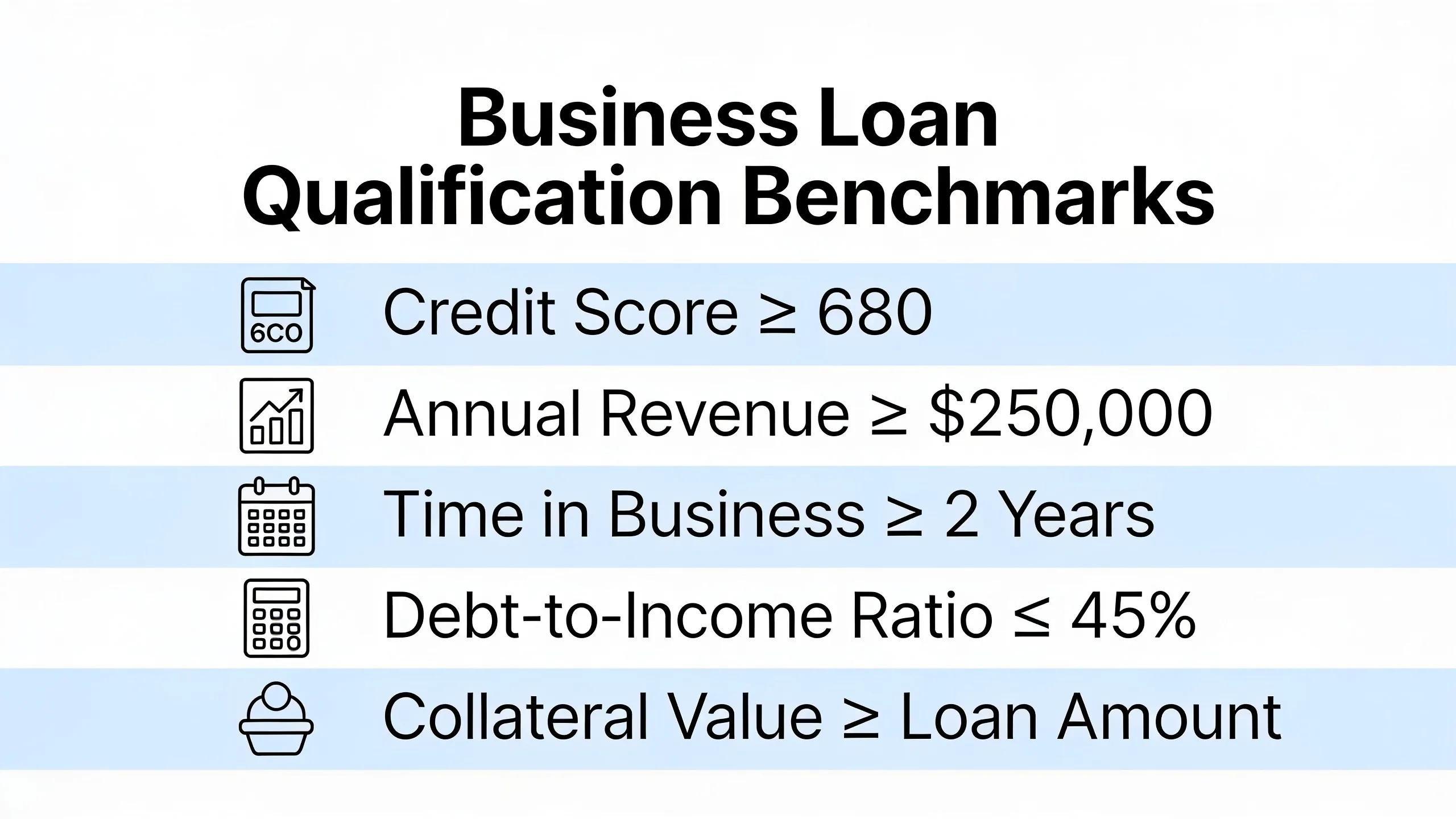
- Most lenders require a personal credit score of 670 or higher for business loan approval.
- Businesses need a minimum annual revenue threshold and one to two years operating history.
- SBA-guaranteed loans offer competitive rates with lower down payments and flexible collateral requirements.
- VIP Business Credit connects entrepreneurs to over 1,000 national and local lenders in the region.
What Do Lenders Actually Look For?
Understanding how to qualify for a small business loan starts with knowing that lenders evaluate a business loan application by weighing multiple factors together, not a single score in isolation. Revenue, credit history, time in business, and repayment capacity all factor into one underwriting decision. A business owner who assumes a strong credit score alone guarantees approval often misses the fuller picture lenders actually use.
Answering common qualification questions starts with understanding what underwriters review line by line.
What factors do lenders check before approving a loan?
Underwriters typically look at seven core areas when deciding whether a business qualifies for financing. These include:
- Personal and business credit history
- Annual revenue and cash flow patterns
- Time the business has been operating
- Available collateral or assets
- Existing debt obligations
- Industry risk and business structure
- Purpose and repayment plan for the requested funds
No single factor decides the outcome. A thin credit file paired with strong revenue can still qualify, just through a different lender than a business with excellent credit but limited operating history.
Why does lender variety matter for approval odds?
Different lenders prioritize different combinations of factors, so matching a business to the right lender matters as much as meeting the raw numbers. A network spanning traditional banks, alternative finance providers, and specialized programs allows a financing strategy to align with each business's stage, sector, and risk profile. VIP Business Credit, operating through vipbizfunds.com, connects business owners to more than 1,000 national and local lenders precisely for this reason. That breadth means a newer venture with limited history and an established firm scaling into new markets both have realistic paths forward, rather than being forced into one rigid set of loan requirements.

What Credit Score Do You Need To Qualify?
A score of 670 or higher on the personal side gives most business owners a realistic shot at approval. Among the small business loan requirements lenders weigh most heavily, this score pairs with two other checkpoints: a minimum annual revenue threshold and at least one to two years of operating history. Fall short on any one of these, and approval odds drop sharply, even with a strong business plan on paper.
These three benchmarks form the backbone of most [loan requirements](https://vipbizfunds.com/post/Small-Business-Loans-101-What-You-Need-To-Get-Approved) across banks, credit unions, and alternative lenders.
Does Personal Credit Always Determine Business Approval?
Not necessarily, and this is where many founders miss an opportunity. Establishing credit under the company's own EIN shifts some evaluation weight away from a single owner's score. VIP Business Credit works with entrepreneurs across Northern Virginia and the greater Washington, DC region to build that EIN-based profile, so the business itself starts carrying its own credit weight instead of relying entirely on the founder's personal history.
How Can a Business Owner Check Standing Before Applying?
Guesswork before submitting an application wastes time and invites rejection. A proprietary diagnostic, offered through VIP Business Credit's scoring tool, shows owners exactly how underwriters view their company before any paperwork goes out. That visibility answers many common **qualification questions** early. Which lenders fit, which gaps need closing, and which numbers still need work.
Reviewing credit standing this way turns a vague set of eligibility [FAQs](https://vipbizfunds.com/faqs) into a clear checklist. Owners see precisely where their score, revenue, and operating history stand against the 670-plus benchmark, rather than discovering weaknesses only after a denial letter arrives. That early clarity saves months of wasted applications and protects the business's standing with future lenders.

How Much Do Revenue And Time In Business Matter?
Revenue and business age carry enormous weight in loan decisions. Three factors dominate underwriting: credit profile, time in business, and average monthly deposits or revenue. Lenders weigh these three together rather than in isolation, since a strong number in one area often offsets a weaker showing in another.
A business open for six months faces a different set of loan requirements than one operating for five years. Newer ventures typically lean harder on personal credit and cash reserves to prove reliability. Established firms, by contrast, can point to years of deposit history and revenue trends as their primary proof of stability.
Does A Newer Business Have Any Real Financing Options?
Yes. Financing strategies exist for both newer companies chasing their first approval and established operations looking to scale or consolidate existing costs. The path looks different depending on where the business stands. A startup may qualify for smaller lines or vendor credit first. A mature company can pursue larger term loans or consolidation offers.
What Can A Business Owner Do To Improve These Numbers Over Time?
Strengthening revenue consistency and lengthening the credit track record both take deliberate steps. A structured, sequential process for building stronger credit standing helps owners move toward better terms, higher limits, and lower rates as their profile matures. That process typically includes:
- Keeping deposit activity steady and documented month over month
- Separating personal and business finances completely
- Paying vendors and creditors on time to build trade history
- Monitoring credit reports for errors that could weaken applications
None of these steps produce overnight results. Revenue and tenure both compound — a business that strengthens its numbers this quarter often sees stronger offers a year later, not the following week.

What Documents Should You Prepare To Apply?

A practical business loan documents checklist covers four categories of paperwork that form the backbone of most applications: tax returns, bank statements, financial statements, and a written business plan. Missing even one of these creates delays that push a decision back by weeks, sometimes costing a business the working capital it needed on a tighter timeline. Lenders use these documents to verify income, confirm cash flow patterns, and judge whether the business can handle repayment.
Organizing this paperwork before submission matters more than most applicants realize. A lender reviewing an incomplete file rarely calls to ask for the missing piece. The application stalls or gets declined outright. Building a checklist ahead of time prevents that outcome.
What should a complete document package include?
A well-prepared package typically covers:
- Tax returns — usually the two most recent years, business and personal
- Bank statements — recent months showing consistent deposit activity
- Financial statements — profit and loss reports plus balance sheets
- A written business plan — outlining how the funds will be used and repaid
Each piece answers a different underwriting question. Skipping one leaves a gap a lender has to fill with assumptions, and assumptions rarely favor the applicant.
Where can an owner get help assembling these documents?
A local Business Credit Advisor helps owners organize. Present these materials before submission, reducing the back-and-forth that slows down approvals. This kind of guidance often catches formatting issues or missing pages an owner wouldn't spot alone.
Business owners in the region can also seek in-person support at VIP Business Credit's Sterling, Virginia office, located at 21000 Southbank St Ste 106-380, Sterling VA 20165, for hands-on help preparing a complete, lender-ready file.
Do You Need Collateral Or A Personal Guarantee?

Many lenders require collateral, a personal guarantee, or both before releasing funds. Skipping this question leads to unpleasant surprises mid-application, when a signature or asset pledge suddenly appears in the fine print. Understanding these terms upfront saves founders from wasted time chasing loans they can't actually close.
A personal guarantee means the owner agrees to repay the debt personally if the business cannot. Collateral means pledging a specific asset — equipment, real estate, receivables — that the lender can seize on default. Some programs ask for one, some ask for both, and a few ask for neither depending on the lender's risk appetite.
Can a business avoid a personal guarantee entirely?
Not always, but building strong business credit reduces how often it's required. VIP Business Credit's approach centers on establishing credit under the company's own EIN rather than the owner's Social Security number. This separates personal and business liability over time. Approvals lean less on an owner's personal signature as the credit file matures.
Does lender choice affect collateral requirements?
Yes — collateral demands vary widely across the lending market. Working across a network of more than 1,000 national and local lenders widens the pool of programs available, including options that place less emphasis on heavy asset pledges. That range matters because a single bank's rejection rarely reflects the entire market's terms.
Loan requirements around collateral and guarantees shift by lender type, loan size, and business credit history. Founders working through qualification questions early — before submitting an application — avoid rejections tied to mismatched expectations. Reviewing common eligibility FAQs on this topic helps set realistic terms before signing anything.
How Do SBA Loan Requirements Differ?
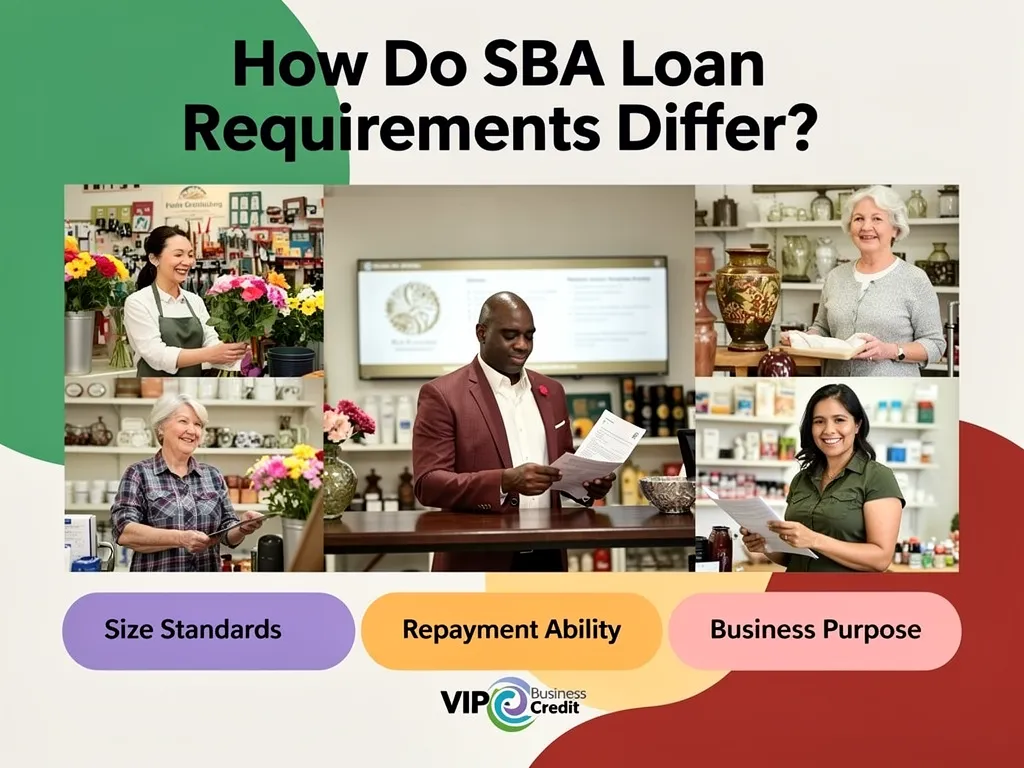
SBA-guaranteed loans follow a distinct eligibility framework compared to conventional bank financing. Size standards, repayment capacity, and business purpose sit at the center of this framework, giving small business owners a clearer benchmark for the loan requirements they'll face.
Lenders reviewing an SBA application look at three core factors:
- Size standards — the business must fall within SBA-defined limits for its industry
- Repayment ability — cash flow and revenue history must support the debt load
- Business purpose — the loan must fund a legitimate, documented business need
These standards apply broadly, but the weight lenders give each factor shifts depending on loan type and program.
Does Bad Credit Disqualify a Business From SBA Funding?
Weaker credit does not automatically end the conversation. Startup-focused SBA programs exist specifically for founders whose credit history isn't spotless yet, and lenders typically supply a full list of eligibility criteria upfront. That transparency helps owners answer their own qualification questions before investing time in a full application. Reviewing those criteria early also prevents wasted paperwork on programs a business isn't ready for yet.
What Other Financing Options Exist Beyond SBA Programs?
SBA loans represent only one lane on a much wider road. A broad network spanning traditional banks, alternative finance providers, and specialized programs opens additional paths for owners whose stage, sector, or risk profile doesn't fit neatly into SBA guidelines. This matters most for newer ventures still building a track record.
Working through common eligibility FAQs early — around size limits, credit thresholds, and documented purpose — helps owners identify which lane fits their business today and which requires more preparation before applying.
How Does Business Credit Separate Personal Risk?

Business credit measures how reliably a company pays its debts, vendors, and lenders, keeping that track record apart from an owner's personal credit history. Strong business credit profile qualifications give a company its own financial identity in the eyes of underwriters. A missed loan payment tied only to a personal Social Security number puts a founder's home, savings, and future borrowing power on the line. When the same debt lives under the company's EIN instead, personal exposure shrinks and the business builds its own reputation with lenders.
This separation matters most in the early stages, when many owners still guarantee everything personally without realizing it. Lenders, card issuers, and vendors form judgments based on consistent business identity data — matching name, address, and phone records across every account and filing. Reporting trade credit activity accurately to the bureaus lenders use reinforces that identity. A supplier payment or equipment lease gets counted as evidence of reliability rather than disappearing into personal credit files.
What Steps Strengthen Business Credit Profile Qualifications?
Building a distinct business credit file starts with a few concrete moves:
- Keep business name, address, and phone number identical across every registration, license, and lender application.
- Open trade lines with vendors who report payment activity to business credit bureaus.
- Pay every business obligation on time, since payment history drives the score underwriters review.
- Monitor bureau data regularly to catch errors before they block an approval.
Why Does Pre-Qualification Matter for Lender-Ready Business Credit?
A pre-qualification review sorts financing programs into two clear buckets: ones an owner can access immediately, and ones that need more preparation first — the goal being a lender ready business credit profile before an application ever goes out. This step prevents wasted applications and hard credit pulls on programs a business isn't ready for yet. It also gives founders a concrete action list — specific gaps to close — so the next application carries real approval odds instead of guesswork.
What Steps Improve Your Qualification Odds?

Preparation moves the needle more than any single document ever will. Federal Reserve data shows 60% of firms applied for financing, according to the 2026 Report on Employer Firms from the Federal Reserve Banks' 2025 Small Business Credit Survey. That statistic matters: financing isn't a rare event reserved for struggling companies. It's a routine step most businesses eventually take, which means preparing for qualification questions early pays off long before an application deadline arrives.
How does working with an advisor change the outcome?
A small, focused team changes how closely a business owner's plan gets managed. VIP Business Credit operates with three employees, a structure that keeps advisory work hands-on rather than handed off to a call center. Each client's qualification strategy gets built and monitored by people who know the file, not a rotating cast of representatives.
What should a business owner expect from ongoing support?
Support shouldn't end once funding closes. A long-term partnership model, built on transparent, no-surprise pricing, keeps credit-building active well beyond the first approval. This structure treats loan requirements as a moving target that improves over time, not a one-time hurdle to clear and forget.
Steps that consistently strengthen a qualification profile include:
- Reviewing current credit standing before applying, rather than after a denial
- Working with an advisor who tracks the file directly instead of passing it between departments
- Choosing a funding partner with published, predictable pricing
- Treating credit-building as continuous work, not a single transaction
- Preparing answers to common eligibility FAQs so gaps get addressed proactively
Owners who treat qualification as an ongoing relationship — rather than a scramble before one application — build stronger positions with lenders over time.
FAQ
What credit score is needed for business loan eligibility?
Most lenders require a personal credit score of 670 or higher. This benchmark pairs with a minimum annual revenue threshold and one to two years in business to determine approval odds.
What documents do lenders require during the application process?
Lenders review tax returns, bank statements, and financial statements as part of the application process. Some lenders also require collateral or a personal guarantee depending on the loan structure.
How does VIP Business Credit help businesses qualify for loans?
VIP Business Credit connects entrepreneurs to over 1,000 national and local lenders, matching businesses to the right fit based on their profile. Their scoring tool identifies credit gaps and maps a path toward stronger loan terms.
Conclusion
In closing, business loan eligibility hinges on demonstrating financial stability, business legitimacy, and repayment capacity—factors that lenders evaluate consistently across the marketplace. By understanding these core requirements and taking deliberate steps to strengthen your business credit profile, you position yourself to access better terms and higher limits. The path forward requires clarity about where you stand today and intentional action to close any gaps. Your business's creditworthiness is built, not inherited, and that foundation opens doors to sustainable growth.
About The Author
Lee Johnson is the Co-Founder and CEO of VIP Business Credit and a Master Certified Professional Coach with more than 500 coaching hours. He holds a Bachelor of Science from Fairleigh Dickinson University and a Master of Business Administration from the University of Phoenix. Since 2005, Lee has built a personal real estate investment portfolio exceeding 1,700 units valued at approximately $254 million across multiple U.S. markets.
Lee's mission is to help small business owners — including those in home services, trucking, and real estate — achieve financial freedom by first establishing a strong business credit profile, then accessing the highest loan amounts at the best terms available. He and his team guide business owners nationwide through VIP Business Credit's signature 12-month business credit coaching program.
Connect with Lee and VIP Business Credit:
- 📞 Phone: (571) 248-3863
- ✉️ Email: [email protected]
- 📅 Book a Consultation: https://vipbizfunds.com/consultation
- 🌐 Website: vipbizfunds.com
- 📍 Proudly serving Sterling, VA and the surrounding Northern Virginia / DC region
Explore our funding solutions and consult our business loan advisory pricing to prepare your application.


