Business Loan Application Process Step by Step Guide
Business Loan Application Process Step by Step Guide
Business loan applications follow five core steps: assess fundability, gather financial documents, match with lenders, submit paperwork, and review offers. VIP Business Credit's Business Fundability Scan identifies credit gaps in just 2-5 minutes with zero impact on personal credit, connecting entrepreneurs to over 1,000 lending options before any application
Key Takeaways
- Prepare your EIN-based business credit profile before approaching lenders in Northern Virginia and Greater Washington, DC.
- VIP Business Credit connects entrepreneurs to over 1,000 national and local lenders for optimal loan matching.
- Gather financial documents, tax returns, and business plans to complete your loan application successfully.
What Will This Guide Help You Accomplish?
This guide equips small business owners with a clear understanding of the business loan application process from start to finish. Paperwork and lender terminology often feel intimidating at first glance. That reaction is normal. Once the requirements behind each document become clear, the process turns manageable rather than overwhelming.
Entrepreneurs working through this material will walk away knowing how to evaluate funding options, prepare documentation, and approach lenders with confidence instead of guesswork.
Who Benefits Most From This Guide?
Startups seeking their first round of capital and established companies looking to scale both benefit. VIP Business Credit serves entrepreneurs in Northern Virginia. The Greater Washington, DC region, helping them build credit tied to the business itself rather than to the owner's personal profile. This matters because EIN-based credit protects personal assets while giving the company its own financial identity in the eyes of lenders.
What Outcomes Should Readers Expect?
By the end of this guide, readers should understand the core funding requirements lenders evaluate before approving an application. They will also recognize how a broader lender network changes their odds of approval. Readers can expect clarity on the following:
- How to assess readiness before submitting an application
- What documentation most lenders request during underwriting
- How connecting with more than 1,000 national and local lenders widens access to high-limit loans and credit lines
- Why building credit under the company's EIN, rather than the owner's Social Security number, strengthens long-term fundability with banks and vendors
The goal is confidence, not confusion, at every stage of the loan process.
What Do You Need Before You Apply?
Preparation determines outcomes long before a lender reviews a single document. A business loan application succeeds or fails based on three factors: preparation, documentation, and a clear vision for how the funds will be used, according to BankIowa's guide to securing a small business loan. Entrepreneurs who treat these three elements as equally important, rather than racing to submit paperwork, put themselves in a stronger position with underwriters.
Approaching the loan process systematically changes the outcome. BankIowa notes that organizing documents ahead of time streamlines the process and significantly increases approval odds. That means gathering financial records, clarifying the loan's purpose, and confirming the business meets baseline funding requirements before contacting a single lender.
What documents should a small business owner gather first?
Start with a clear purpose statement: what the money funds, and why. Pair that with basic financial records, a sense of current credit standing, and a short explanation of how repayment will work. Lenders respond to clarity, not volume of paperwork.
Does it help to work with a local advisor?
Yes. A concierge-level advisor reviews the business's financial position before submission, flags gaps early, and matches the business to lenders suited to its stage. VIP Business Credit, based in Sterling, Virginia, connects applicants with local Business Credit Advisors who provide this kind of personalized guidance.
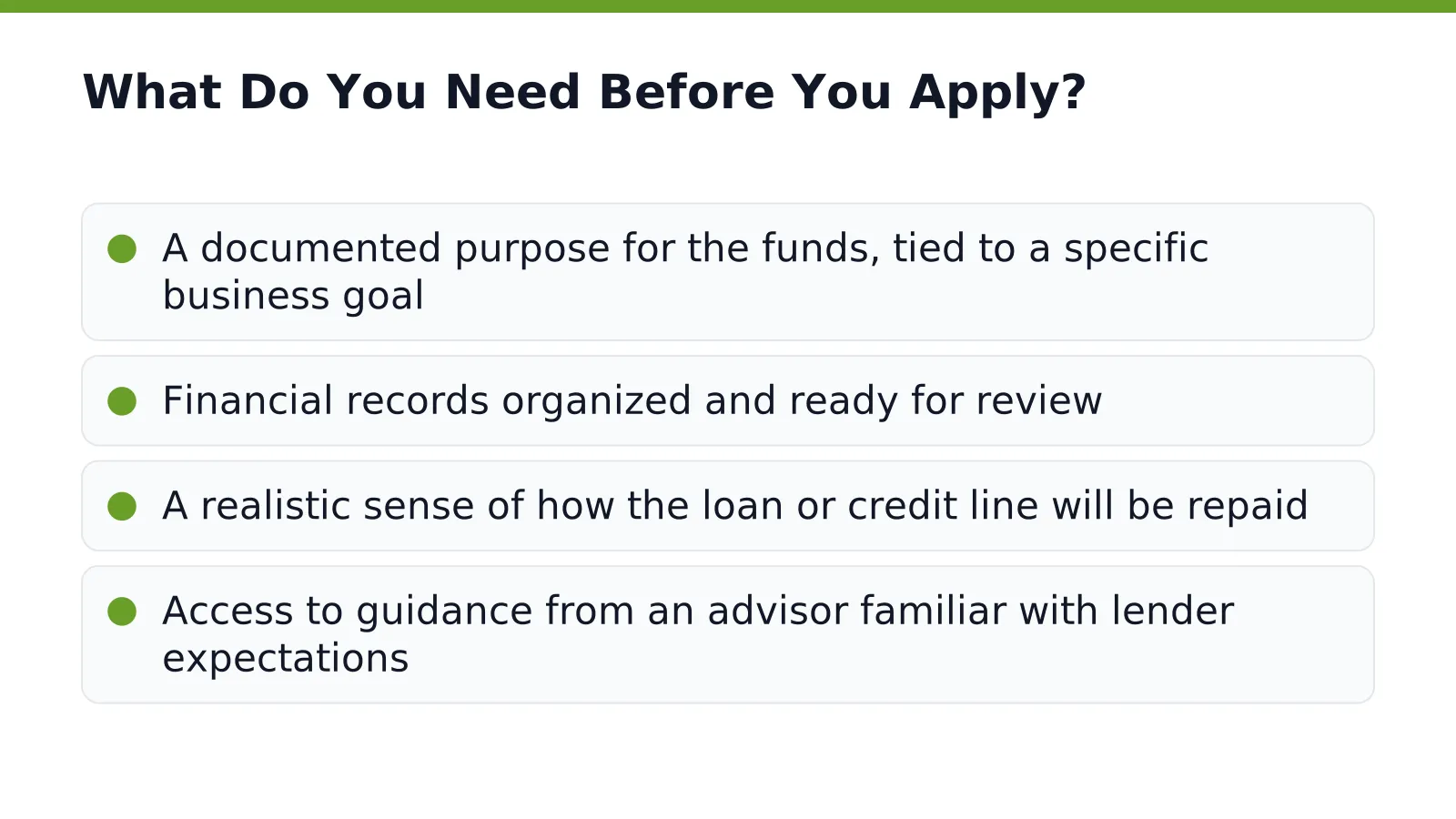
Before submitting anything, business owners should confirm the following:
- A documented purpose for the funds, tied to a specific business goal
- Financial records organized and ready for review
- A realistic sense of how the loan or credit line will be repaid
- Access to guidance from an advisor familiar with lender expectations
Preparation at this stage shapes every step that follows.

How Do You Check Your Credit Position First?
A strong credit position starts with an honest look at business financial condition before any paperwork gets filed. The Commercial Loan Application Guide notes that evaluating a company's financial condition is the first move to make before approaching any lender. Skipping this step leaves owners guessing about what underwriters will find. That guesswork often surfaces at the worst possible moment, mid-review, when there's little time to fix it.
What Should a Business Owner Review First?
Financial condition covers more than a bank balance. It includes revenue trends, outstanding debt, and how consistently the business meets its obligations. Lenders read these signals closely, so a clear picture upfront prevents surprises later in the loan process.
Does Credit Need to Be Built Separately From the Owner's Personal Credit?
Yes. Establishing credit under the company's EIN, rather than leaning on the owner's Social Security number, is a foundational step before submitting a business loan application. This separation protects personal liability and gives lenders a cleaner view of the company as its own financial entity.
Three checkpoints help clarify where a business actually stands before approaching a lender:
- Financial condition: revenue stability, debt load, and payment history
- Identity consistency: matching business name, address, and registration details across every bureau and vendor record
- Risk profile fit: understanding how stage, sector, and risk level shape which lenders are realistic options
Consistent business identity data and active trade credit reporting strengthen how lenders and vendors perceive risk. A business that looks organized on paper earns more trust before a single document gets reviewed. Financing strategies also aren't one-size-fits-all. They're matched to a company's stage, sector, and risk profile, which means knowing where a business currently sits is what makes the right match possible. Owners who check their position first walk into funding requirements conversations prepared, not reactive.
How Do You Choose The Right Loan Type?
The right loan type matches the purpose of the capital to the structure of the financing. Startups typically need funds for equipment and overhead costs, while growing businesses tend to seek capital for renovation, expansion, or real estate purchases. Matching loan structure to actual need is the first decision point in any business loan application, and skipping this step leads to mismatched terms, wasted interest costs, and slower approvals down the line.
A small business loan makes the most sense when the funds act as a catalyst for growth, not a patch for routine cash shortfalls. Lenders look closely at how capital will be used. Clarity on purpose strengthens an application before a single document gets submitted. Business owners who define their funding need in specific terms, rather than general working capital, tend to move faster through the loan process.
What Loan Type Fits Equipment Or Vehicle Needs?
Equipment credit lines let a business acquire needed machinery immediately, build credit history while using it, and deduct payments as a business expense. Fleet credit lines work similarly but apply to vehicles, financing multiple trucks, vans, or cars at once while building business credit and locking in tax deductions. Both options suit businesses whose growth depends on physical assets rather than cash reserves alone.
Consider these starting questions before narrowing a loan type:
- Identify whether the need is one-time (equipment, vehicles, real estate) or ongoing (overhead, payroll gaps).
- Match asset-based needs to equipment or fleet credit lines for tax and credit-building advantages.
- Reserve general small business loans for growth-driving projects, not routine shortfalls.
- Review how each option affects funding requirements, including documentation and collateral expectations.
Matching purpose to product up front keeps the entire funding journey more predictable.
How Do You Organize Your Loan Documentation?
Organized documentation separates a fast approval from a stalled application. Lenders review financial metrics first, so paperwork needs to prove stability before anything else gets a second look. Missing files force underwriters to pause a review. That pause often costs a business its place in the approval queue.
A well-prepared business loan application lays the groundwork for a smoother, faster approval process. This holds true whether the funding covers expansion, refinancing, or a real estate purchase. The goal stays the same across every scenario: give the lender a complete picture before questions arise.
A thorough documentation checklist typically includes:
- Financial statements that show evaluated metrics such as revenue trends and debt obligations.
- Organized records of tax filings, bank statements, and existing credit accounts.
- A clear summary of how the funds will be used.
- Research identifying the lending partner best matched to the business's stage and risk profile.
What Funding Requirements Do Lenders Check First?
Lenders check cash flow before almost anything else. Reliable funding requirements center on proof that a business can cover payments on schedule, not just on paper. Organized cash flow strategies demonstrate that working capital stays available when it's needed, rather than scrambled together after a shortfall already hit.
How Does the Right Program Support Document Organization?
A structured program pairs financing products with ongoing coaching on what underwriters actually look for. Business loans and lines of credit work best when paired with education on loan process expectations, not handed over without context. That coaching helps owners spot gaps in their documentation before a lender does, turning a reactive scramble into a repeatable, confident system for every future application.
How Do You Find The Right Lender Match?
The right lender match depends on matching a business's stage, sector, and risk profile against a wide pool of funding sources. A narrow search limits options to whichever bank happens to be nearby. That single relationship may not fit the business at all. Owners who rely on one institution risk missing programs built specifically for their situation.
Large financial institutions tend to be risk-averse. Decisions at these banks often prioritize shareholder profits over personalized attention to a specific business, which frequently results in denied applications even when a company is otherwise healthy. A broader lender network changes those odds significantly.
VIP Business Credit connects clients to over 1,000 national and local lenders, spanning traditional banks, alternative finance providers, and specialized programs. That scale matters because every lender sets its own underwriting rules.
Why does working with more lenders improve approval odds?
More lenders means more underwriting models evaluated against a single business profile. A company rejected by one institution's criteria may qualify easily under another's, simply because risk tolerance and documentation requirements differ. Casting a wider net turns a single yes-or-no decision into dozens of chances at approval.
What should a business owner look for beyond interest rate?
Rate matters, but pricing transparency matters just as much. A transparent, no-surprise pricing structure protects owners from hidden fees that surface after funds are disbursed. Owners should also weigh whether the relationship ends after one transaction or continues as ongoing support.
Finding the right match works best through a structured process:
- Identify the business's current stage, industry, and risk factors.
- Compare that profile against multiple lender types, not just one bank.
- Prioritize lenders offering clear, upfront pricing terms.
- Favor a long-term advisory relationship over a single transactional broker deal.
Combining broad lender access with purpose-built software and hands-on guidance gives owners far more clarity and speed than searching alone, reducing the guesswork that derails so many funding searches.
What Happens After You Submit Your Application?
Submission triggers a review period, not a verdict. Lenders begin verifying financial details. A local Business Credit Advisor steps in to guide the business owner through follow-up requests and underwriting conversations. Securing a small business loan marks a major milestone, one capable of fueling expansion, bridging a seasonal cash gap, or launching a new venture off the ground.
The post-submission process generally unfolds in this order:
- Document verification. The lender confirms bank statements, tax filings, and other records submitted with the business loan application.
- Advisor follow-up. A Business Credit Advisor reviews any lender requests and helps the owner respond quickly and completely.
- Underwriting review. The lender assesses risk, cash flow, and credit history against its own approval criteria.
- Decision and terms. The business receives an approval, denial, or counteroffer with specific rates and repayment terms.
How long does the loan process take after submission?
Timelines vary by lender and by how quickly requested documents arrive. A Business Credit Advisor stays involved throughout, flagging missing items early so the loan process doesn't stall on avoidable delays.
Who should a business contact with questions during underwriting?
Clients working with VIP Business Credit can direct questions to the Sterling, Virginia office, located at 21000 Southbank St Ste 106-380, which serves as a point of contact once an application moves forward. This single point of contact matters whether the business is a newer venture seeking its first approval or an established firm looking to scale, consolidate costs, or expand with better-priced capital. Either way, the goal stays the same: matching the right funding requirements to the right lender, without unnecessary back-and-forth.
What Mistakes Should You Avoid Along The Way?
Four mistakes derail most owners before approval ever happens: skipping the decision stage, chasing funds without a clear purpose, applying under personal credit, and going it alone without lender access or guidance. Each one costs time, money, or personal liability that a little preparation would have protected.
The first mistake happens before the business loan application even starts. Deciding whether to borrow at all deserves careful thought, according to the CO guide published by the U.S. Chamber of Commerce. Owners who skip this step often borrow more than needed, or borrow for the wrong reason entirely.
Why does purpose matter before approaching a lender?
Clarity on purpose shapes the entire loan process. BankIowa's guide to securing a small business loan stresses that an owner needs absolute clarity on why the money is needed and how it will generate revenue. Ever speaking with a banker. Without that clarity, lenders see a vague request, and vague requests get declined or underfunded.
What's the biggest structural mistake owners make?
Many owners apply using personal credit by default. Building credit under the company's EIN instead keeps personal. Business liability separate, protecting personal assets if the business later struggles.
Common missteps include:
- Applying before clarifying the exact use of funds
- Mixing personal and business credit instead of building under the company's EIN
- Approaching only one lender instead of comparing options across a broader network
- Ignoring funding requirements specific to the product being sought
Skipping guided execution and broad lender access leaves owners navigating a crowded funding marketplace alone. That isolation costs clarity, speed, and confidence, exactly what protects personal assets and supports sustainable growth.
FAQ
What are the five core steps in the business loan application process?
The process includes assessing fundability, gathering financial documents, matching with lenders, submitting paperwork, and reviewing offers. VIP Business Credit's Business Fundability Scan identifies credit gaps in minutes, connecting entrepreneurs to over 1,000 lending options before applying.
How does VIP Business Credit widen access to lenders?
VIP Business Credit connects entrepreneurs in Northern Virginia. The Greater Washington, DC region to over 1,000 national and local lenders. This broader network improves approval odds and widens access to high-limit loans and credit lines.
Why should business owners build EIN-based business credit before applying?
Building credit under the company's EIN, rather than the owner's Social Security number, protects personal assets and gives the business its own financial identity. This strengthens long-term fundability with banks and vendors.
Conclusion
In closing, navigating the business loan application process becomes far simpler when you understand each step and prepare your financial foundation beforehand. By organizing your documentation, strengthening your business credit profile, and matching your needs to the right lender, you position yourself for faster approvals and better terms. The effort you invest upfront, from gathering records to building credibility signals, directly shapes how underwriters evaluate your business and the capital options available to you. Take these steps methodically, stay organized throughout the process, and approach each application with confidence in your preparation.


