Business Funding FAQs: Loans and Credit Lines
Business Funding FAQs: Loans and Credit Lines
Business loans require fixed repayment terms and lump-sum funding, while credit lines offer revolving access to capital as needed. VIP Business Credit connects entrepreneurs in Northern Virginia. The Greater Washington, DC region to over 1,000 national and local lenders, using its Capital-Ready Score tool to match businesses with optimal financing options.
Business loans and credit lines work best when matched to clear goals, which is why VIP Business Credit connects entrepreneurs across Northern Virginia. Greater DC to over 1,000 national and local lenders, using the proprietary Capital-Ready Score to identify EIN-based financing options suited to each business's specific capital needs.
Business loans and credit lines raise recurring questions about eligibility, structure, and timing. A Business Capital-Ready Scan identifies credit gaps within minutes and builds a clear funding roadmap. Business Line credit requires a 680+ FICO Score, six months in operation, and personal guarantees from owners holding 25% or more equity.
Key Takeaways
- Business loans, lines of credit, and credit cards each serve different financing needs with unique advantages and trade-offs.
- Lenders typically require guarantors with a FICO Score of at least 680 and 6 months of business operation.
- VIP Business Credit connects entrepreneurs to over 1,000 national and local lenders across Northern Virginia and Greater Washington, DC.
- Understanding your specific business needs helps you select the right financing tool for growth and operational success.
What Are the Most Common Questions About Business Funding?
Owners asking about business funding typically want to know which product fits, how lenders evaluate risk, and what separates good debt from bad debt. These business funding FAQs repeat across industries because the stakes are high: picking the wrong structure can mean overpaying for years or getting denied when cash flow matters most. Understanding the common questions in advance saves owners time and protects them from costly missteps.
VIP Business Credit, based in Sterling, Virginia, fields these questions daily from business owners across Northern Virginia and the greater Washington, DC region. That local vantage point shapes how financing help gets delivered. Regional lending patterns and local lender relationships often factor into the advice owners receive.
Which Type of Financing Is Right for My Business?
This question comes up constantly because financing options serve different purposes. Business financing gives owners access to funds for operating and growing their companies. Not every option functions the same way. A line of credit, a term loan, and a credit card each carry distinct repayment structures, costs, and flexibility levels. Matching the product to the actual need matters more than chasing the lowest rate.
How Do I Know Which Lender Will Approve Me?
Lender fit is one of the most frequent common questions business owners raise, largely because the lending landscape is fragmented. VIP Business Credit connects owners to a network of more than 1,000 national and local lenders, which allows financing strategies to be matched against a business's stage, sector, and risk profile rather than forcing a one-size-fits-all approach.
Other recurring questions include:
- What documentation do lenders require before approval?
- How does business credit differ from personal credit?
- What repayment terms should a growing company expect?
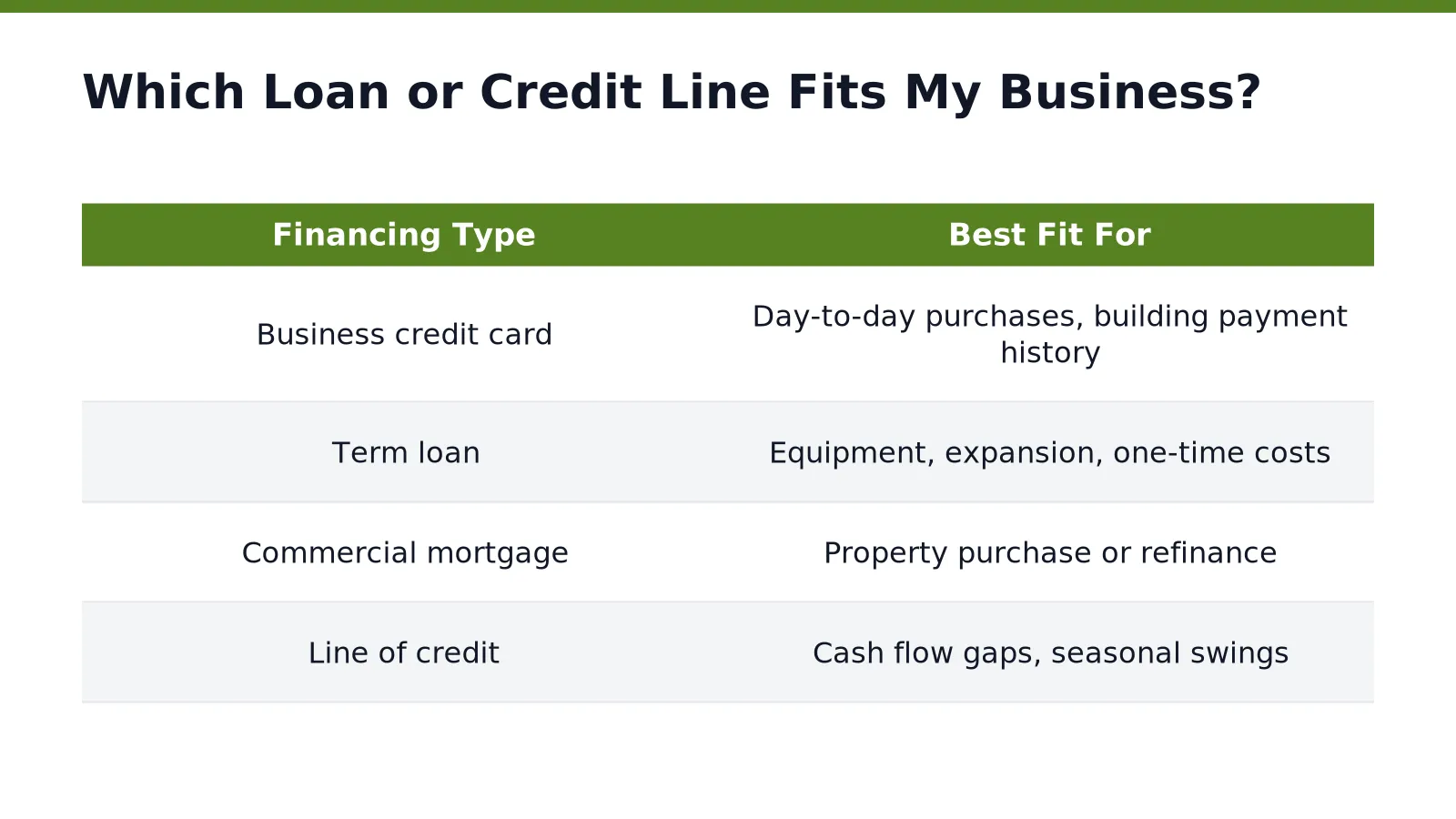
Which Loan or Credit Line Fits My Business?
The right financing product depends on cash flow timing, collateral, and how fast capital needs to move through the business. A strong lender starts with questions, not paperwork. Before recommending a product, a qualified lender interviews a business owner to understand the full scope of operational needs, from payroll gaps to equipment purchases. Skipping that step risks mismatched terms that strain cash flow for years.
What financing options should a full-service lender offer?
A lender equipped to handle most business situations should offer four core products: a business credit card, a term loan, a commercial mortgage, and a line of credit. Each one solves a different timing problem. A credit card handles small recurring purchases; a term loan funds a one-time investment. A mortgage covers real estate; and a line of credit bridges uneven revenue.
VIP Business Credit draws on a broad network of lenders to match each financing strategy to a business's stage, industry, and risk profile. That matching process matters more than product availability alone. A startup with limited revenue history needs a different lender appetite than an established company refinancing debt.
Does company size affect how financing gets matched?
Matching quality often depends on attention per client, not transaction volume. VIP Business Credit operates as a three-person team, a structure that supports hands-on, personalized guidance rather than a high-volume brokerage approach. Business owners working through common questions about loan structure get direct answers instead of automated referrals.
Owners weighing these choices benefit from straightforward financing help before signing anything. Reviewing these business funding FAQs early prevents costly mismatches between product type and actual business need.

How Does a Business Line of Credit Work?
A business line of credit gives an owner flexible access to funds, capped at a set limit, that can be drawn from as needed. Unlike a lump-sum loan, the money sits ready until a specific expense arises. Skip this structure, and a company risks borrowing more than necessary and paying interest on cash it never truly needed.
Limits on these credit lines commonly range from about $1,000 to $5 million. Interest applies only to the portion actually drawn. That pay-as-you-use model keeps carrying costs lower than a traditional term loan. Interest accrues on the full balance from day one. For a business managing seasonal cash flow gaps, that difference can mean thousands of dollars saved over a year.
What Can a Business Credit Line Be Used For?
Credit lines stretch across several practical business needs, not just emergency cash. Two specialized versions illustrate how targeted draws work:
- Equipment credit lines let a business acquire needed machinery or tools right away, build credit history through on-time payments, and deduct those payments as ordinary business expenses.
- Fleet credit lines allow a company to finance multiple vehicles at once, strengthen its business credit profile with each payment, and lock in available tax deductions tied to the purchase.
Both structures turn routine spending into credit-building activity, a detail many owners miss when weighing common questions about financing help.
Why Does Draw Flexibility Matter?
Draw flexibility matters because it matches borrowing to actual timing, not projected need. A contractor waiting on a late invoice, for example, draws only what covers payroll that week. This kind of financing help keeps debt proportional to real cash flow, answering one of the most frequent business funding FAQs owners bring to a lender conversation.

What Should I Ask Before Applying for a Loan?
Four questions separate a confident applicant from a confused one: What options fit my business? What gaps exist in my credit profile? What will approval actually require? And who is guiding the process? Answering these before submitting an application prevents wasted time and avoided rejections.
A trustworthy lender or advisor presents multiple paths forward, not a single forced product. Business owners should expect a side-by-side look at loan structures, lines of credit, and alternative options, each with clear trade-offs. A single recommendation without comparison is a warning sign, not a solution.
How do I know which loan type fits my business?
Fit depends on cash flow timing, collateral, and how the funds will be used. A business funding FAQs checklist should always include a comparison step. An advisor lays out pros and cons side by side rather than steering toward one product.
Who should guide me through the application?
Guidance works best when it comes from someone who knows the local lending landscape and the owner's specific situation. VIP Business Credit delivers this through local Business Credit Advisors, offering personalized, one-on-one support before and during the application itself.
Pairing that advisory relationship with a credit scan adds another layer of clarity. A pre-application credit scan shows owners exactly where their business stands with lenders, long before an application goes out. It surfaces specific credit gaps and lays out a clear roadmap, so owners walk in prepared instead of guessing. This kind of financing help turns an uncertain process into a structured one, built on common questions every serious applicant should raise early.
How Do Loans, Lines of Credit, and Cards Differ?
Three financing tools dominate small business funding: term loans, lines of credit, and credit cards. Each one solves a different problem, and picking the wrong tool creates cash flow strain that catches many owners off guard. Choosing the right one starts with understanding what sets them apart.
A business loan delivers a lump sum upfront, repaid on a fixed schedule. It suits a one-time investment: new equipment, a leased space buildout, or a major expansion push. A business line of credit works differently. It gives an owner access to funds up to a set limit, with draws made only as needed. Interest applies solely to the amount drawn, not the full limit.
Credit cards offer similar revolving access but typically come with smaller limits and higher pricing. Lines of credit generally stand apart from cards through larger available limits. Lower overall cost, making them a stronger fit for recurring operational needs rather than everyday purchases.
Which option is best for managing day-to-day cash flow?
A revolving line of credit usually serves cash flow needs better than a term loan. Loans are built for defined, one-time costs with a repayment date already set. Cash flow strategies work best when capital arrives exactly when a business needs it, not after a shortfall has already disrupted payroll or inventory orders.
Can a business use more than one financing tool at once?
Yes. Many companies pair a term loan for equipment with a line of credit for seasonal gaps. A credit card for small recurring expenses. The table below summarizes the core differences:
What Credit Score and Time in Business Qualify Me?
Most revolving credit programs set a minimum guarantor credit score of 680. Require at least six months of operating history before approval. These numbers represent a common industry benchmark rather than a hard rule for every lender. They give business owners a realistic target to plan around. Falling short in either area does not close every door; it narrows the list of programs available.
Ownership structure matters as much as the score itself. Many business lines of credit require a personal guarantee from any owner holding 25 percent or more of the company. Lenders also typically expect combined guarantees covering at least 51 percent of total ownership. Skipping this step, or misunderstanding who needs to sign, stalls applications that would otherwise move quickly.
Does a Low Personal Credit Score Disqualify My Business?
A low score limits options rather than eliminating them entirely. Building credit under the company's EIN, instead of relying solely on a personal score, gives lenders a separate profile to evaluate. VIP Business Credit works with entrepreneurs across Northern Virginia. The Greater Washington, DC region to establish that EIN-based credit history over time.
What If My Business Doesn't Meet Standard Lender Criteria?
A thinner credit file does not mean a dead end. Access to more than 1,000 national and local lenders means a business can compare several programs instead of facing one rigid cutoff.
Business owners who fall short of one benchmark often still qualify through an alternative lending path. Asking a common questions checklist before applying, and seeking financing help early, keeps the search efficient and avoids wasted applications.
How Does Building Business Credit Raise Approval Odds?
Strong business credit raises approval odds by giving lenders documented proof that a company manages debt on its own merit, separate from the owner's personal history. Weak or thin credit files push underwriters toward denial, higher rates, or personal guarantees that put an owner's assets at risk. Business owners searching through business funding FAQs often find this question first. Approval odds hinge on it more than almost any other factor.
A proprietary Capital-Ready Score from VIP Business Credit shows business owners how underwriters are likely to view their file before a formal application goes in. Instead of guessing, an owner sees the gaps a lender would flag and can close them ahead of time. That kind of visibility turns a vague worry into a specific, fixable task.
Does Advisory Support Actually Change the Outcome?
Guidance matters because credit-building decisions compound over time. VIP Business Credit keeps its advisory team small, with just three staff members. Each business owner works with someone who already knows the file instead of starting over with a new contact each call. That continuity is part of the financing help that separates a guided application from a cold submission to a lender's portal.
Cash flow strategy plays a supporting role too. Working capital arranged before it's needed, rather than scrambled together after a shortfall, keeps payment history clean, and payment history is one of the clearest signals underwriters read.
Lenders still evaluate each file on its own terms. Among the common questions owners raise is whether a near-miss application can still get approved:
Every applicant is unique, and some exceptions apply even when a file doesn't match standard criteria exactly. Final approval always rests with the lender's own review.
What's the Fastest Way to Get Pre-Qualified?
A short online credit scan delivers the fastest path to pre-qualification, matching a business to funding options in a matter of minutes. This single step answers one of the most common questions business owners raise when they start researching financing help: where to even begin. No credit pull against a personal file happens during this process, which removes one of the biggest hesitations owners carry into their first conversation with a lender.
Speed matters, but accuracy matters more. A scan built around a company's actual credit profile, not generic guesses, produces results worth acting on. VIP Business Credit's scan process surfaces pre-qualified options based on how a business currently appears to underwriters, giving owners a realistic starting point rather than a hopeful estimate.
Does working with a local office change the outcome?
A physical, named office location adds a layer of accountability that a purely online broker cannot match. VIP Business Credit operates from Sterling, Virginia, giving business owners a specific address tied to the guidance they receive. That grounding matters when owners want a real point of contact behind a national lender network, not just a website.
Why does one scan surface multiple funding paths?
Breadth of lender access explains why a single scan often returns more than one viable option. VIP Business Credit connects applicants to a network of over 1,000 national and local lenders, spanning banks, alternative finance providers, and specialized programs. That range means a pre-qualification result typically points toward several realistic next steps, not one narrow product.
Three things define a productive pre-qualification experience:
- Zero impact on personal credit during the initial scan
- A broad lender network spanning traditional and alternative sources
- A named, accountable advisor rather than an anonymous intermediary
Pre-qualification still carries one important limit worth stating plainly. Every funding application remains subject to the lender's final credit approval. The scan offers a strong early signal, not a guarantee, which is why careful preparation afterward still counts.
FAQ
What's the difference between a business loan and a line of credit?
A line of credit, a term loan, and a credit card each carry distinct repayment structures, costs, and flexibility levels. Matching the product to the actual need matters more than chasing the lowest rate.
What credit score and history do I need to qualify for a business line of credit?
Business Line credit requires a 680+ FICO Score and six months in operation. Lenders also require personal guarantees from owners holding 25% or more equity.
How does VIP Business Credit help me find the right lender?
VIP Business Credit connects entrepreneurs to over 1,000 national and local lenders using its proprietary Capital-Ready Score. This tool identifies EIN-based financing options suited to each business's specific capital needs.
Conclusion
In closing, securing the right business loan or credit line requires understanding how lenders evaluate your company and what steps strengthen your readiness to secure financing. By addressing the questions covered here, from eligibility criteria to credit-building strategies, you gain clarity on the path forward. The foundation you build today through intentional credit management and informed financing decisions directly shapes your business's access to capital tomorrow. Take the next step by assessing where your company stands and connecting with guidance tailored to your specific situation.


