Business Credit FAQs: Build and Improve
Business Credit FAQs: Build and Improve
Entrepreneurs building EIN-based business credit gain access to our network of over 1,000 national. Local lenders, plus our proprietary business credit scoring tool to track progress. Serving Northern Virginia and the Greater Washington, DC region, we guide business owners through every step of establishing strong, separate business credit.
Business credit questions center on separating personal and corporate liability, timelines, and lender criteria. VIP Business Credit's business credit scan tool helps identify potential funding options in minutes, without affecting personal credit, then delivers a roadmap covering Paydex scores, EIN-based credit building, and access to 1,000+ lending options nationwide.
Key Takeaways
- Business credit reflects your company's financial reputation and directly impacts financing options and loan terms.
- Separating personal and business finances establishes the foundation for building strong EIN-based business credit.
- VIP Business Credit connects entrepreneurs to over 1,000 national and local lenders for financing opportunities.
- Monitoring credit bureaus and vendor relationships strengthens your business credit score and unlocks favorable terms.
What Exactly Is Business Credit And Why Does It Matter?
A company's financial reputation lives inside a score, and that score determines what lenders will offer. Business credit works as a snapshot of how a company handles debt. It directly shapes access to financing and the terms attached to it. Weak business credit means higher interest rates, smaller limits, and stalled growth plans. Strong business credit opens doors that stay closed to companies without a track record.
Lenders read this snapshot the same way they read personal credit. Business credit shows how a company manages debt. Financial obligations, much like a personal score reflects an individual's payment habits. The difference is what's on the line: personal credit carries an owner's Social Security number. Business credit attaches to the company's Employer Identification Number, or EIN.
Why Does Separating Business And Personal Credit Matter?
Separation protects personal assets from business risk. When a company builds credit under its own EIN instead of the owner's SSN, a business downturn no longer threatens the owner's home, personal savings, or individual credit score. VIP Business Credit's core focus centers on guiding clients toward high-limit loans and revolving credit lines built this way, tied to the company's EIN rather than the founder's personal history.
Who Benefits Most From Building Business Credit Early?
Startup founders and small business owners gain the most, since lenders favor companies with an established history. Entrepreneurs across Northern Virginia and the Greater Washington, DC region turn to VIP Business Credit to build this EIN-based profile from the ground up. Early action matters because credit history takes time to accumulate. Waiting until funding is urgent leaves fewer options and worse terms on the table.

How Does Business Credit Differ From Personal Credit?
Personal credit tracks an individual's Social Security number and borrowing history. Corporate credit tracks a company's Employer Identification Number, separate from the owner's personal finances entirely. That distinction matters more than most founders realize when the first loan application lands on a lender's desk.
New businesses face a specific problem here. Startups rarely have an established financial track record that lenders can use to verify risk, according to CO by U.S. Chamber of Commerce. Without that history, a lender has nothing to measure. No repayment pattern, no revenue trend, no proof the business handles debt responsibly. That gap is exactly why a deliberate credit-building plan matters from day one, rather than something owners address after a funding rejection.
Establishing accounts under the company's EIN, instead of the owner's SSN, builds that separation going forward. Every trade line, credit card, and loan reported under the business's own identity strengthens its profile while keeping personal liability out of the equation. This is the foundation of any strategy to improve business credit: consistent, on-time activity tied to the company itself.
Why does lender access matter for this separation?
Access to a wide range of lenders gives a business more chances to qualify on its own financial merits. A network spanning more than 1,000 national and local lenders means a company with thin personal credit. Strong business fundamentals still has viable paths to approval.
Can a new business ever build credit without personal guarantees?
Early on, most lenders still ask for a personal guarantee since the business lacks history. Over time, as the company reports positive payment activity and expands its own credit file, that dependence on the owner's personal profile decreases significantly.
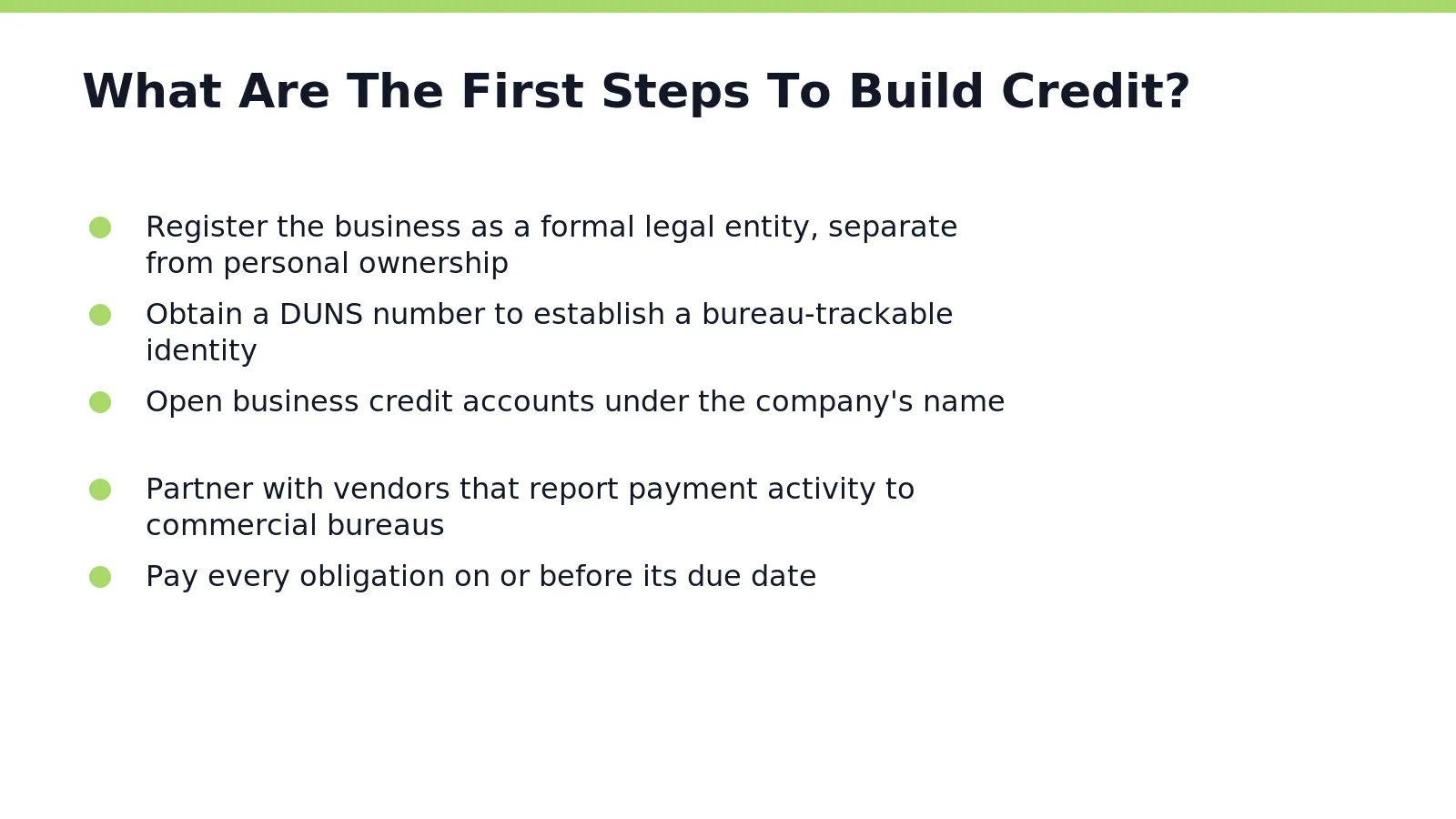
What Are The First Steps To Build Credit?
Formal registration comes first. A business earns a separate credit identity only after it exists as a legal entity, separate from its founder's Social Security number. This single step lays the foundation everything else builds on. Skip it, and every later application ties back to personal liability instead of the company's own track record.
Once the entity exists, several building blocks come next. A Data Universal Numbering System (DUNS) number gives the business an identity that credit bureaus can track. Opening dedicated business credit accounts, working with vendors who report payment history, and paying every bill on time all reinforce that identity over time.
How long does it take to build business credit?
Timelines vary by industry, lender, and how consistently a business reports payments. Steady, on-time payment activity across multiple accounts tends to move the needle faster than any single large purchase or loan.
Which steps matter most early on?
Early-stage businesses benefit most from getting the legal structure right, then layering in reporting relationships. The sequence matters:
- Register the business as a formal legal entity, separate from personal ownership
- Obtain a DUNS number to establish a bureau-trackable identity
- Open business credit accounts under the company's name
- Partner with vendors that report payment activity to commercial bureaus
- Pay every obligation on or before its due date
Owners working through these steps often benefit from improving business credit with structured guidance rather than trial and error. A credit-building program that pairs education with coaching helps founders understand what underwriters actually look for, not just what forms to fill out. Combined with access to a broad lender network — matched to a company's stage, sector, and risk profile — that guidance turns early registration steps into a financing strategy built for long-term growth. For owners weighing how to build credit the right way, that structured foundation matters more than speed.

What Foundational Signals Do Lenders Look For?
Lenders look for consistency first. A business name, address, and phone number that match across every registration, license, and vendor account signal stability rather than risk. Mismatched details raise red flags before an underwriter even reviews revenue or repayment history.
Trade credit reporting matters just as much. When vendors report on-time payments to commercial bureaus, that history becomes part of the profile lenders and card issuers review before extending terms. Businesses that strengthen these credibility signals, from identity data to reporting relationships, get viewed as lower-risk borrowers. This groundwork matters for anyone asking business credit faqs about why some applications sail through while others stall.
Why does identity consistency matter so much?
Underwriters cross-reference business identity data against multiple databases during review. A discrepancy between what's listed on a loan application. What appears in state filings can trigger manual review or outright denial. Consistency across every document removes friction from that process.
What role does technology play in spotting gaps?
Purpose-built platforms reveal how underwriters actually view a business, not just how the owner sees it. These tools identify eligibility gaps and surface funding products matched to the business's current profile, giving owners a clearer sense of how to build credit strategically rather than by guesswork.
A pre-qualification workflow adds another layer of clarity. It shows which programs a business qualifies for right away, and which ones need more groundwork first. That distinction saves time and prevents wasted applications.
Once these foundational signals are solid, business credit does real work: it opens doors to loans, grants, and other funding activities that stay closed to businesses with inconsistent or thin profiles.
How Do Vendor And Trade Lines Improve Business Credit?
Vendor and trade lines build a payment history tied directly to the company, giving lenders proof that the business meets its obligations on time. Skip this step, and a company stays invisible to commercial credit bureaus no matter how healthy its bank balance looks. Trade relationships fill that gap by creating a paper trail of on-time payments that underwriters can actually verify.
Equipment credit lines show how this works in practice. A business gets the machinery or tools it needs right away, builds a credit record with every payment, and deducts those payments as ordinary business expenses. Fleet credit lines follow the same pattern on a larger scale: a company finances several vehicles at once, strengthens its credit profile, and locks in tax deductions tied to the purchase.
Why Does Vendor Credit History Matter For A New Business?
Vendor relationships function the same way personal credit history functions for individuals. Establishing that history helps a company secure loans, attract business partners, and qualify for better insurance rates. Without it, a young company has no track record for lenders to evaluate, which slows down approval and often means higher rates when financing finally comes through.
Does Cash Flow Affect Vendor Credit?
Yes. Cash flow management determines whether a company can meet vendor payment terms consistently. Consistency is what builds trade credit in the first place. Strong cash flow strategies keep working capital available exactly when it's needed, rather than after a shortfall has already caused a missed payment.
The table below shows how each tool contributes to a stronger credit position:
How Long Does It Really Take To Build Business Credit?
No fixed calendar date marks a finished credit profile. Timelines depend on entity age, vendor relationships, and how consistently a company reports payment activity to the bureaus lenders check. What matters most is starting the process early. Building corporate credit takes real time and owners who wait until funding is urgent lose that cushion.
Delaying the work carries a cost that many founders underestimate. Weak credit makes growth harder to finance, slower to scale, and more expensive when loans finally get approved. A company with no credit history often faces the same friction as one with poor credit. Lenders and vendors have no data to evaluate risk.
How can a business owner check progress without hurting personal credit?
A business credit scan tool helps identify potential funding options in just minutes, using business data rather than a personal credit pull. That speed matters for founders who want an honest snapshot before committing to a lender application. Checking early, then rechecking every few months, turns credit-building into a measurable process instead of a guessing game.
Does the timeline shorten with outside guidance?
Working with a Business Credit Advisor helps compress the learning curve. These advisors deliver concierge-level, one-on-one guidance suited to each business's stage and sector, rather than generic checklists.
Rough milestones owners can expect:
- Foundational setup (entity structure, EIN, business bank account): early stage
- First vendor trade lines reporting activity: early-to-mid stage
- Established revolving credit and stronger Paydex data: later stage as payment history accumulates
Consistency, not speed, determines how quickly a profile improves business credit standing with lenders.
What Tools Help You Track And Improve Business Credit?
Specialized scanning and monitoring tools give business owners a clear view of where their company stands with lenders. A business credit scan identifies specific gaps in a company's profile and lays out a roadmap for securing funding. This removes the guesswork that traps many founders who apply for financing without knowing how underwriters see them.
Monitoring doesn't stop at the initial scan. Regular tracking, paired with proactive financial management, helps a business maintain a strong credit profile over time. Owners who check their standing only when applying for a loan often miss warning signs — a missed vendor payment, a reporting error, a sudden score drop — until it's too late to fix before underwriting begins.
What does a business credit scan actually show?
A scan reveals the specific gaps holding a business back from qualifying for stronger financing terms. It then delivers a roadmap showing what steps close those gaps, whether that means adding trade lines, correcting business identity data, or building payment history with reporting vendors.
How does a credit score tool help with funding decisions?
A proprietary scoring tool condenses a company's entire credit picture into one number, reflecting how ready that business is to qualify for capital. This single score gives owners a fast benchmark for how to build credit strategically, rather than guessing which accounts matter most.
Beyond scanning and scoring, bureau-facing monitoring tools track the actual accounts and data that lenders pull during underwriting. These tools matter because:
- They flag reporting errors before they influence a lending decision.
- They track payment history across the bureaus lenders actually reference.
- They surface score changes as they happen, not months later.
Used together, these tools turn business credit-building from a passive waiting game into an active, measurable process. Which is central to any effort to improve business credit over time.
How Do You Choose Financing Once You Are Credit-Ready?
Financing choice depends on matching loan structure to business stage, industry, and risk profile rather than chasing the lowest advertised rate. A credit-ready business gains leverage here: a strong business credit score can unlock better financing options, lower interest rates, and more favorable supplier terms, turning preparation into real savings.
The mistake many owners make is stopping at the first offer. Skipping comparison costs real money over the life of a loan, especially when repayment terms stretch across several years.
What Financing Options Should a Credit-Ready Business Compare?
Credit-ready businesses have more products available to them than newer companies, and the right fit varies by need. A network spanning 1,000+ lending options across banks, alternative finance providers, and specialized programs allows financing to be matched to a company's specific stage, sector, and risk profile.
Comparison typically includes:
- Term loans for one-time capital needs like equipment or expansion
- Revolving lines of credit for ongoing cash flow flexibility
- Industry-specific or specialized programs built for particular sectors
- V
FAQ
What is business credit?
Business credit is a snapshot of how a company handles debt, tied to its EIN rather than the owner's SSN. It directly shapes financing access and the terms lenders offer.
Why does separating personal and business credit matter?
Building credit under a company's EIN protects personal assets from business risk. A downturn no longer threatens the owner's home, savings, or personal credit score.
How does VIP Business Credit help entrepreneurs build credit?
VIP Business Credit connects entrepreneurs in Northern Virginia. The Greater Washington, DC region to over 1,000 national and local lenders. Their proprietary Fundability Score tool tracks progress along the way.


