Build Business Credit: Building Business Credit: A Step-by-Step Guide to Business Credit Steps and Checklist
Build Business Credit: Building Business Credit: A Step-by-Step Guide to Business Credit Steps and Checklist
Building business credit starts with registering the business, obtaining an EIN, and securing a D-U-N-S Number. This guide walks through how to build business credit step by step, from initial EIN business credit registration through opening tradelines, applying for a business credit card, and monitoring bureau reports. VIP Business Credit's Capital-Ready Scan identifies credit gaps in minutes and maps a clear path toward lender-ready status. Following essential business credit steps and a structured business credit checklist ensures a strong foundation for financing opportunities.
Key Takeaways on How To Build Business Credit
- Establish your EIN first, then register your business to create a foundation for credit building.
- Open a business bank account and maintain separate finances from personal accounts immediately.
- VIP Business Credit connects you to over 1,000 national and local lenders for financing opportunities, helping you progress through critical business credit steps.
What Will You Accomplish By Building Business Credit?
Strong business credit produces a payment history that lenders and suppliers trust before they extend terms. Nav's guide on establishing business credit confirms this foundation: a reliable track record signals to underwriters that a company pays what it owes, on time, every cycle. Without that history, financing options shrink and vendor terms tighten, leaving owners to fund growth out of pocket or personal cards.
The bigger payoff comes from where that credit lives. Establishing credit under the company’s Employer Identification Number (EIN) rather than the owner's Social Security number separates personal and business liability entirely. That separation matters more than most new owners realize and is a key part of the business credit steps every entrepreneur should follow.
Why does separating personal and business credit matter?
A business owner who never separates the two risks putting a house, a car, or a personal credit score on the line every time the company borrows. EIN-based credit shifts that risk onto the business entity itself, where it belongs. This structure also positions the company to qualify for financing based on its own performance, not the founder's personal history.
Entrepreneurs across Northern Virginia and the Greater Washington, DC region work through this exact process to build EIN-based profiles that stand apart from personal finances. The result of following disciplined business credit steps shows up in three concrete outcomes:
- Lender confidence in the company's payment record, independent of the owner's personal score
- Reduced personal exposure on business debt and credit lines
- Access to financing shaped around the business's actual stage and risk profile, not guesswork
Executing a thorough business credit checklist correctly requires more than a single tactic. It takes lender access, the right monitoring tools, and consistent guidance. Combining those three elements protects personal assets while giving the business room to scale on its own strength.

What Do You Need Before You Start Building Business Credit?
Preparation, not paperwork, determines how quickly a business moves from no credit file to a lender-ready profile. Entrepreneurs who wait until funding feels urgent often lose months to setup work that could have happened earlier. Establishing business credit takes time, so starting the process before capital is urgently needed protects a company from scrambling later. A little foundation now prevents a funding delay when opportunity knocks.
Before diving into a comprehensive business credit checklist, business owners should gather a few essentials and understand two key ideas.
What documents does a business need before applying for credit?
A business needs its formation paperwork, an Employer Identification Number, and a dedicated business bank account before pursuing credit in the company's name. Consistent business identity information across every application matters too. Lenders and vendors compare names, addresses, and phone numbers against public records, and mismatches slow approvals.
How does lender access affect the first credit application?
Not every lender fits every business. A network spanning more than 1,000 lending options gives owners room to match financing to their company's stage, industry, and risk profile rather than applying blindly to a single bank. This range matters most for newer businesses, which often get declined by traditional lenders but qualify with alternative programs built for early-stage credit files.
Before applying anywhere, follow these essential business credit steps in order:
- Confirm the business entity is registered and in good standing.
- Secure an EIN separate from a personal Social Security number.
- Open a dedicated business bank account.
- Run a pre-qualification check to see which programs fit now versus later.
A pre-qualification workflow shows which programs a business can access immediately and which require more groundwork first, saving owners from wasted applications and unnecessary credit inquiries.
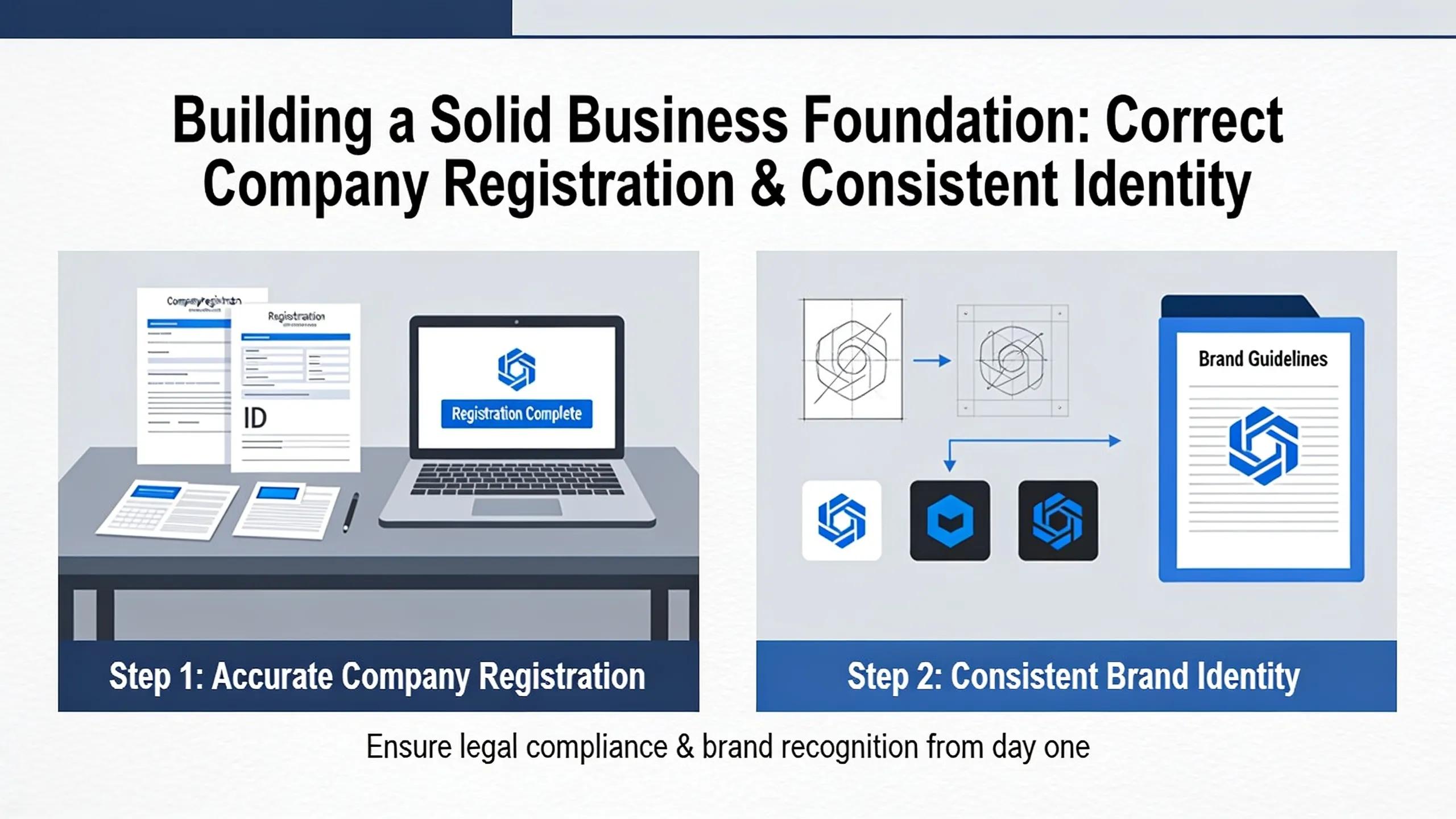
How Do You Lay Your Business Foundation First As Part of Business Credit Steps?
A solid business foundation starts with registering the company correctly and locking in consistent identity details across every record. This foundation serves as the opening move in the sequence that carries a company from "no file" status to a lender-ready credit profile. Skipping this stage creates mismatched records that underwriters flag later, delaying approvals and shrinking access to non-personally-guaranteed capital.
Founders who want to build business credit on solid footing need identity details that match everywhere: the Secretary of State filing, the IRS EIN registration, business bank accounts, and vendor applications. Lenders and vendors pull data from multiple sources to verify a company exists and operates legitimately. Inconsistent addresses, phone numbers, or business names raise red flags and slow underwriting decisions.
What counts as a strong business identity for lenders?
A strong identity means the business name, address, and phone number appear identically across state filings, the IRS, the bank, and any directories that vendors or lenders check. Consistency signals stability and reduces perceived risk, making the company easier to underwrite with confidence.
Founders working through a detailed business credit checklist should treat these foundational business credit steps as sequential, not optional:
- Register the business as a formal legal entity with the state.
- Obtain a federal EIN separate from the owner's Social Security number.
- Open a dedicated business bank account under the registered name.
- Secure a business phone line and list it consistently everywhere.
- Verify the business address matches every filing and application.
VIP Business Credit, rooted in Northern Virginia and active across Loudoun County, guides founders nationwide through this groundwork before pursuing financing, ensuring the foundation holds up under lender scrutiny.
How Do You Register With Business Credit Bureaus as a Key Business Credit Step?
Registration starts with two identifiers: a D-U-N-S Number and an Employer Identification Number (EIN). These credentials give bureaus a way to open a file separate from any owner's personal record. Skipping this step keeps a company invisible to lenders, no matter how strong its revenue looks on paper.
The process itself follows a clear sequence, and each step needs to happen before the next one works properly.
- Secure an EIN from the federal government to establish the business as its own legal and financial entity.
- Obtain a D-U-N-S Number, which creates the file bureaus use to track payment history and credit activity.
- Open accounts that report to bureaus, since not every vendor or lender submits payment data automatically.
- Confirm the business address, phone number, and entity name match across every application and public listing.
- Monitor the file regularly to catch errors before they affect an approval decision.
A properly built business credit checklist treats these identifiers as the foundation, not an afterthought. Without them, payment history has nowhere to attach, and months of on-time payments generate no score at all.
Does Registration Replace Personal Credit Checks?
Registration does not automatically remove personal credit from the equation, but it changes what lenders can rely on instead. A well-documented Capital-Ready checklist links reported activity to the company's EIN rather than the owner's Social Security Number. Over time, this separation lets approval decisions rest on the business's own payment record.
What Comes After Registration as Part of Your Business Credit Steps?
Registration only opens the file; building it requires active financing relationships that actually report. VIP Business Credit connects business owners to more than 1,000 national and local lenders, widening the pool of accounts that can generate bureau-visible payment history. A dedicated scoring platform then shows exactly how underwriters view the resulting file and flags any remaining gaps before they cost an approval.
Business Credit Registration Checklist
Use this quick-reference checklist to track each registration step and confirm nothing gets missed.
How Do You Open Tradelines That Report Payments for Business Credit Building?
Tradelines report payments when a business opens accounts with lenders, card issuers, or equipment financers who send payment data to the commercial credit bureaus. Establishing these reporting relationships is one of the most direct business credit steps a company can take. Each on-time payment builds a track record lenders can verify.
Opening a business credit card or charge card is a standard move in most sequences designed to build business credit. Card issuers that report to commercial bureaus turn routine spending — office supplies, software subscriptions, travel — into documented payment history. That history becomes evidence of reliability the next time a company applies for a larger credit line.
Equipment and fleet financing serve a similar dual purpose. An equipment credit line lets a business acquire machinery, tools, or technology it needs right now. Payments build credit and qualify as deductible business expenses. Fleet credit lines work the same way for vehicles: a company finances multiple trucks or cars, builds a payment record, and locks in tax deductions along the way.
Founders can follow this sequence to open tradelines that actually report as part of their business credit checklist:
- Apply for a business credit or charge card tied to the company's EIN.
- Add an equipment credit line if the business relies on physical assets.
- Open a fleet credit line for companies operating multiple vehicles.
- Confirm with each provider that payment activity reports to commercial bureaus before relying on it for credit-building.
Does Opening a Business Tradeline Require a Personal Guarantee?
Not always. Founders looking to establish business credit without a personal guarantee typically start with tier 1 vendor tradelines — accounts available with no personal credit check or guarantee. Approval on these accounts often happens quickly. That structure matters for founders who want financing tied to the company's EIN rather than their own Social Security number. It keeps personal liability separate from business risk. Skipping this step leaves a business dependent on personal credit indefinitely, limiting how much capital the company can access on its own strength.
How Do You Maintain A Strong Payment History as Part of Building Business Credit?
Strong payment history comes from paying every invoice and credit account on time or early, month after month. According to Nav's Establish Business Credit Fast: 7-Step Guide for 2026, paying on time or early ranks among the core business credit steps that shape how bureaus score a company's payment behavior. A single late payment can undo months of consistent, on-time activity, so consistency matters more than any one transaction.
Small business owners often treat payment timing as an afterthought. That mindset creates risk. Late payments signal instability to lenders, even when a business is otherwise healthy.
Why does cash flow planning matter for payment history?
Cash flow planning matters because bills can only be paid on time when funds are available before they're due. Structured cash flow strategies help business owners keep working capital on hand ahead of need, rather than scrambling once a due date arrives. This proactive posture reduces the chance of a missed or late payment reaching the credit bureaus.
What role does financial education play in business credit building?
Education and coaching give owners the tools to understand underwriting criteria and manage credit usage responsibly. A business owner who understands how lenders evaluate risk makes smarter decisions about which accounts to open and how much to draw.
A few habits reinforce reliable payment history:
- Schedule payments a few days ahead of the due date, not on it.
- Monitor cash flow weekly to spot shortfalls early.
- Review credit usage regularly to avoid overextension.
- Build a business credit checklist that tracks due dates across every vendor and lender account.
Consistency, planning, and financial literacy work together to protect a business's standing with lenders over time.
How Do You Monitor And Grow Your Business Credit Score?
Regular monitoring closes the loop on every earlier step in the credit-building process. A business owner reviews reports and scores on a set schedule, spots errors early, and corrects course before a lender notices a problem. Monitoring is not an afterthought. It is the final stage in a complete set of business credit steps, coming right after registration, tradeline setup, and account activity.
What Does a Business Credit Monitoring Tool Actually Show?
A proprietary scoring tool gives an owner a clear, immediate snapshot of where a company's credit profile stands with lenders. Rather than guessing how underwriters view the business, the owner sees gaps, strengths, and next actions in one place. That visibility turns monitoring from a passive check-in into an active planning tool.
Following a structured process, month after month, helps a company qualify for better terms, higher credit limits, and lower rates over time. Consistency matters more than any single report pull.
Monthly monitoring routine:
- Pull the business credit report from each reporting bureau.
- Compare current scores against the previous month's figures.
- Flag any late payments, errors, or unfamiliar accounts.
- Dispute inaccurate information immediately.
- Adjust credit usage or payment timing based on findings.
- Re-check the score after 30 days to confirm the correction worked.
How Often Should a Business Check Its Credit Score?
Monthly checks work best for most growing companies. Understanding this information and monitoring the score on a regular basis allows an owner to take proactive steps to improve standing before a lender ever pulls the file. Waiting until a loan application is submitted to check for the first time leaves no room to fix errors or rebuild a damaged score. A short, recurring review habit protects the progress already built through a solid business credit checklist and keeps the path toward stronger financing open.
What Mistakes Should You Avoid Along The Way To Build Business Credit?
Rushing the process ranks as the most common error business owners make when they try to build business credit. Expecting a fully funded profile within weeks sets founders up for disappointment and premature decisions. Building business credit does not happen overnight; it develops the same way the business itself grows. Through consistent, deliberate effort over months rather than days.
A second mistake involves going it alone without personalized support. Local Business Credit Advisors deliver concierge-level guidance for a reason: gaps in a credit file are easy to miss without an outside set of eyes. Skipping that guidance leaves founders guessing which accounts report, which bureaus matter, and which business credit steps actually move a file forward.
Why does working with a long-term partner matter more than picking the cheapest option?
Choosing a lender relationship based on price alone often backfires later. Transactional brokers close a deal and disappear, leaving business owners without support when questions arise. A long-term partner offering transparent, no-surprise pricing keeps costs predictable and stays available as the business scales.
To avoid the most damaging missteps, founders should:
- Set a realistic timeline instead of expecting instant approval.
- Work with a knowledgeable advisor rather than navigating lender requirements alone.
- Vet any financing partner for transparent, no-surprise pricing before signing an agreement.
- Follow a structured business credit checklist rather than applying for accounts at random.
Each correction addresses a specific failure point. Ignoring the timeline invites frustration and rushed applications. Ignoring guidance invites costly gaps that surface only after a lender declines an application. Ignoring pricing transparency invites hidden fees down
FAQ
What is the first step in building business credit?
Business owners establish their EIN first, then register the business to create a foundation for credit building, followed by securing a D-U-N-S Number, all integral to the business credit steps and business credit checklist.
Why should a business separate personal and business credit?
Separating the two shifts risk onto the business entity, protects personal assets like a house or car, and lets the company qualify for financing based on its own performance.
How does VIP Business Credit help entrepreneurs build credit?
VIP Business Credit connects entrepreneurs to over 1,000 national and local lenders and uses its proprietary Capital-Ready Scan to identify credit gaps and map a path to lender-ready status, supporting owners through the critical business credit steps.
Contact & Strategy Call
- 📞 Phone: (571) 248-3863
- ✉️ Email: [email protected]
- 📅 Booking: Schedule A Business Financial Health Strategy Call
- 🌐 Website: vipbizfunds.com
- 📍 Proudly serving Sterling, VA and the surrounding Northern Virginia and Greater Washington, DC area
About The Author
Lee Johnson is a seasoned Real Estate Investor, Business Growth Strategist, and Master Certified Professional Coach dedicated to helping entrepreneurs achieve financial freedom and long-term business sustainability. At VIP Business Credit, he guides business owners through the process of building lender-ready business credit profiles, establishing vendor trade lines and Net-30 accounts, and separating business liabilities from personal assets. Through structured credit strategy and access to the proprietary Capital-Ready platform, he empowers small-to-midsize businesses to secure high-limit financing under their own EIN.


