Unlocking Business Growth: Line of Credit Benefits Explained

Business Line of Credit: What It Is, How It Works, and Why It Matters
A business line of credit is a revolving borrowing option that gives a company on-demand access to funds up to an agreed limit. You can draw, repay and draw again as needed. This guide walks through how small business lines of credit operate, the concrete cash-flow benefits they deliver, common lender qualification criteria, and how to decide between a line of credit and a term loan. Many owners face timing gaps between receivables and payables, seasonal inventory needs, or surprise expenses — a line of credit helps by charging interest only on what you use while keeping liquidity available. Read on for the draw-and-repay mechanics, typical fees and rate structures, a lender-document checklist, and practical steps to get the most value without becoming dependent on credit. We also compare secured, unsecured, and startup-focused lines against term loans and include examples and simple tables to make choices easier.
What Are the Key Benefits of a Business Line of Credit?
A business line of credit strengthens liquidity by providing revolving access to capital you can tap when cash is tight and repay as revenue comes in — a practical fit for working capital. The credit limit renews as you pay down principal, and because interest is charged only on the drawn balance, a line can be cheaper for short-term needs than taking a lump-sum loan. For many owners this means smoother payroll, on-time supplier payments, and the agility to act on short-term opportunities without committing to long-term debt. Below is a compact list of the main advantages and the outcomes owners typically see.
Business lines of credit deliver these main benefits:
Flexible cash-flow smoothing: draws cover shortfalls like payroll or vendor bills during slow seasons.
Lower cost for short-term needs: you pay interest only on the amount and days you borrow, which reduces financing expense.
Emergency liquidity: immediate access for repairs, returns, or one-off costs.
Operational agility: the ability to buy discounted inventory or fund quick-growth marketing efforts.
How Does a Business Line of Credit Improve Cash Flow Management?

A line of credit acts as a buffer to bridge timing gaps between cash inflows and outflows so you can meet obligations without interrupting operations. For example, a retailer can draw to buy inventory ahead of a busy season and repay after sales pick up; a service provider can cover payroll while waiting on slow invoices. Numeric example: with a $50,000 limit, drawing $20,000 for 30 days at an APR that translates to about $150 in interest can cost less than late fees or lost supplier discounts. The revolving nature — plus interest only on used funds — gives predictable short-term relief and preserves capacity for future needs. Next, we break down the steps to draw and repay so you know what to expect operationally.
What Flexibility Does a Business Line of Credit Offer Compared to Other Financing?
Lines of credit give revolving access, while term loans deliver a one-time lump sum. LOCs let you make multiple draws up to your limit, often with interest-only minimums and the option to redraw as you repay — features that suit variable or seasonal cash needs. Variants such as secured and unsecured LOCs differ by collateral and pricing: secured LOCs typically offer higher limits and lower rates; unsecured LOCs can be faster but carry stricter underwriting. That flexibility contrasts with term loans, which have fixed repayment schedules and usually more predictable long-term costs. For many businesses, LOCs are the right tool for working capital and short-term opportunities; term loans fit capital expenditures and long-lived investments. If you want help preparing and managing a LOC, our platform and coaching resources can assist with draw planning and qualification guidance.
For businesses seeking guided help to prepare for and manage a line of credit, the platform and coaching services provided by the lead-generation information hub can offer targeted support with draw planning and qualifying guidance. This practical assistance complements the educational material above without replacing technical lender advice.
How Does a Business Line of Credit Work for Small Businesses?
A business line of credit begins with underwriting that establishes a credit limit based on revenue, time in business, cash flow, and credit history. After approval you can draw up to that limit and repay according to the agreement. Lenders typically review bank statements, revenue trends, business or personal credit scores, and collateral when required; the result is a limit and terms that define the rate, fees, and renewal cycle. The lifecycle is simple — approve → draw → repay → redraw — with interest charged only on outstanding balances and available credit restored as you pay down principal. Understanding this cycle helps you set repayment discipline and monitoring routines to avoid fee creep or covenant issues. The next section lays out the draw-and-repay sequence step by step.
Startup-focused LOCs and other variations may underwrite using cash-flow projections instead of years in business, which can open access for newer companies but may affect pricing and covenants.
What Is the Draw and Repayment Process in a Business Line of Credit?
The draw-and-repay process is straightforward: request a draw, receive funds (usually ACH or transfer), make minimum or scheduled payments, and restore available credit as you pay principal. Many lenders provide online portals or secured checks for access; you can take single or multiple draws within the limit. Repayment expectations often include interest-only minimums with periodic principal payments or an annual review that could trigger amortization. Example: draw $10,000, pay monthly interest, then repay $2,500 in principal after three months — that restores $2,500 of availability and reduces future interest because you only paid for the time you used the funds. Understanding these steps prepares you to evaluate fees and rate mechanics.
How Are Interest Rates and Fees Applied in a Business Line of Credit?
Interest on a LOC is usually charged on the outstanding balance and can be variable or, less commonly, fixed. APR reflects total borrowing cost when fees are included. Typical fees include maintenance fees, draw fees, non-usage fees and renewal fees. Variable rates track an index plus a margin, so rate risk exists; fixed-rate options reduce that risk but are rarer. Fees affect effective APR — a small monthly maintenance or occasional draw fee can materially raise short-term costs if you rarely use the line. Compare cost by combining interest on your average daily balance with periodic fees to decide whether a LOC or an alternative financing option is cheaper for your use case. Next, we cover the documents and thresholds lenders usually require.
What Are the Requirements to Qualify for a Small BusinessLine of Credit?
Qualification generally depends on documented revenue, time in business, business and personal credit scores, and supporting financial statements. Lenders commonly ask for recent bank statements, profit & loss statements, business tax returns, and personal financial statements when personal guarantees are considered. Revenue thresholds vary, but steady cash flow and positive net income improve approval odds; newer businesses may seek lenders that underwrite based on cash-flow metrics rather than tenure. Below is a practical checklist of common documents and thresholds lenders often request.
Typical qualification checklist:
Bank statements for 3–12 months showing cash flow
Business tax returns and profit & loss statements
Business and personal credit reports and scores
Documentation of collateral or a personal guarantee when required
Targeted coaching and platform-based preparation, available through the lead-generation information hub, can help you assemble documents, improve readiness, and take concrete credit-improvement steps before applying. That preparation often improves both approval chances and terms.
Which Financial Documents and Credit Scores Are Needed?
Lenders typically request bank statements, profit & loss statements, and recent tax returns to verify revenue consistency and cash flow; business and owner personal credit scores factor into pricing and limits. If business credit is thin, lenders will often rely more heavily on the owner’s personal credit. Practical prep steps include reconciling accounts, ensuring deposits match invoices, and addressing any collections before applying. Projecting a 90-day cash flow and organizing reconciliations can materially improve approval odds and pricing.
How Do Business Size and Revenue Affect Eligibility?
Lenders use business size and revenue to gauge repayment capacity and set limits; higher annual revenue and longer operating history usually translate to larger credit lines and better pricing. Traditional banks often prefer businesses with multiple years of steady revenue, while alternative lenders can underwrite shorter histories using daily sales or receivables. Example: a business with steady $300k in annual revenue is typically positioned for larger limits than a first-year business with $50k, though cash-flow underwriting can still provide smaller lines to startups. Knowing these dynamics helps you pick lenders aligned with your size and revenue profile.
What Are the Pros and Cons of Using a Business Line of Credit?
Lines of credit offer operational advantages like flexible liquidity and lower short-term cost, but they come with risks: variable rates, fee complexity, renewal uncertainty, and the temptation to cover structural shortfalls with borrowed funds. Benefits include immediate access during shortfalls and cost control for short-term financing; risks include rate volatility and renewal or covenant risk at review time. Mitigation steps include internal draw limits, monthly KPI monitoring (DSO, current ratio), and repayment discipline to prevent overreliance. The lists below summarize advantages and practical mitigation strategies.
Advantages small businesses should weigh:
Improved liquidity for working capital gaps and seasonal swings.
Interest only on amounts used, reducing cost for short durations.
Stronger lender relationships that can lead to larger future lines.
Risk mitigation strategies:
Set internal approval workflows and draw limits.
Track KPIs monthly and reconcile accounts regularly.
Keep contingency plans in case renewal terms change.
These pros and cons set the stage for comparing LOCs to term loans, where predictability and use case are key deciding factors.
What Advantages Should Small Businesses Consider?
LOCs give operational flexibility for bridging receivables, stocking seasonal inventory, and smoothing payroll — actions that help preserve customer relationships and avoid penalties. The revolving nature means capital is reusable, and interest-on-used-funds lowers carrying costs compared with holding a large cash buffer or using high-cost alternatives like merchant cash advances. Responsible LOC usage can also build a lending relationship that eases future borrowing for growth.
What Potential Drawbacks or Risks Exist?
Drawbacks include exposure to rate increases, fee traps (maintenance or non-usage fees), renewal and covenant risk, and the behavioral risk of treating an LOC as permanent working capital. Variable-rate structures can push up payments, and lenders may reduce or cancel lines at renewal if performance slips, creating refinancing risk. Mitigations include conservative draw policies, regular financial reviews, and pairing LOCs with predictable term financing for long-term investments.
How Does a Business Line of Credit Compare to a Business Loan?
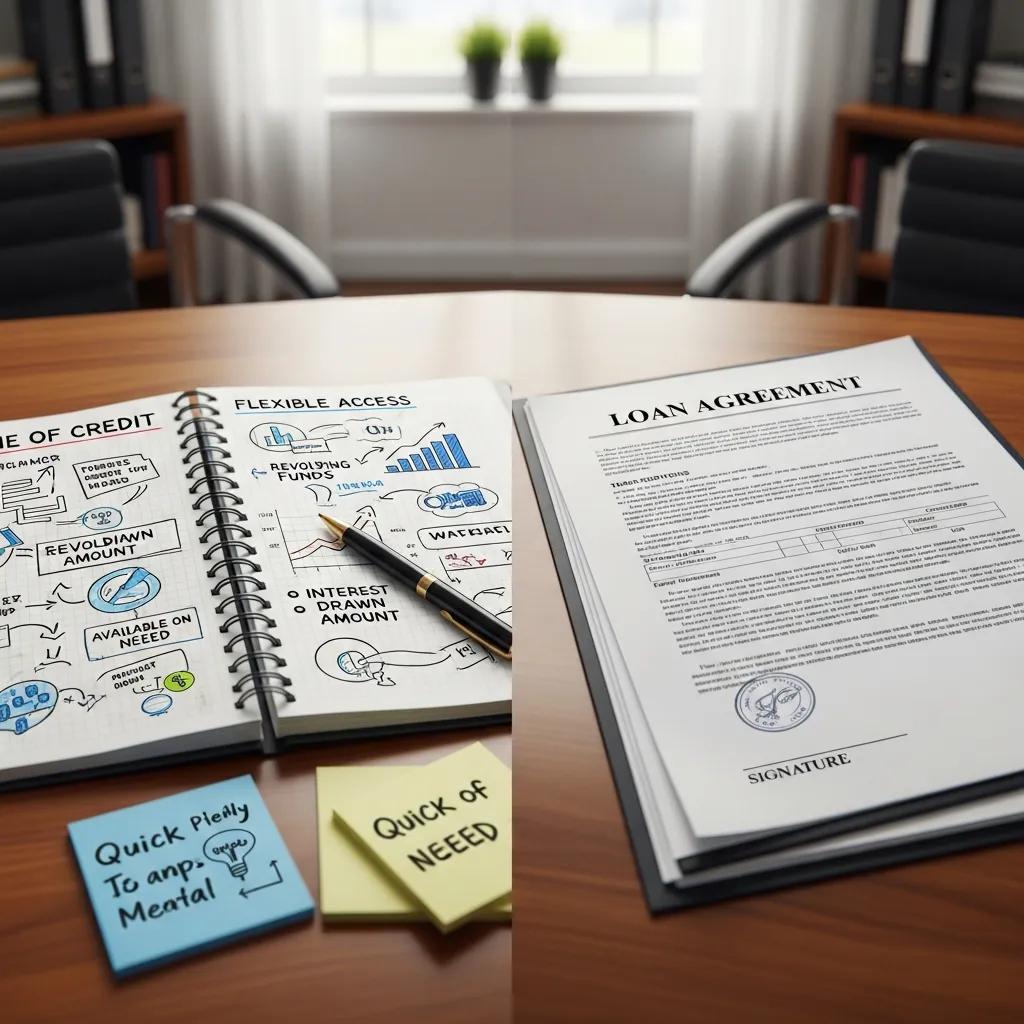
In short: a line of credit gives revolving access and variable usage; a term loan delivers a one-time lump sum with fixed amortization. LOCs are ideal for short-term working capital and unpredictable needs; term loans suit fixed, long-term investments like equipment where predictable payments match the asset’s useful life. Cost structures differ: LOCs often have variable APRs and usage fees; loans usually have steadier payment schedules. The table below provides a side-by-side comparison to help you decide.
What Are the Differences in Terms, Access, and Costs?
Lines of credit keep funds available up to a limit and charge interest on what you borrow; term loans give a fixed amount repaid on a set schedule. LOC costs often depend on usage and may include periodic fees, while loans offer more predictable monthly payments. LOCs (especially unsecured varieties) can be faster to access; term loans typically require longer underwriting but reduce rate variability. Choose based on duration of need, tolerance for rate swings, and whether fixed amortization suits the investment’s timeline.
When Should a Business Choose a Line of Credit Over a Loan?
Pick a line of credit for short-term, variable, or recurring needs: seasonal inventory buys, bridging delayed receivables, or covering intermittent payroll. Choose a term loan for one-off, capital-intensive purchases whose benefits last multiple years — for example, equipment or a new production line. Rule of thumb: use LOCs for tactical, time-bound expenses and term financing for strategic, long-lived assets. If you want help matching instrument to need, our coaching and platform resources can walk you through amortization and draw planning.
For hands-on assistance with matching financing type to business needs and planning amortization or draw schedules, the coaching and platform resources provided by the lead-generation information hub can guide qualifying strategy and repayment planning in practical terms.
How Can Businesses Maximize the Benefits of a Line of Credit?
Maximize an LOC by setting disciplined draw limits, keeping a regular repayment cadence, monitoring the line in monthly financial reviews, and pairing LOC use with term financing for capital projects. Governance practices include internal policies (for example, capping outstanding balances as a percentage of monthly revenue), weekly bank reconciliations, and tracking KPIs like days sales outstanding and current ratio to ensure borrowing stays strategic. Tactical uses — like using a short draw to capture supplier discounts or fund a limited marketing push — can convert liquidity into measurable growth. Below is a practical checklist to embed LOCs into your financial operations.
Best-practice checklist:
Set internal approval workflows and maximum draw thresholds tied to revenue.
Reconcile accounts weekly and review LOC balances in monthly financial meetings.
Prioritize paying down principal after revenue spikes to restore availability.
Combine LOCs with fixed-term loans for predictable, long-term investments.
What Best Practices Ensure Effective Use and Repayment?
Good LOC governance means explicit rules: cap outstanding borrowings as a percentage of monthly revenue, require dual approval for draws above set thresholds, and document the intended use for every draw to prevent mission creep. Monthly reconciliations and KPI tracking surface early warning signs, while scheduled principal payments when cash allows cut interest expense and restore capacity. Clear processes — for example, "Owner → approves → draw" and "Draw → recorded → intended use" — improve accountability and auditability.
How Can a Line of Credit Support Business Growth and Stability?
Used strategically, a line of credit smooths short-term gaps, enables opportunistic purchases, and funds targeted marketing or hiring bursts that produce measurable returns. For example, a controlled draw to buy discounted inventory that sells at a 20% margin can more than cover interest costs and grow cash reserves. Pairing LOCs with term loans for fixed assets builds a balanced capital stack that blends flexibility and predictability. If you want help turning these ideas into an executable plan, our information hub and coaching resources can help you build draw schedules, repayment plans, and qualification roadmaps that improve your chances of favorable credit outcomes.
Actionable next step: Map expected cash inflows against potential draws to identify safe borrowing windows.
Governance: Require documentation and approvals for each draw, and schedule principal reductions after revenue upticks.
Strategy: Use LOC for tactical growth initiatives and term financing for strategic, long-lived assets.
Owners ready to put these best practices into action can benefit from expert coaching and a platform that helps prepare documents, improve readiness, and guide qualification steps. These resources speed access to appropriate financing while preserving disciplined use of credit.
Frequently Asked Questions
What types of businesses can benefit from a business line of credit?
Lines of credit can help a wide range of businesses — startups, small firms, and established companies across retail, services, manufacturing and more. Any business with variable cash flow, seasonal needs, or occasional unexpected expenses can use a LOC to draw as needed and repay when cash inflows stabilize.
How can a business improve its chances of qualifying for a line of credit?
Improve approval odds by maintaining steady revenue, controlling expenses, and keeping a good credit profile. Gather recent bank statements, profit & loss reports, and tax returns before you apply. Building a track record of responsible credit use and developing a relationship with a lender also helps.
What are the common fees associated with a business line of credit?
Common fees include maintenance fees, draw fees, non-usage fees and renewal fees. Maintenance fees keep the account active; draw fees apply when you access funds; non-usage fees may be charged if the line sits unused; renewal fees can apply at review. Factor these into your effective APR when comparing options.
Can a business line of credit be used for long-term investments?
LOCs are designed for short-term needs, though they can fund longer projects if cash flow supports ongoing repayment. For major, long-lived investments like equipment or real estate, a term loan usually makes more sense because its fixed repayment schedule better matches the asset’s useful life.
What strategies can businesses implement to avoid overreliance on a line of credit?
Avoid overreliance by setting internal borrowing limits, monitoring KPIs regularly, and prioritizing principal paydown when cash allows. Diversify financing sources so you’re not dependent on one line, and keep contingency plans for renewal or rate changes.
How does a business line of credit impact a company's credit score?
Responsible LOC use — on-time payments and low utilization relative to the limit — can help your credit profile. High utilization or missed payments will hurt scores. Lenders often report activity to credit bureaus, so managing the line well supports better borrowing terms in the future.
Conclusion
A business line of credit can be a practical tool to smooth cash flow, seize short-term opportunities, and handle emergencies — all while preserving liquidity. When you understand how draws, interest, fees and renewals work, you can use a LOC strategically rather than reactively. Combine disciplined governance with the right mix of financing and you’ll support both stability and growth. If you want help preparing documents, improving readiness, or building a draw-and-repayment plan, our coaching and platform resources are designed to guide small-business owners through each step.


